

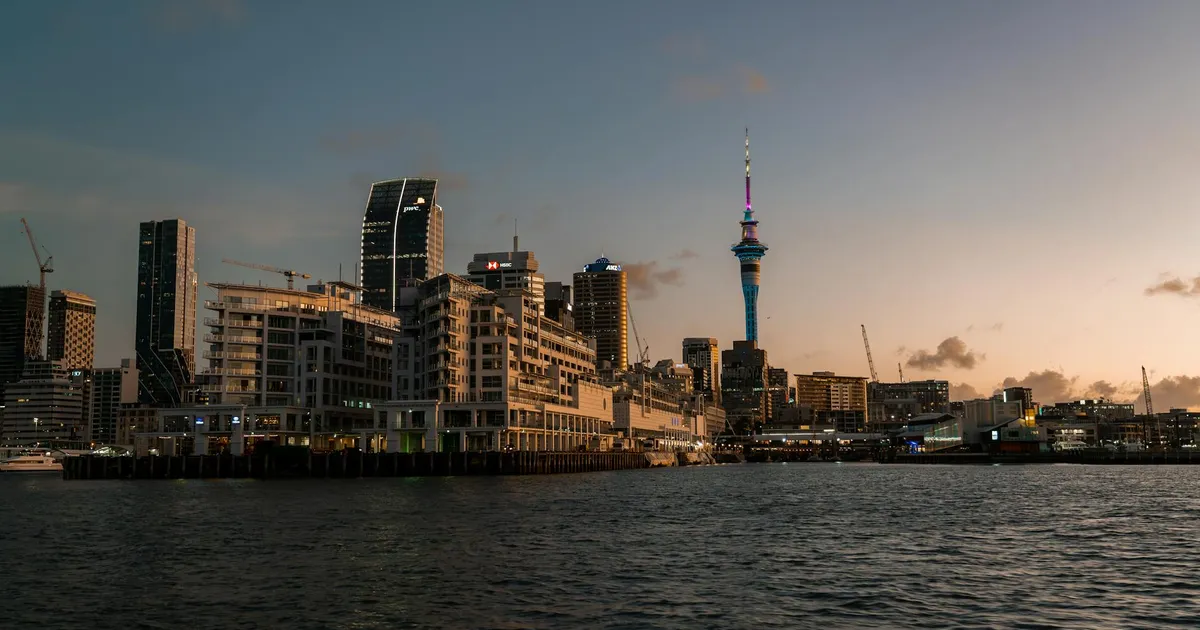
New Zealand’s tallest unfinished building is officially for sale. The Seascape tower on Customs Street East, a 56-level, 183-metre structure that was supposed to define Auckland’s skyline, is being marketed through Bayleys and Knight Frank after its Shanghai-based developer was placed into receivership by China Construction Bank over an unpaid debt exceeding $100 million. The tower has sat silent since August 2024. What the agents are calling a “unique control opportunity” is, more plainly, a test of whether anyone is willing to pour hundreds of millions more into Auckland CBD apartments.
Every bet came unstuck at once
Seascape’s failure is not a freak accident. It is what happens when a specific set of assumptions all break simultaneously.
Shundi Group entered New Zealand at the peak of offshore Chinese development capital flowing into Auckland. The construction contract was signed in September 2017 when the building design was still at concept level. Completion was due July 2021. The project is now approaching a decade with no end in sight.
Critically, the funding model bypassed the presale discipline that underpins conventional New Zealand development. As NZ Herald property editor Anne Gibson noted, “It was a strange project, first for how it was funded and lack of presales. It was a speculative development.” Standard practice requires presales to cover construction cost risk before a bank will lend. Seascape relied on offshore developer equity and Chinese bank debt instead.
Foundation problems emerged in 2020. By August 2024, China Construction suspended the contract and sent 25 subcontractors home over $33 million in unpaid bills. The related entity Shundi Tamaki Village, which holds an 11-hectare former Auckland University campus in Glen Innes, is also in receivership.
The numbers are brutal for any buyer
Completion cost estimates range from $120 million to $300 million and could take up to three years. Icon Construction was thought to have bid around $180 million to finish the job. A new buyer pays an acquisition price on top of that.
Construction experts are split on whether the building is even salvageable. One called it “New Zealand’s biggest demolition job.” Others warn that salt water has been seeping into the basement for years, degrading steel reinforcing. The head of a major house-building business said all glass curtain walls would need to be removed and replaced. One expert was blunt about the end market: “the luxury apartment market in the CBD is pretty much dead anyway.”
Meanwhile, approximately 166 apartment buyers who paid 10% deposits years ago sit in limbo. Those from a later marketing campaign are now unsecured creditors. If no buyer emerges, demolition could cost tens of millions and leave a site worth only a few tens of millions as a carpark.
The pitch is to the same capital pool that already failed
The agents are not being subtle about their target buyer. Knight Frank Singapore’s Dan Dixon said “Asian-based and other global capital will be particularly attracted” to the project. Bayleys chairman Mike Bayley called it “a unique control opportunity”.
They have one genuine new lever. A March 2026 regulatory change allows Active Investor Plus visa holders to purchase one residential property valued at $5 million or more. Completed Seascape apartments could hit that threshold, giving a buyer a thin new demand channel.
But the macro environment is working against the pitch. Net migration collapsed to 14,200 for the year ended December 2025, the population growth that was supposed to underpin apartment demand has largely evaporated. Unemployment hit 5.4%, its highest since 2015. Auckland values fell 0.5% in February alone. And Plan Change 120 reduced Auckland’s theoretical housing capacity from 2 million homes to 1.6 million, a regulatory tightening that runs counter to the density story the city has been telling.
Smaller developers should be watching closely
The mainstream narrative treats Seascape as a one-off with an unusual funding structure. It is not. It is a stress test of every assumption that large-scale urban residential development in New Zealand relies on: offshore appetite, manageable construction costs, strong migration-driven demand, and a luxury market that actually wants to live in the CBD.
All of those assumptions are currently under pressure. The NBR valued the original project at $300 million, and the receivership sale will reveal just how much of that has evaporated. If the marquee tower on the waterfront cannot attract a buyer willing to spend another $120 million to $300 million finishing it, the signal to every mid-tier Auckland apartment developer is unmistakable.
Gibson has warned that overseas owners have left Auckland CBD properties vacant for 20 to 40 years. The possibility that Seascape simply sits there, a 56-level monument to misplaced confidence, is not the worst-case scenario. It is the base case until someone proves otherwise.
Sources
- NZ Herald: Receivers launch sale campaign for Auckland’s partly built Seascape apartment tower (2025-06-04)
- NZ Herald: Is Seascape Auckland’s first ghost tower? (2025-03-21)
- RNZ: Seascape developer Shundi Customs placed in receivership (2025-03-17)
- NZ Herald: China Construction applies to liquidate Seascape developer Shundi associate (2025-03-05)
- NZ Herald: Auckland Seascape tower developer Shundi Customs put into receivership (2025-03-17)
- NZ Herald: Seascape in receivership – experts split on future (2025-03-19)
- NBR: Developer of $300m Seascape tower tipped into receivership (2025-03-17)
- NZ Herald: $5m-plus foreign house-buyers allowed in from Friday (2026-03-27)