

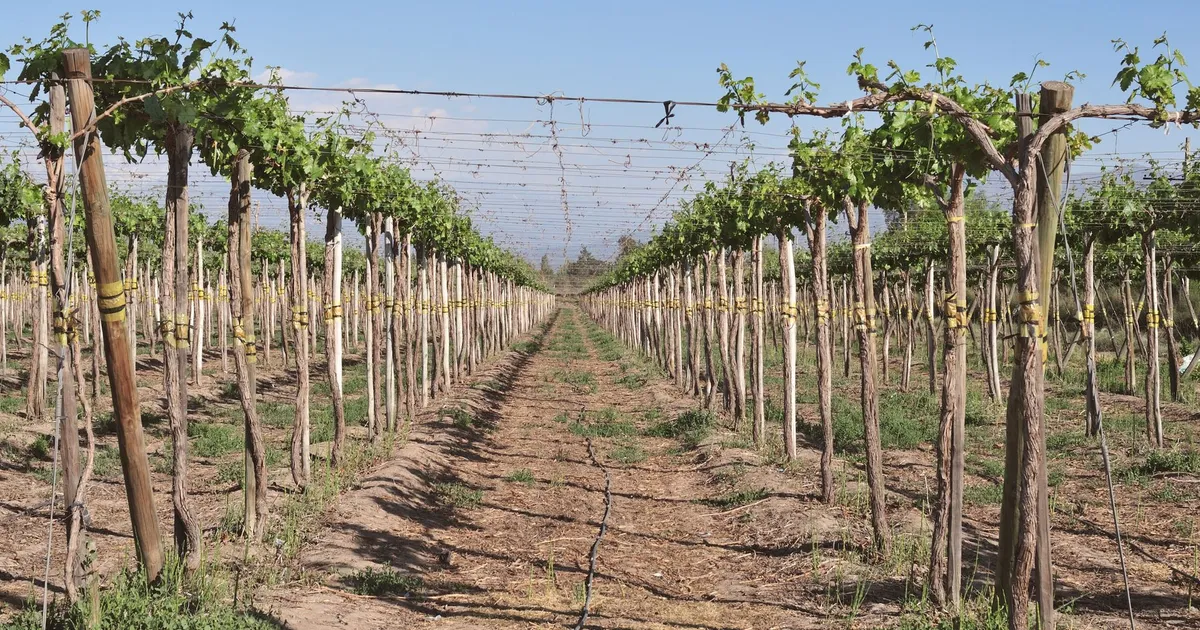
New Zealand growers have pulled out about 2000 hectares of grapevines, according to New Zealand Winegrowers. That will take total planted area down 3 percent to 42,357 hectares by 2027. This is the bust phase of a classic commodity cycle. The people absorbing it are the contract growers who carry the fixed costs, not the wine companies that set the demand signal.
Gisborne has been hit hardest. Indevin Group’s exit from the region cut its vineyard area roughly in half, leaving local growers without their main buyer. In August 2026, 1News reported harvest area falling from 1340 hectares to about 660, a loss of $19.5 million in income to growers and the pruners, harvesters and spray contractors who depend on them. Hawke’s Bay and Nelson are also shrinking.
The boom planted this problem
None of this came from nowhere. Farmers Weekly reported in July 2026 that national vineyard area grew from 36,225 hectares in 2015 to 42,520 hectares in 2025, with production rising from 313.9 million to 378.4 million litres. Growers responded rationally to what buyers told them.
Colliers’ Andy Poswillo said in September 2026 that Marlborough vineyard prices had fallen 50 percent from the 2023 peak, “when wine companies were taking as many grapes as contractors could grow”. That appetite, he said, snowballed until supply and demand fell out of balance. Several heavy vintages later, the industry is sitting on stock. Wineries have capped intake, and vintage 2026 came in at roughly 440,000 tonnes, down 15 percent on the previous year.
Buyers can walk, growers can’t
The asymmetry is the real business story. When a processor changes strategy, it rewrites a sourcing plan. When a grower loses a contract, they are left with a block of vines, a mortgage, and an annual operating bill.
Ryan Fraser, vineyard manager at Paritua Vineyard near Hastings, is pulling out five hectares of merlot. He told RNZ that Constellation “were a big buyer of Merlot for rosé and they’ve gone” after selling to Poulter Group, which can source cheaper rosé from Europe, closer to market. That has left long-standing contract growers forced to change or find a new home for their fruit. Uncertainty is also freezing new planting, because nobody knows where markets will settle.
The cost side makes it worse. In September 2026, BDO viticulture specialist Rosie Jarvis described growers being “hit on both sides by lower prices and lower volumes”, while labour, insurance and fertiliser costs stayed high. Revenue falls and costs stay put. When that happens, ripping out vines becomes the cheapest option. Pulling a block costs money once. Keeping it costs money every year.
Demand has changed, not just paused
The industry’s preferred explanation is a post-Covid inventory hangover. That is part of it, but drinking habits are also shifting. Farmers Weekly cited Gallup data showing mean weekly drinks among US adults falling from 4.8 in 2023 to 2.8 in 2025, with the share who drink at all down 8 points over two years. That decline is structural, and the US is a core market.
Jarvis argued in 2026 that the squeeze was “less about a collapse in demand for New Zealand wine” than an industry-wide rebalancing after large vintages. That is probably right for branded premium sauvignon blanc. It is far less comforting for growers supplying bulk wine or commodity rosé, where New Zealand has no natural cost advantage over Europe.
The market is already reallocating the land
The correction is working as it should, without bailouts. Poswillo said buyers are now asking about converting vineyards to apples, cherries and garlic. One 250-hectare North Canterbury vineyard is reverting to pasture, and two Hawke’s Bay blocks have sold for sheep and beef and stonefruit. He picked 2026 as the bottom of the market but still expects more vines to come out on marginal land.
The aggregate numbers still look healthy. Exports reached $2.108 billion in the year to June 2026. NZ Winegrowers’ Charlotte Read said in August that the country is “only 1% of the world’s wine”, with a distinctive, sustainable proposition that puts it in a good position internationally.
Both things can be true at once. The premium brand story can hold up while hundreds of growers in Gisborne and Hawke’s Bay lose their businesses. The lesson for anyone in a contract-supply model, whether grapes, kiwifruit or anything else, is clear. A buyer’s appetite in a boom year is not a long-term commitment, and the grower usually carries the risk when it ends. The vineyards that survive this cycle will be the ones on the best land, with the strongest brand relationships, and with costs low enough to wait out the next glut.
Sources
- RNZ: Winegrowers pulling out vineyards due to global oversupply of wine (2026-11-12)
- 1News: Thousands of grapevines uprooted amid global oversupply of grapes (2026-08-27)
- NZ Herald (Gisborne Herald): Thousands of grapevines uprooted as Indevin departure cuts Gisborne’s vineyards in half (2026-08-20)
- Farmers Weekly: Wine glut drives growers to rip out vines (2026-07-08)
- New Zealand Winegrowers: Annual Report (2026-09-23)
- BDO: New Zealand’s wine future lies in quality, not quantity (2026-09-16)
- The Post: Is this the end of the great, grape goldrush? (2026-09-19)
Join the discussion
Add useful context, ask a good question, or challenge an idea — keep it specific and respectful.