

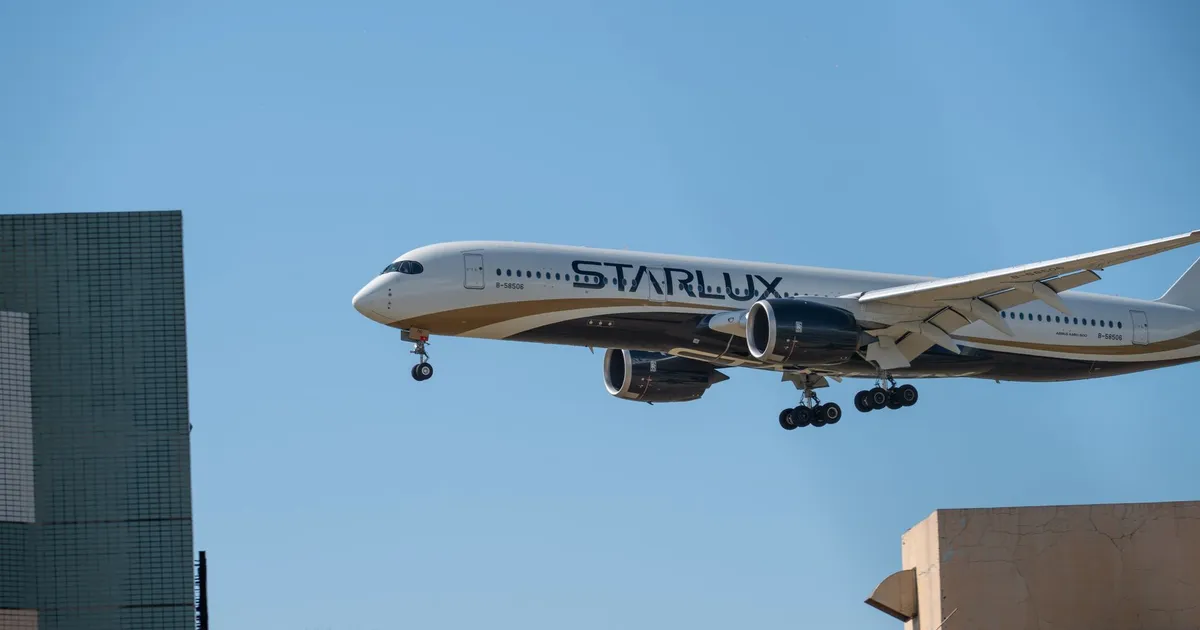
New Zealand just picked up a new long-haul link into Asia without the national carrier lifting a finger. Taiwan’s Starlux Airlines will fly Taipei to Auckland via Sydney from 23 March 2027, starting at four flights a week on an Airbus A330-900neo and stepping up to daily from 1 May.
It is not a headline-grabbing nonstop. But it is a genuine win, and the bits that matter most to business are not the ones most coverage will lead with.
Cherry growers get another plane
The tourism story is obvious. The freight story is better. Auckland Airport chief customer officer Scott Tasker says Taiwan is “already New Zealand’s largest market for air-freighted cherries”, and the A330-900neo “has bellyhold capacity to carry high-value exports alongside passengers”. He also points to 72% growth in NZ-Taiwan travel over the past decade, calling the route “another link into Asia”.
For perishable exporters, every additional widebody belly is competition for space and pricing on a run where options are thin. Seven departures a week from Auckland into Taipei, with onward connections across Starlux’s network, is real capacity for cherries, seafood and other high-value product that lives or dies on transit time.
The schedule helps. The return flight JX184 leaves Auckland at 17:30 and lands in Taipei at 04:15, early enough for product to clear and move into Asian distribution the same morning.
The demand was already there
This is not a speculative punt. Stats NZ data released this week showed 5,500 Taiwanese visitors in September, a record for the month and up 1,700 on a year earlier. Annual arrivals climbed from 53,000 to 68,000 in the year to September, the third-biggest increase of any market.
That is a market growing quickly without much capacity. Starlux is simply following the money.
Auckland is the bonus, not the point
It is worth being honest about why this is happening. Starlux’s real target is Sydney. Taiwan-Sydney passenger numbers grew 18% in 2025 to almost 194,000, and the only other carrier flying direct between Australia and Taiwan is China Airlines. Starlux CEO Glenn Chai calls Sydney “one of the world’s great gateway cities”. He did not say that about Auckland.
There is also a fleet logic. Chief strategy officer Simon Liu says the expansion is partly about lifting utilisation of eight A330-900s mostly stuck on regional routes. Extending a Sydney flight across the Tasman keeps an expensive aircraft earning instead of sitting on the ground.
None of that diminishes the win. If anything, it is the more important lesson. New Zealand’s air connectivity does not have to be rationed by Air NZ’s network planners or negotiated through ministerial trade missions. Foreign carriers with their own hub ambitions will plug Auckland into their networks when the commercial maths works. Starlux wants to lift its transit passenger share from about 35-40% to 45-50%, funnelling travellers through Taipei to Southeast Asia and North America. Kiwis get those connections as a by-product.
The Sydney-Auckland leg also puts another product on the Tasman, a competitive alternative to Qantas and Air New Zealand on one of the region’s busiest corridors. More seats, more competition, better fares. That is how open skies are meant to work.
Why every new route counts
Auckland’s recovery has been patchier than it looks. In the 2024 financial year the airport handled 18.5 million passengers with international seats at 91% of pre-pandemic levels. A year later, in FY25, growth had slowed to 1%, with volumes at only 89% of 2019 levels amid what the airport called global fleet shortages and reduced airline capacity. Cargo value kept surging, up 20% to $31.8 billion over the same period.
That gap between passenger stagnation and cargo growth is exactly where a new widebody earns its keep. Back in 2024, Auckland already moved 89% of New Zealand’s international air cargo by value, much of it in passenger bellies.
The economic case for connectivity is well established. A 2024 NZ China Council report cited modelling that every 1% increase in connectivity drives a 6.3% increase in two-way trade, and airport estimates at the time put a new year-round daily widebody at roughly $125 million in visitor spend and $500 million in high-value exports a year. Those are generic figures, not a Starlux forecast, but they show the order of magnitude at stake.
What comes next
Bookings are not open yet, and Starlux still has to prove it can fill a premium product on a one-stop routing against nonstop options via other hubs. The first real test comes when daily flights start in May 2027.
But the direction is right. Exporters get more belly space into a top cherry market, tourism operators get access to a fast-growing visitor base, and travellers get another choice. The policy takeaway for Wellington is simple. Keep the door open, keep airport charges and border processing competitive, and let foreign airlines do the heavy lifting. Starlux did not need a subsidy to come here. It needed a market, and New Zealand had one.
Sources
- NZ Herald: New Taipei-Auckland flights via Sydney as Starlux Airlines expands to New Zealand (2026-11-11)
- Aeroroutes: Starlux Plans Sydney / Auckland late-March 2027 Debut (2026-11-10)
- CAPA: STARLUX Airlines to launch Taiwan Taoyuan-Sydney-Auckland Service in Mar-2027 (2026-11-11)
- Canberra Times: Snoopy tickets and Michelin chefs, luxury airline Starlux confirms Aussie launch (2026-10-13)
- Aerotime: STARLUX Airlines announces Sydney as first Australian route (2026-06-03)
- NZ China Council: The Southern Link, advancing New Zealand’s potential as a trade, tourism and logistics hub (2024-09-24)
Join the discussion
Add useful context, ask a good question, or challenge an idea — keep it specific and respectful.