

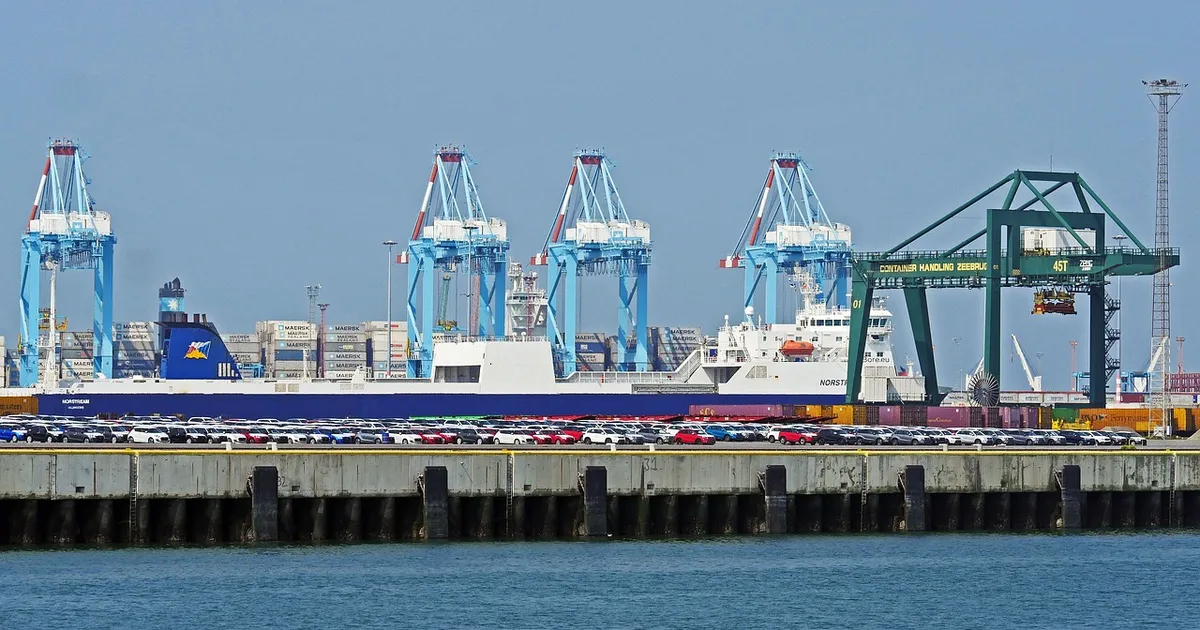
New Zealand has stumbled onto a natural experiment in EV policy. Strip out the subsidy, let petrol climb past $3 a litre, and buyers come back on their own. The catch is that the supply chain they depend on is about to narrow sharply. Wallenius Wilhelmsen (WWL), the Norwegian-Swedish car carrier, is suspending its Japan-to-Oceania roll-on/roll-off service for 2027. WWL is the only RORO line carrying used battery EVs other than the Nissan Leaf, which moves on a separate carrier. Petrol, diesel and hybrid cars keep shipping as normal. Teslas, BYDs and the rest of the non-Leaf used EV market do not.
The market did the subsidy’s job
The demand recovery is real and it is household-led. EV registrations in the September quarter were up 206% year-on-year, as 91 octane climbed from $2.90 to $3.35 a litre. By October, plug-in hybrids and BEVs made up 22.7% of new light vehicle registrations, against 8.9% a year earlier, and almost 60% of BEVs went to private owners rather than fleets.
Motor Trade Association sector manager Larry Fallowfield says there is growing belief that higher fuel prices are not a temporary spike and will shape buying behaviour long-term. That matters. Buyers are not chasing a rebate that could vanish with the next budget. They are responding to running costs, which is a far sturdier foundation for a market.
The contrast with the post-subsidy slump is stark. In the year to June 2025, Stats NZ reported that fully electric vehicle import value had fallen 57% to $395 million, as buyers drifted to hybrids once the clean car discount went. Price signals have since reversed that without a cent of taxpayer money.
A third of the used EV pipeline just lost its ship
The used side has been booming too. Used EV registrations reached 3318 year-to-date to October, up 135%, with Tesla alone at 538 against 140 a year earlier. About a third of that volume, roughly 1094 cars, were exactly the non-Leaf models now stranded without RORO capacity.
Imported Motor Vehicle Industry Association chief executive Greig Epps expects used EV arrivals to drop from about 3500 this year to around 2500 in 2027. His explanation is blunt economics. China built 34.5 million vehicles last year against Japan’s 8.5 million, ships are being pulled to Europe and the US, and New Zealand offers little cargo for the return leg. “We’re at the end of the line… Empty ships don’t make money,” he said. He also suggested carriers may be wary of the small but catastrophic risk of lithium battery fires aboard vessels worth around $150 million.
Containers will roughly double the freight bill
Importers can still containerise, but at a price. Hayden Johnston of Auckland importer GVI Electric says peak season costs run to $6000 to $7000 a car in a container, against about $2500 on a RORO vessel. On a $15,000 to $20,000 used EV, that is a margin killer or a price rise, and Johnston is clear which one buyers will see. “Prices will lift on what is still able to come in, and unfortunately prices will also lift on what is already here,” he said, adding that Leaf prices will firm as buyers chase the unconstrained stock.
For dealers, that means repricing existing inventory upward and rethinking 2027 sourcing now. For fleet managers, cheap used EVs for pool cars just got scarcer. For lenders, residual value assumptions on used EVs should be revised up, not down, which is an unusual position for a segment long plagued by depreciation worries.
Hybrids and Chinese new cars fill the gap
Epps’ answer is to lean on hybrids, where Japan’s decade-long focus gives a deep pool of 2018 and 2019 stock on unaffected carriers. The market is already there. Petrol hybrids, led by the Toyota Aqua, took 53.8% of October’s 8285 used imports, the busiest month of the year.
The bigger shift may come from the top. University of Auckland researcher Kenny Ching notes almost 97% of used passenger imports came from Japan in 2025, a single-channel dependency now exposed. He argues that if a credible new EV costs as little as $30,000, it compresses the whole used-car price ladder and reduces New Zealand’s reliance on Japanese depreciation.
The model is bending, not breaking
This is not a crisis for the car market. It is a squeeze on one segment that the market will route around, through containers, hybrids and cheaper new Chinese EVs. The genuinely good news is that fuel-driven demand is proving durable without subsidy. The risk for importers is assuming 2027 will look like 2026. Anyone who has not already locked in container capacity, as Johnston quietly did, is about to pay peak-season prices for a strategy their competitors priced in months ago.
Sources
- RNZ: Why buying a used EV could get harder next year (2026-11-26)
- BusinessDesk: Wallenius Wilhelmsen suspends Japan-to-Oceania service for 2027, hitting secondhand EV importers (2026-11-22)
- Autotrader: Shipping change set to push up used EV prices (2026-11-20)
- Autotalk: Wallenius Wilhelmsen to suspend Japan-Oceania service for 2027, importers told (2026-11-19)
- RNZ: 200 percent jump – Petrol prices drive EV surge (2026-10-02)
- MTA: Electric Vehicles Ride Fuel Price Wave (2026-11-02)
- Autotrader: Aqua leads as used imports have their busiest month of the year (2026-11-01)
- Stats NZ: Electric vehicle imports lose charge as volumes drop (2025-07-22)
- University of Auckland: Cheap EVs could reshape used car market (2026-10-12)
Join the discussion
Add useful context, ask a good question, or challenge an idea — keep it specific and respectful.