

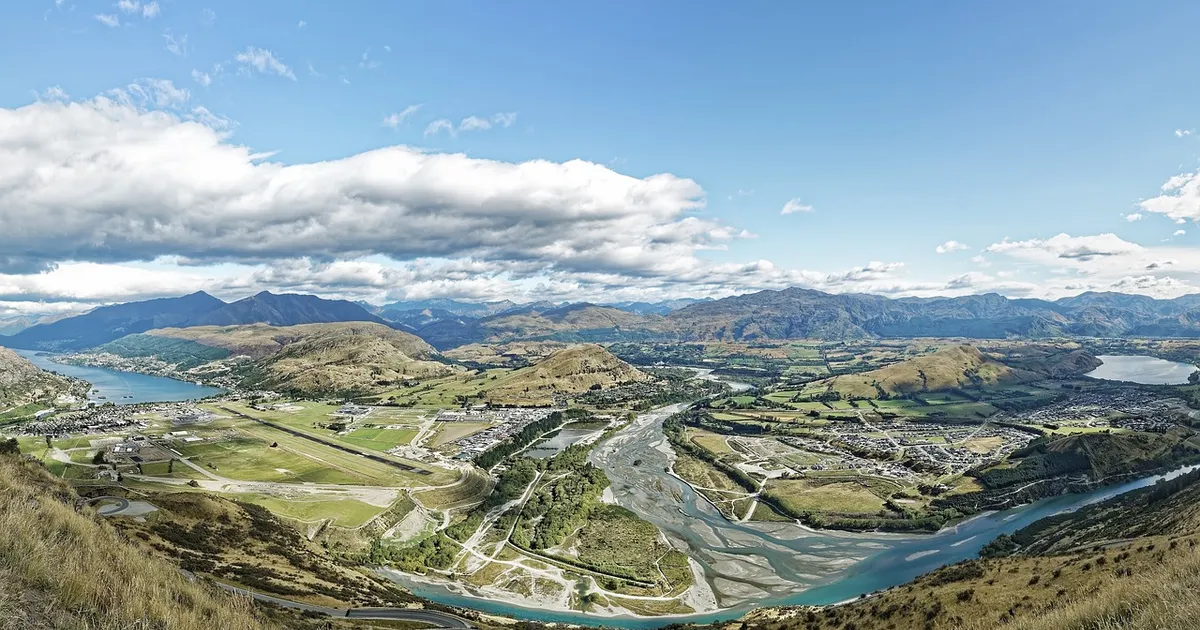
Queenstown has spent 15 years selling growth faster than it could treat the sewage. That gap is now before the Environment Court, where the Shotover wastewater plant faces what the ODT calls a major legal test over discharges into the Shotover River. When a judge is weighing your wastewater, the council no longer controls the timetable, and neither do the developers and tourism operators who depend on it.
A plant that ran out of road early
This was not bad luck. In 2025, Newsroom’s David Williams traced the failure to 2010, when the planned Project Shotover upgrade was shelved within days of a cost-cutting local election. The district then grew at 2.6 percent a year against the 1.4 percent assumed in planning. By 2018 the plant had reached the capacity it was designed to hit in 2026, and the $30 million first stage of the new system filled up soon after commissioning.
The 2019 dose-and-drain disposal field fared no better. The Environment Court’s 2025 decision recorded that suspended solids blocked soil pores and biological growth cut permeability, leaving persistent ponding almost from day one.
Then the council built a pipe without consent
Faced with a saturated field, the council built an unconsented overflow pipe in September 2024 to send treated wastewater straight into the Shotover River at high flows. The Otago Regional Council issued abatement and infringement notices, then went to the Environment Court in January 2025. Then-chief executive Richard Saunders said at the time it was “vitally important” that consent holders complied with their conditions.
The court granted enforcement orders by consent in June 2025. The council had to lodge a consent application for a new disposal system by May 2026 and have it built by December 2030. In July 2025, its retrospective consent for the river discharges was referred directly to the Environment Court, which meant a judge, not the regional council, would rule. That is the hearing now under way.
The fix costs more than the plant ever did
In March, councillors voted to pursue a 35-year consent to discharge into the Kawarau River instead. The $77.5 million plan involves advanced filtration and a 1.4km pipeline to a rock outfall, sized for volumes projected to more than double to 26 million litres a day by 2060. Ngāi Tahu called direct discharge of human waste “abhorrent”, and councillor Niki Gladding voted against, warning the pathway would be hard to reverse once locked in.
Mayor John Glover said in March there were “no realistic other options”, adding that “in a district where land is very expensive … it’s a challenge” to pursue land-based disposal.
The numbers in May’s consent application show why the clock matters. Average daily flow climbed from 10,500 cubic metres in 2018-2020 to 11,500 in 2024, while peak dry weather flow jumped from 12,650 to 16,469 cubic metres a day. The council is seeking a maximum of 60,000 cubic metres a day to cover 2060.
Growth was the forecast, not the surprise
The Post’s Andrea Vance called it “an entirely foreseeable infrastructure failure” in March, noting up to 29,700 new homes are projected for the district by 2053. She also recalled a 2025 call by then-deputy mayor Quentin Smith to pause development until the plant was fixed. It was not acted on.
The council’s own 2023-24 annual report projected peak day population more than doubling, from 103,722 to 221,340 by 2054. Nobody can claim the demand crept up on them. Local outlet Crux has gone further, publishing unverified allegations that building consents kept flowing while plant failures were known. Those claims remain untested, but the timeline alone is damning enough.
What developers and operators should price in
This is not a story about red tape strangling growth. It is a council failing at its most basic job, then being held to the same rules any business discharging into a river would face. A private operator that built an unconsented outfall would expect enforcement. Councils should too.
For business, the practical risks are clear. Developers should assume wastewater capacity, not zoning, is the binding constraint on new subdivisions until the Kawarau pipeline is consented and built, and that court conditions could tighten the pace. Ratepayers and commercial property owners should expect the $77.5 million figure to be a floor, with consenting, monitoring and enforcement costs stacking on top. Tourism operators trading on a pristine-lakes brand face reputational exposure every time sewage and Queenstown share a headline.
The wider lesson travels well beyond the Wakatipu. Any fast-growing council that underbuilds pipes to keep rates down is borrowing against its future consent pipeline. Queenstown deferred a hard argument in 2010 to save money. It is now paying several times over, on a timetable set by a judge. Whatever the court decides, other high-growth districts should read the ruling as a bill that eventually arrives for everyone who skips the plumbing.
Sources
- ODT: Shotover River wastewater discharge under Environment Court microscope (2026-11-24)
- Newsroom: How Queenstown’s wastewater system went wrong from the start (2025-04-29)
- Environment Court: Decision No. [2025] NZEnvC 178 – ORC v QLDC Enforcement Orders (2025-06-09)
- ORC: ORC lodges Enforcement Order claim with Environment Court (2025-01-23)
- RNZ: Queenstown Lakes District Council must fix issues with Shotover wastewater plant – court (2025-06-10)
- QLDC: Request approved for retrospective consent regarding wastewater discharge to go before Environment Court (2025-07-11)
- RNZ: Queenstown Lakes District Council seeks 35-year consent to pump wastewater into Kawarau River (2026-03-19)
- RNZ: Pumping wastewater into Kawarau River only option, Queenstown mayor says (2026-03-20)
- ORC: Shotover WWTP Resource Consent Application – Wastewater Discharge Volume and Timing (2026-05-28)
- The Post: Country’s water crisis flows through Queenstown (2026-03-21)
- QLDC: Annual Report 2023-2024 (2024)
- Crux: Evidence mounts of 4-year sewage cover up to protect Queenstown property development
Join the discussion
Add useful context, ask a good question, or challenge an idea — keep it specific and respectful.