

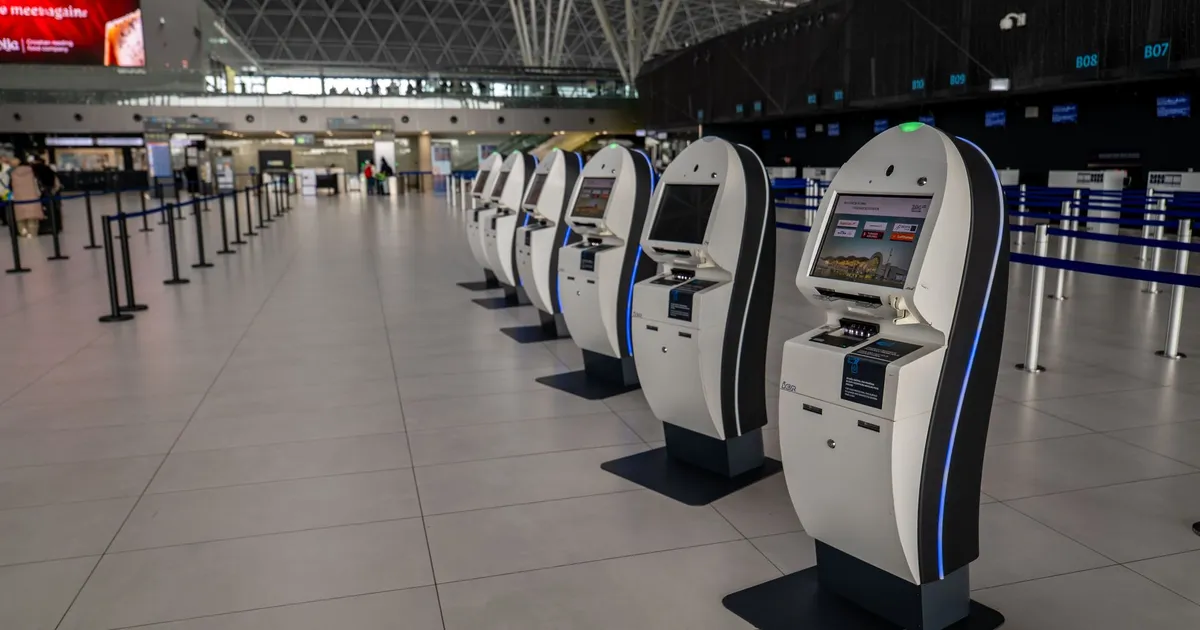
Auckland Airport opened the first of five new international check-in zones today. Cathay Pacific, Jetstar, Malaysia Airlines and Qantas passengers now face 28 self-service kiosks and 15 automatic bag drops where 22 staffed desks used to be.
The official pitch is shorter queues and more control for travellers. The more useful way to read it is as a productivity decision. The passenger now does the work a desk agent used to do, and a smaller, mobile team handles the exceptions. That is a sensible trade for an airport running out of room. It just is not quite the trade being advertised.
Capacity is the real customer
In March 2026, chief operations officer Chloe Surridge said the airport processes roughly 16,000 international check-ins a day and has to absorb growth ahead of the new integrated terminal. She framed self-service as reflecting “what people now expect at major airports around the world”, while stressing that “airport teams remain an important part of the experience”, with staff in pink vests deployed to guide travellers.
The end state is big. By 2029 the airport plans 130 kiosks and more than 60 bag drops across five zones, part of a $3.9 billion programme that promises 44% more passenger processing capacity than the current terminal. In 2025, Aviation Week put the broader terminal upgrade at NZ$5.7 billion, a figure the airport’s own numbers do not reconcile with, most likely because of differing scope.
The logic is straightforward. A desk assigned to one airline sits idle between that carrier’s departures. Common-use machines do not. Every square metre of a constrained terminal works harder, and airlines get throughput without paying for rows of agents to stand at counters.
The numbers back the bet
This is not a speculative punt. The airport’s FY26 results presentation shows 19.04 million passenger movements, up 2%, with median international departure processing times down 15.6% and domestic departures down 7.0%. Passenger satisfaction sat at 83.5%. Those are hard gains, achieved while the terminal is a building site.
The back-of-house investment is just as telling. 1News reported a new robotic baggage system and a “bag hotel” holding 3,000 pieces of luggage, letting travellers drop bags up to 24 hours before they fly. That is a genuine improvement for anyone juggling a hotel checkout and an evening flight, and a smart way to flatten peak demand at the bag belts.
Somebody still has to fix the bag tag
Here is the part the launch coverage glosses over. Self-service works brilliantly for the frequent flyer and less well for everyone else. A 2025 systematic literature review of passenger non-adoption found certain segments persistently resist airport self-service, preferring human contact, which leaves operators running both automated and staffed channels at added cost.
European industry analysis by ACI Europe identifies bag drop specifically as a high-stress touchpoint, a sequence of scanning, weighing, tag printing and belt placement where small mistakes stall the line. Some European carriers restrict who can use it or charge for a staffed counter to manage demand.
Auckland Airport’s executives clearly know this. Chief digital officer Richard Wilkinson says that “because the space isn’t tied to one airline, we can adapt it as demand changes through the day”, then adds that “a family or someone flying overseas for the first time can take their time and get all the help they need”, in comments to the Herald. Read that carefully. Human help has moved from the default channel to an exception-handling service. Whether it works depends entirely on how many pink vests are on the floor at 6am when three long-haul flights check in at once.
The phone is the next desk
The kiosk is a stepping stone. In 2025 the airport cited a survey showing 77% of travellers were interested in using a smartphone loaded with a digital passport, rising to 90% among under-25s. Biometrics, Changi-style, is clearly where this heads.
For business, the verdict is mostly positive. Corporate travellers and regular flyers will get through faster. Airlines get cheaper, more flexible processing. Tourism operators get a gateway that can handle growth instead of choking on it. That matters for a country that competes for visitors with hubs that automated years ago.
The risk sits with the travellers least able to absorb it: older passengers, families with prams and car seats, first-time international flyers. They are also the ones most likely to blame the airport, not the airline, when a bag tag will not print. Four more zones open before 2029. The machines will keep getting better. The real test is whether Auckland Airport staffs the exceptions as seriously as it has funded the hardware.
Sources
- NZ Herald: Auckland Airport opening new check-in zone for Cathay Pacific, Jetstar, Malaysia Airlines and Qantas today (2026-11-29)
- Aviation Week: Auckland Airport Plans Check-In Hall ‘Digital Overhaul’ (2025-09-03)
- 1News: Behind the scenes of Auckland Airport’s check-in transformation (2026-10-01)
- Journal of the Air Transport Research Society: A systematic literature review of passenger non-adoption of airport self-service technologies (2025-02-26)
- ACI Europe: The New Passenger, Analysis of Digitalisation and Automation at European Airports
- NZ Herald: Auckland Airport says check-in overhaul means no more ‘long queues’, more biometric technology (2025-08-26)
Join the discussion
Add useful context, ask a good question, or challenge an idea — keep it specific and respectful.