

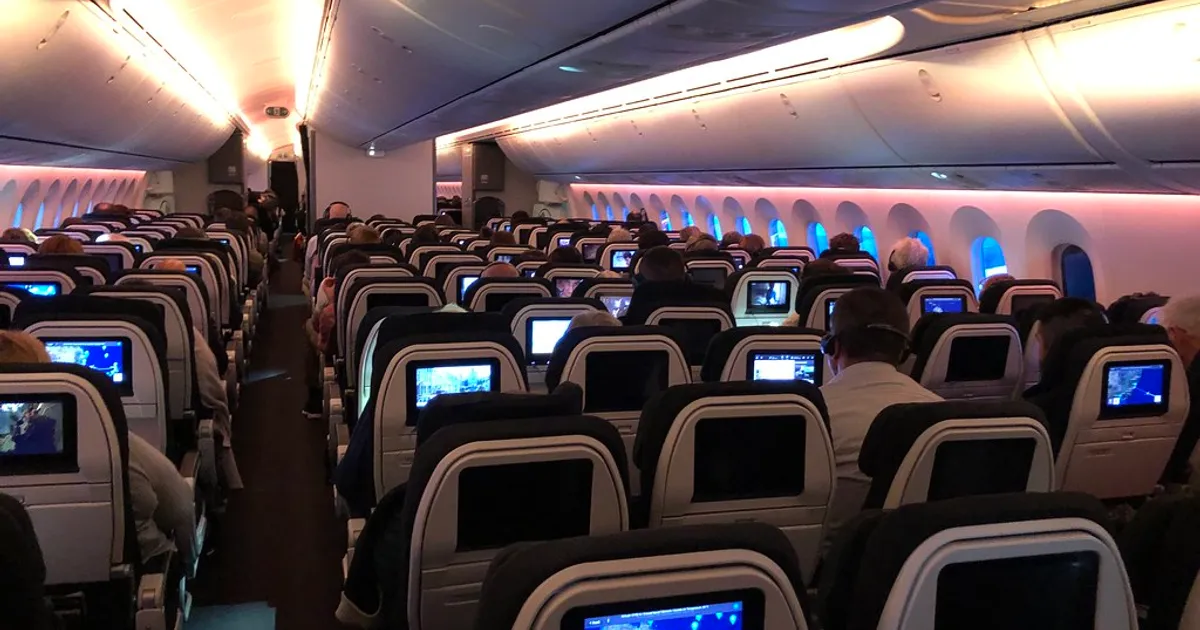
Air New Zealand has just reset what a business traveller should expect from a domestic flight. The airline will introduce free Starlink-powered wi-fi on domestic jet flights from early 2027, with international jets following from mid-2027. Once connectivity is free on the main trunk, it stops being a perk and becomes the minimum. That puts pressure on rivals, and it leaves the regions on the wrong side of a new divide.
Flight time becomes billable time
Chief customer and digital officer Jeremy O’Brien says the trials won the airline over on reliability as much as speed. “What impressed us wasn’t just the speed, but how reliably it performed and what passengers could do,” he told RNZ, pointing to streaming live sport, catching up on work and staying in touch with home. He made the same case for Starlink’s reliability on Newstalk ZB.
For the airline, the competitive logic is about the motorway as much as other carriers. In 2025, Nikhil Ravishankar, then Air NZ’s chief digital officer, put it plainly to Wired: “Typically we compete with a car, but you can’t work from a car.” On routes like Auckland-Wellington, Auckland-Christchurch and Auckland-Queenstown, a reliable connection turns an hour in the air into an hour of email, proposals or client calls prep. Once business travellers get used to that, they will expect it everywhere, from every operator.
The global trend points the same way. Wired’s 2025 analysis described free satellite wi-fi shifting from premium add-on to baseline, noting Delta had spent more than US$1 billion rolling out free connectivity. That figure is the reminder that “free” to the passenger is a serious capital cost to the airline, recovered through loyalty and fares rather than a wi-fi charge at the gate.
Four years from announcement to take-off
Credit where due, but this has not been fast. Air NZ was among the first airlines in the world to announce Starlink plans in late 2023, yet trials only began in mid-2025 and the confirmed rollout lands roughly two years behind the original target. The upside is a bigger scope than first flagged, with international jets now included rather than domestic alone, as One Mile at a Time notes.
The timing also says something about priorities. Air NZ posted a $242 million net loss after tax for FY2026, reversing a $108 million profit the year before, as jet fuel prices and engine availability problems bit. Aviation system charges, the airport and airways fees, rose $142 million to $1.2 billion. Yet operating revenue still grew 3.9% to $7.0 billion and customer satisfaction edged up to 84.0%, per the same annual report. The airline is betting that product, not price cutting, protects that revenue line. It is the right bet. A flag carrier that skimps on the cabin during a downturn tends to hand its premium customers to someone else.
The wi-fi spend sits alongside a heavy cabin programme. The final Boeing 787-9 from a nose-to-tail retrofit has just returned, and a 777 retrofit starts in 2027. O’Brien says that by the end of next year customers will be enjoying “some of the newest cabin products in the sky” across the widebody fleet, according to RNZ.
The regions get the slow lane
Here is the catch the headlines skipped. The domestic rollout excludes Air NZ’s ATR and Q300 turboprops, the aircraft that serve smaller regional routes. The airline’s Starlink page frames this as putting money into the jet fleets where it can reach the most customers at scale, with jets targeted for completion by the end of 2028. There is no committed timeline for turboprops at all.
That is a defensible commercial call. Jets carry the volume, and capital is scarce in a loss-making year. But the consequence is a two-tier network. A consultant flying Auckland to Christchurch works the whole way. Their counterpart flying into a regional centre on an ATR sits offline. For businesses based outside the main centres, already paying more and waiting longer for air connections, it is one more small productivity penalty that compounds across a year of travel.
What business should do with this
For travel managers, the trunk routes just became more valuable per seat, and that should factor into which carrier gets the corporate account. For any rival on those routes, matching free connectivity is no longer optional. For regional firms, councils and airports, the message is to lobby early. Turboprop connectivity will only get funded if someone makes the commercial case before 2028, not after.
Air NZ has made free wi-fi the baseline on the routes that matter most to its revenue. The next question is whether that baseline ever reaches the rest of the country.
Sources
- RNZ: Air NZ to introduce free wi-fi on domestic jet flights in 2027 (2026-11-30)
- Newstalk ZB: ‘Great reliability’: Air NZ to use Starlink for Wi-Fi on jet planes (2026-11-30)
- One Mile at a Time: Air New Zealand’s Free Starlink Wi-Fi Rollout Starts In 2027, Years Late (2026-11-29)
- Air New Zealand: Starlink Wi-Fi
- Wired: Airplane Wi-Fi Is Now … Good? (2025-07-02)
Join the discussion
Add useful context, ask a good question, or challenge an idea — keep it specific and respectful.