

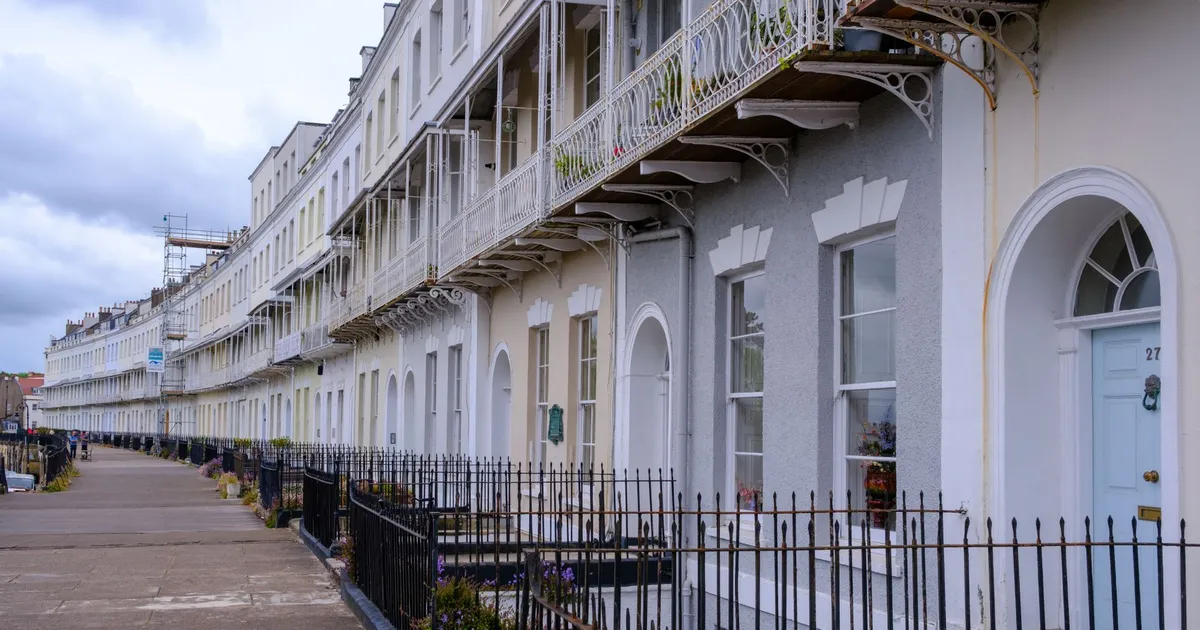
Most Auckland residential developers spend their lives managing vacancy risk, tenant churn and a capital-gains story that no longer stacks up. Ngāti Whātua Ōrākei Whai Rawa has sidestepped all three. Its 61 new terrace-style homes at Bayswater are leased for a decade to the New Zealand Defence Force, which sub-leases them to Royal New Zealand Navy personnel.
That is a single, Crown-backed tenant on a long term. In property finance, it is close to the best income profile a residential project can get.
A $50 million bet with the income already locked in
The project replaced 19 ageing weatherboard houses next to Belmont Park Bowling Club, with construction costing more than $50 million, roughly $819,000 a home. The homes sit across two enclaves, 44 on 14 sites in Portsmouth and 17 on five sites in Roberts. Precision Construction built them to Cottee Parker Architects designs.
The Herald’s first look inside the homes features Whai Rawa chief executive Grant Kemble and development manager Nicole Carseldine. Back in 2025, when the deal was announced, Kemble framed it in commercial terms, saying the iwi’s focus with each development was “building thriving communities, not just homes”.
The timeline is worth noting too. Construction began in mid-2025 with completion targeted for the end of 2026, under a single arrangement in which the iwi builds, leases and manages the homes. It delivered on schedule. Plenty of Crown-led projects cannot say the same.
The Navy stopped wanting to be a landlord
This arrangement has deep roots. In 2012, the Crown transferred 253 Devonport, Bayswater and Hauraki Navy properties to Ngāti Whātua Ōrākei as part of its Treaty settlement, turning the Navy from owner into tenant. Bayswater is the next step in a relationship that has now run more than a decade.
The Navy’s requirements were clear. In 2025, Deputy Chief of Navy Commodore Karl Woodhead set out four priorities: quality modern homes fit for family size, proximity to other Navy families, and a location within 30 minutes of Devonport Naval Base. At the October completion ceremony, Woodhead said the homes give sailors “a strong foundation from which our sailors can serve effectively”. NZDF’s own post said the development strengthens its relationship with Ngāti Whātua Ōrākei.
Read that language carefully. This is not welfare housing. It is about getting sailors into uniform and keeping them there.
Housing is now a retention problem
Bayswater is one piece of a large national catch-up. In September 2025, then-Associate Defence Minister Chris Penk launched what RNZ called the largest defence housing project in decades, including 50 homes at Waiouru. A 2023 estimate found regenerating all 1,900 NZDF homes would need more than $1 billion in capital and $2 billion in operating spend over 25 years.
In June, Cabinet approved at least 63 more homes across Linton, Ohakea, Trentham and Burnham. The Cabinet paper explicitly ties the programme to housing that “supports operational readiness and retention requirements”. That is the government conceding that staff housing is infrastructure, not a side issue.
Private capital does not have to cost more
The usual objection to letting private or iwi capital deliver public housing is that taxpayers pay a premium. Officials have already tested that. In 2024, Infrastructure Commission analysis of a proposed Linton PPP concluded the Crown’s service payments would be no greater than a conventional build, provided risk and performance standards were set properly.
That is the logic Bayswater runs on. The iwi carries development risk and gets a bankable income stream. The Crown gets modern homes without tying up capital on its balance sheet.
What ordinary landlords can only envy
Compare that with the open market. In 2025, the Auckland Property Investors Association warned that “the era of easy capital gains is over”, with rental performance hinging on occupancy certainty and stock that suits the workers Auckland actually attracts. A decade-long institutional lease is occupancy certainty in its purest form.
A template for other big employers
The lesson reaches well beyond defence. Hospitals, ports, freight operators and regional manufacturers all face the same bind: a fixed worksite, staff who cannot afford to live near it, and turnover that costs real money. Bayswater shows a workable answer. Pair a landholder with scale and patient capital with a creditworthy employer willing to sign a long lease, and housing that pencils poorly on the open market suddenly finances itself.
Ngāti Whātua has proven the model at 61 homes. The next question is which employer is first to copy it, and whether government gets out of the way when they do.
Sources
- NZ Herald: Ngāti Whātua Ōrākei builds 61 Bayswater homes leased to NZ Defence Force Navy personnel (2026-11-29)
- NZ Herald: First look inside 61 new terraced homes developed by Ngāti Whātua Ōrākei Whai Rawa (2026-11-29)
- NWO Properties: Ngāti Whātua Ōrākei to build new Navy housing on the North Shore for NZDF (2025-05-30)
- Defence Security Wire: New North Shore homes bolster Navy families and deepen partnership with local iwi (2026-10-05)
- NZDF LinkedIn: A new housing development in Bayswater will provide 61 new homes for Navy families (2026-10-05)
- RNZ: Work finally begins on ‘largest defence housing project in decades’ (2025-09-23)
- RNZ: Public-private partnership for NZDF housing no different in cost than usual approach – officials (2024-09-02)
- APIA: Auckland’s next ten years of tenants, are your rentals future-fit? (2025-02)
Join the discussion
Add useful context, ask a good question, or challenge an idea — keep it specific and respectful.