

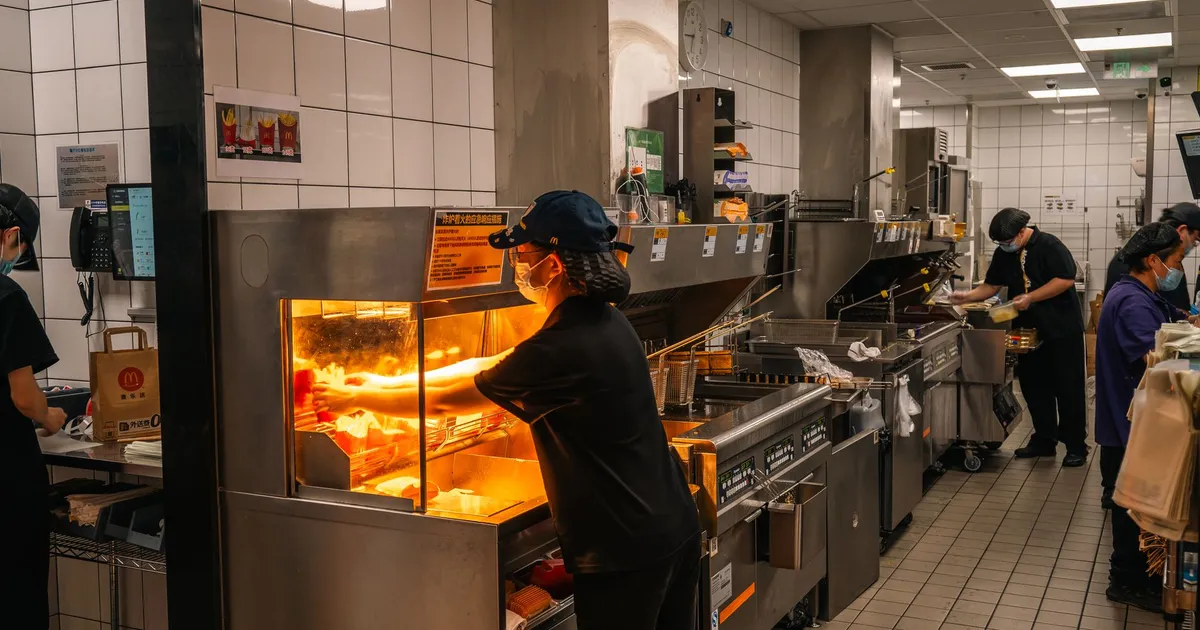
David Seymour spent part of the campaign trail praising McDonald’s workers as ‘not unskilled’ while defending ACT’s plan to cut the entry wage for under-20s. Critics call that hypocrisy. For employers it is the whole argument in one line. Entry-level work takes real skill, but the skill has to be learned on somebody’s payroll, and right now the price of that first year is rising faster than the output it buys.
ACT’s package is blunt, politically risky and aimed squarely at the cost pressure hospitality, retail and franchise operators live with. It deserves a hearing on the numbers, not the slogans.
Two policies sold as one cut
Most coverage treats this as a single ‘wage cut’. It is two separate moves. The first is a three-year freeze on the adult minimum wage, currently $23.95 an hour. That is a cost-certainty play for every existing payroll at or near the floor. For context, the rate was $23.50 from April 2025.
The second is a new training wage of $14.37 an hour for workers under 20 in their first 12 months with any employer, replacing the current $19.16 starting-out rate. That is 60% of the adult rate and a cut of roughly 25% on the existing youth rate. On B2B News calculations, a full-time trainee would earn about $29,890 a year against $49,816 for an adult on the floor, a gap of around $19,926.
The freeze is about margins. The training wage is about whether a new entry-level role gets created at all. Lumping them together hides the real debate.
Wages outran output
ACT’s core claim is that the minimum wage has risen 35% since Labour took office while productivity grew just 5%. Seymour adds that New Zealand already has one of the highest minimum wages relative to the median in the developed world.
This is not a fringe view. Back in 2020, MBIE’s own review warned that wage increases “need to be paid for by productivity”, and that anything else was effectively borrowing to pay wages. The same document flagged hospitality, retail, tourism, manufacturing and primary produce as the most exposed sectors, and noted the compression effect, where lifting the floor eventually pushes up every pay rate above it.
MBIE’s 2022 review put numbers on the risk. A modest rise would restrain employment by fewer than 1,000 workers, but increases running five to six percentage points ahead of average wage growth could cost between 5,100 and 28,900 jobs. The lesson is that pace matters more than the existence of a floor. That is a more honest case than ‘minimum wages kill jobs’, and it is the one ACT should be making louder.
The youth jobs market is already broken
The strongest evidence sits with young people. Underutilisation among 15 to 24-year-olds rose to 37% in the 12 months to June, up from 34%, with 180,200 young people now underutilised. Seymour also argues that less than 10% of minimum wage earners are heads of household.
ACT small business spokesperson Laura McClure frames it as a growth problem. ACT’s statement spells out the trade-offs for tight-margin operators, “higher prices, fewer hours, reduced hiring, lower investment”, or never creating the job. Every café owner deciding between an untested 17-year-old and an experienced 30-year-old at the same rate knows exactly how that calculation ends.
Where the union has a point
CTU president Sandra Grey calls the plan “unconscionable”, and notes the minimum wage already sits about 20% below the Living Wage. The moral framing will dominate headlines. Her sharper point is mechanical, and employers should take it seriously.
Because the training rate applies to the first 12 months with any employer, a teenager who switches jobs drops back to $14.37. That discourages young workers from moving, which sounds good for retention until you realise many hospitality operators recruit from each other’s staff. It also creates a perverse incentive to cycle trainees out at month 11. ACT needs a portability fix, perhaps tying the rate to cumulative experience rather than tenure, before this becomes a reputational liability for every brand that uses it.
The wider package also cuts the window for personal grievance claims from three years to three months, which would give small employers far quicker certainty on their legal exposure.
What happens after polling day
As the Herald has framed it, this is a clash between employer costs and worker purchasing power. Both are real. But a country with more than a third of its young people underutilised cannot keep treating the wage floor as a free lever.
If ACT holds the balance in coalition talks, expect the freeze to be traded down to slower indexation, and the training wage to survive only with tighter design. Franchise and hospitality operators should model both scenarios now. The fight is worth having, provided ACT turns a provocative number into a policy that actually gets teenagers hired and keeps them.
Sources
- Stuff: ‘Not unskilled’: Seymour praises McDonald’s workers, but wants to cut minimum wage (NZ Election 2026 live updates) (2026-10-31)
- RNZ: ‘Nowhere near enough to live on’ – ACT’s minimum wage plan slammed by union (2026-09-16)
- interest.co.nz: ACT wants to freeze minimum wage for three years (2026-09-15)
- The Post: ACT to freeze minimum wage if elected (2026-09-14)
- ACT New Zealand: Hit Pause on Minimum Wage for Three Years (2026-09-14)
- NZ Herald: Minimum wage: To freeze or not to freeze? (2026-10-21)
- MBIE: 2020 Review of the Minimum Wage (2020-10-19)
Join the discussion
Add useful context, ask a good question, or challenge an idea — keep it specific and respectful.