

Claymark Group is closing its Te Kūiti processing mill, with 35 positions going in a town where that number registers. The company’s owner described breaking the news to staff as “absolutely horrible”, and there is no reason to doubt it.
But the timing is what should worry anyone thinking about regional New Zealand. This is not a mill running out of trees. It is a mill closing just as the trees arrive.
The wood is ready, the mill is not
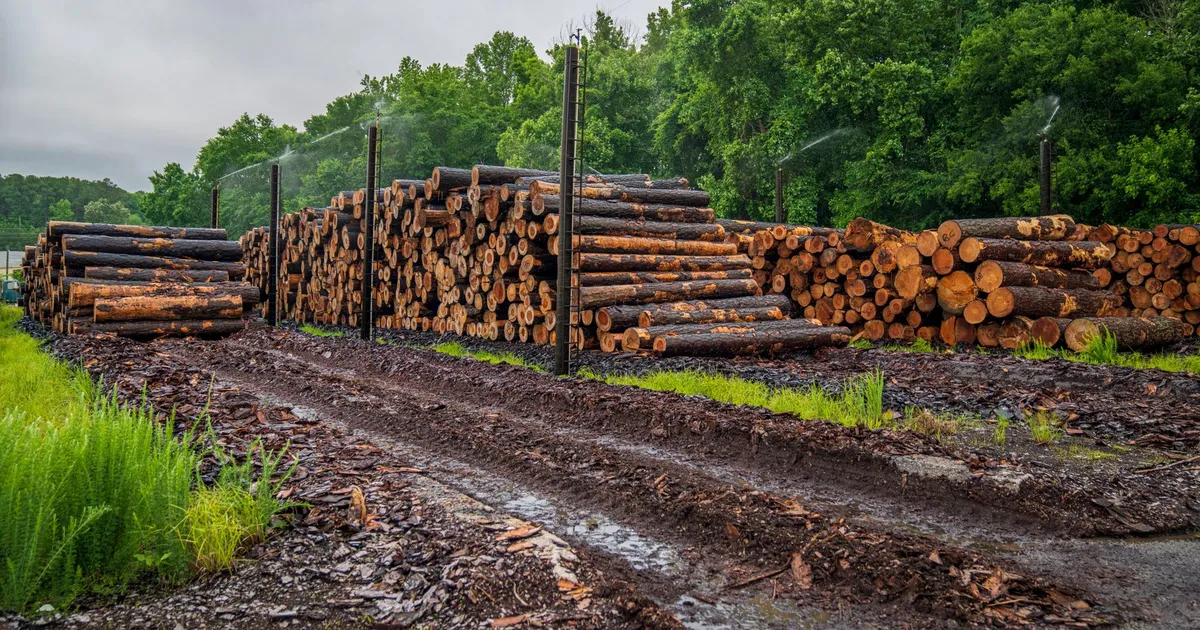
Pine forests planted in the Waitomo district about 30 years ago are now reaching harvest age, and the Te Kūiti mill has been handling an estimated 8-10 truckloads of logs each day, volume that will now travel to Claymark’s Rotorua and Katikati sites, which have the capacity to absorb it.
That is a perfectly rational call for Claymark. It is a worse deal for everyone else in the supply chain. Local growers and harvest contractors face longer hauls and higher freight bills at the very moment their volumes are rising. And a district with a growing wood resource now has a weaker case for anyone to reinvest in processing there, because the infrastructure, workforce and supplier relationships are being dismantled.
Waitomo mayor John Robertson called the closure gut-wrenching but did not pretend it was anything other than “very much a commercial decision” in a market where prices and costs are both tough. He has spoken to the site owners about turning the four-hectare site into an industrial park, on the simple logic that the town needs employment, whatever form it takes.
Te Kūiti is the latest, not the first
The central North Island has been absorbing these hits for more than a year. In 2025, Carter Holt Harvey moved to shut its Eves Valley sawmill near Nelson, affecting 142 jobs. Weeks later it announced the closure of its Tokoroa plywood plant, cutting almost 120 jobs on top of roughly 150 lost at the Kinleith pulp and paper mill, prompting then-South Waikato mayor Gary Petley to say that “taking three hits in the space of 10 months is not good for any community”.
Industry analysts at Globalwood described Tokoroa in October 2025 as the “fourth major mill closure in the past 12 months”, pointing to a worse-than-expected economic contraction that swamped any lift from falling interest rates. Offshore, it flagged a new US 10% tariff on imported timber and 25% on various wood products.
The domestic picture was no kinder. In 2025, Timber Industry Federation executive director Jeff Ilott told RNZ that building consents had fallen from 51,000 in 2022 to 34,000 in the year to June 2025, a drop of about a third, while electricity, compliance and insurance costs kept climbing. His advice to the sector then was to batten down the hatches. Te Kūiti suggests the hatches are still battened.
We export the logs and consolidate the rest
The structural story is older than this downturn. Claymark itself went into receivership in December 2019, the same day a government report on wood processors’ struggles was released. A 2020 NZ Herald analysis found that while the national harvest had grown to 37 million cubic metres a year, 62% of it exported, domestic log consumption had stayed flat at around 15 million cubic metres. The closures, it concluded, came down to “scales and economies”: small provincial mills that could not fund upgrades gave way to bigger operators.
That is exactly what Claymark is doing now, pulling volume into larger sites. And the export mix has barely shifted. MPI data puts forestry exports for the year ended December 2025 at $6.28 billion, with 55% going to China. Logs and poles made up 54% of export revenue, or $3.4 billion, against just $1.2 billion for sawn timber and sleepers. New Zealand still mostly sells the tree, not the product.
Subsidies will not fix this, but costs might
The temptation will be to call for a bailout or a regional processing fund. That would be a mistake. Propping up a sub-scale mill in a weak market only delays the same decision at greater expense. Consolidation into efficient sites is how the industry survives at all.
The things that would genuinely change the maths sit with government: energy prices, compliance load, insurance costs and the pace of consenting that drives domestic timber demand. Those are the levers Ilott was pointing at in 2025, and they are the ones that decide whether the next processor looks at a district like Waitomo and sees opportunity or a freight bill.
The logs will keep coming out of the Waitomo hills for years. The question for the next government, and for anyone weighing investment in the regions, is whether any of the value from them stays nearby, or whether Te Kūiti just becomes the place the trucks start from.
Sources
- Stuff: ‘Absolutely horrible’ telling staff they’ve lost jobs, says owner of Te Kuiti sawmill cutting 35 positions (2026-10-30)
- Waikato Times: ‘Gut-wrenching’: More than 30 jobs to go as Te Kūiti mill closes (2026-10-30)
- RNZ: Timber industry braces in troubled times (2025-08-22)
- RNZ: South Waikato mayor says government doesn’t ‘give a toss’ about the regions as another plant closure announced (2025-09-18)
- Globalwood: NZ wood sector dealt another blow (2025-10-06)
- NZ Herald: Claymark receivership comes same day as Government report on wood processors’ woes (2019-12-05)
- NZ Herald: Big Read: Industry in turmoil: What’s behind all the sawmill closures (2020-02-14)
- MPI: Wood product markets data (2026-06)
Join the discussion
Add useful context, ask a good question, or challenge an idea — keep it specific and respectful.