

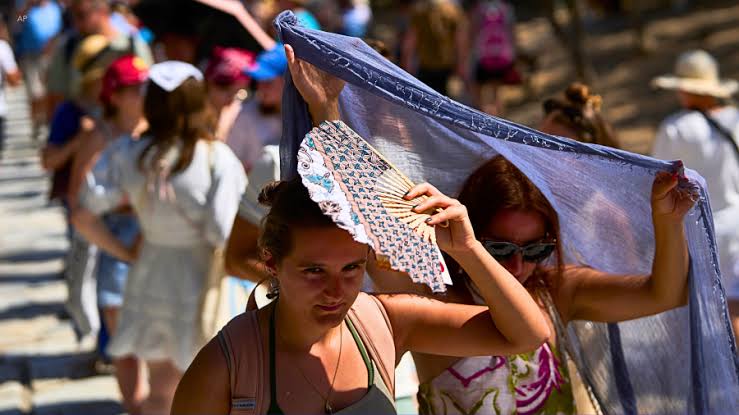
Europe’s latest heatwave is reshaping daily life across the continent, prompting authorities to open public cooling spaces, alter working hours, and cancel events as temperatures climb towards dangerous levels.
In Amsterdam, officials have introduced a trial network of indoor venues where residents can escape overheated homes. Libraries, churches, theatres, community centres, city farms, and supermarkets are among the locations offering water, seating, and toilet facilities. Most are concentrated in Nieuw-West, which was identified as particularly vulnerable because of limited shade, heat-retaining housing, and its large population of children and older people.
Dutch schools are also shortening lessons, extending breaks, and improving ventilation. With no legal maximum for classroom temperatures, individual schools must decide when conditions are no longer suitable for teaching.
In France, air-conditioned cultural venues are being used as temporary shelters. Three cinemas in Paris are offering free afternoon tickets to residents aged under 25 or over 65, while some municipal museums in Lyon have suspended admission charges.
French households have also turned to Blanc de Meudon, a chalk-like powder mixed with water and applied to windows. The coating reflects sunlight and can reduce the amount of heat entering a room.
Across Spain, councils have lowered or removed swimming pool fees, activated public sprinklers, and extended the operating hours of fountains. Several cities have opened air-conditioned buildings to residents who cannot cool their homes. Traditional San Juan bonfires and fireworks displays have also been cancelled in some areas because of the growing wildfire risk.
Italy has revived a state-supported scheme allowing businesses to suspend or reduce work during extreme heat while employees receive furlough payments. Construction workers, farm labourers, and staff in poorly ventilated buildings are among those covered.
Belgium has withdrawn some older trains without air conditioning, while one school near Brussels moved examinations into a church.
Germany has advised postal workers to wear caps, long sleeves, and lighter uniforms. Following several drownings, lifesaving groups have also warned swimmers to remain cautious in lakes and rivers.
The measures show how extreme heat is becoming a recurring public safety challenge. What were once temporary responses are increasingly forming part of Europe’s preparations for hotter, longer summers.