

Money sitting in the ground earning nothing
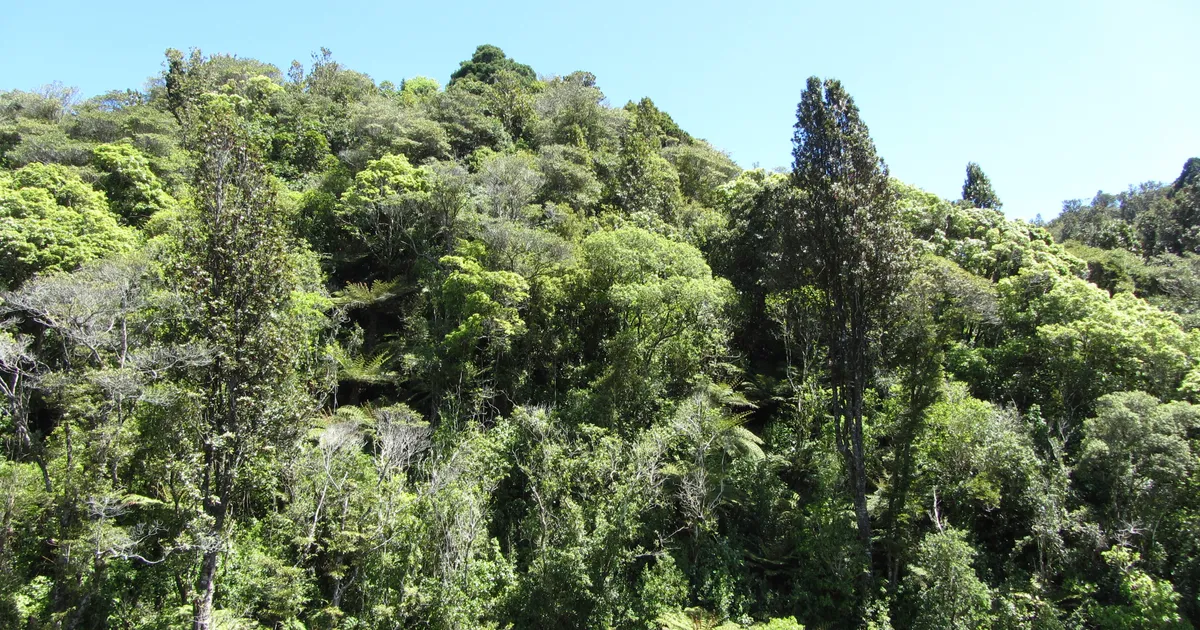
New Zealand has nearly 8 million hectares of pre-1990 natural forest, roughly 29% of the country’s land area, and under the Emissions Trading Scheme almost none of it earns a cent. The ETS only rewards forest planted after 1 January 1990, which leaves the country’s biggest carbon store as a pure liability for the people who fence it, trap it and pull wilding pines out of it.
BNZ and state-owned farmer Pāmu have built a workaround. In a deal both describe as a first of its kind in New Zealand, BNZ leases mature indigenous forest from Pāmu, books it on its own balance sheet, and uses the carbon it locks up to offset the bank’s emissions under voluntary carbon accounting standards. Pāmu takes the lease income and ploughs it back into managing the forest. Cost centre becomes revenue line.
A small pilot doing a big job
The trial covers a 600-hectare property in northern Hawke’s Bay carrying QEII National Trust covenants. It is estimated to offset about 1,100 tonnes of CO2 equivalent a year, against a BNZ emissions profile of between 4,500 and 6,000 tonnes. That is roughly a fifth of the bank’s footprint from one block of bush.
The logic for Pāmu is straightforward. CEO Mark Leslie notes that farmland gets retired for reasons such as erosion and risk to animals, and “when you do retire it there’s still a cost associated with weed or pest control.” Pāmu has already retired more than 16,000 hectares from production, with a little over 10,000 hectares under QEII covenants. That is a lot of land that has been costing money to keep alive.
BNZ CEO Dan Huggins frames the structural breakthrough cleanly: “Unlike other options, which require upfront capital to create a new asset that generates credits, this new model enables landowners to earn revenue from a pre-existing asset.”
Protecting carbon, not chasing it
This is not a maximum-sequestration play, and BNZ does not pretend otherwise. Chief sustainability officer Rebekah Cain says new plantings are much higher growth carbon sinks, but the point is to protect carbon already stored, prevent degradation and improve forest health so it keeps sequestering for longer. Crucially, she also concedes the lease is not significantly cheaper than buying standard carbon credits. The appeal for a corporate buyer is domestic, verifiable, nature-based outcomes instead of offshore credits of uncertain quality.
Verification is handled by climate-tech platform CarbonCrop, and that role is load-bearing. The whole model lives or dies on the credibility of the measurement.
The credibility test nobody has passed yet
Here is the catch. The government signalled support for voluntary nature markets in early 2026 and has ten pilots underway, but the accreditation regime for high-quality credits is still being designed. The Science Media Centre’s expert panel welcomed the direction in May 2026 while warning of “growing scientific and policy concerns about the effectiveness and fairness of voluntary carbon and biodiversity credit and offset schemes internationally,” where benefits had been found false, unenforced or unverified. They added that the government “can’t just outsource environmental restoration to the private sector” and that on measuring quality, the devil is in the detail.
If the framework lands weak, BNZ carries the reputational downside. Pāmu nature investment officer Annabel Davies points to the safeguards already built in, saying there is “some strong governance written into this lease agreement, and transparency and measurable outcomes” for nature, landowner and leaseholder alike.
Why this matters beyond one farm
The prize is large. A May 2026 Petrobase analysis frames Pāmu’s pivot as a play for the global nature-based credit market, projected to hit $35.5 billion by 2030. Demand for native credits has policy backing too. The Climate Change Commission in 2021 assumed an additional 300,000 hectares of indigenous afforestation by 2035 was needed to hit 2050 targets, and forestry removals were forecast at 14.3 Mt CO2e for the 2023-2025 period against net national emissions of 54.8 Mt in 2024.
The honest question is whether an ordinary farmer can copy this. Pāmu has in-house nature investment expertise, covenants already in place and a banking relationship most landowners can only envy. A smaller farmer with a patch of retired bush has none of that, and the price has not been disclosed in per-tonne or per-hectare terms. Until the model is simple enough to work without a dedicated investment officer, it stays a Pāmu-scale story.
But the principle is the important part. For the first time, native bush that the ETS treats as worthless has a buyer willing to put it on a balance sheet. If the accreditation regime holds up, that changes the calculus for every marginal hectare in the back country, and it gives landowners a reason to choose native retirement over another block of pine.
Sources
- Newsroom: Money does grow on old trees, a first-of-its-kind plan to unlock native forests (2026-06-24)
- Rural News Group: BNZ and Pāmu launch new native forest revenue model for New Zealand landowners (2026-03-13)
- Pāmu and True Nature partner to explore large-scale native afforestation (2026-05-11)
- Petrobase: The Great Green Arbitrage and the End of the Pine Paradigm (2026-05-11)
- Science Media Centre: New plans to encourage private investment in nature, expert reaction (2026-05-11)
- Ministry for the Environment: Measuring forest carbon
- Ministry for the Environment: NZ ETS forecasts of emissions, removals and entitlements (2025-10)
- Ministry for the Environment: New Zealand’s Greenhouse Gas Inventory 1990-2024 Snapshot (2026-04)
- Parliamentary Commissioner for the Environment: Indigenous Forestry review (2023-06)