

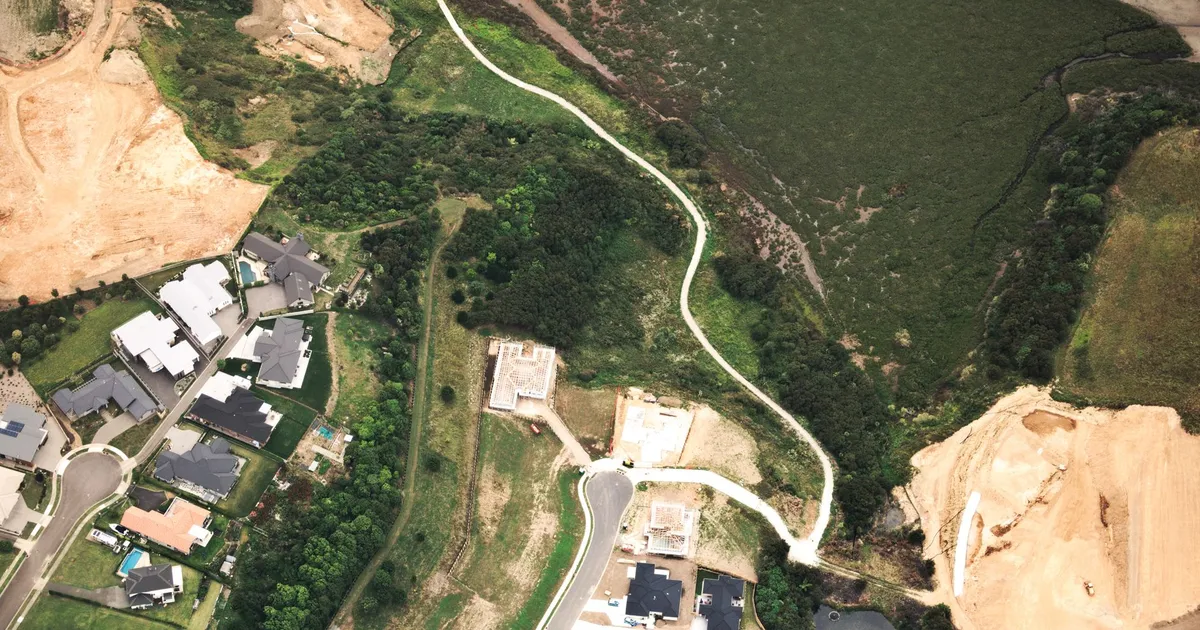
Selwyn district’s population reached 90,800 in the year to June 2026, up 2.9%, more than four times the national rate of 0.7%. The same report shows Selwyn posted the country’s largest net internal migration gain, 1,800 people, and Infometrics puts its GDP growth at 3%, almost double the national figure. Deputy mayor Brendan Shefford’s response to those numbers was telling: “It would be good to get our share of GDP back through roading infrastructure and health from the Government.”
On paper this is the best-performing district in New Zealand, and Stuff’s latest look at the district shows why buyers keep coming. Underneath the headline, though, is a stack of infrastructure invoices that have not been posted yet.
The treatment plant is already full
Selwyn Water has no available capacity at the Pines Wastewater Treatment Plant. By June, construction analyst Mike Blackburn had counted 15 builders told of capacity restrictions, concentrated in Prebbleton and Templeton. One developer was told flatly: “No, we would not approve this resource consent because we have no capacity.” Others bolted on storage tanks or macerator systems, or waited months for sign-off. “Without question, there are capacity constraints,” Blackburn said.
The council’s own water services strategy, cited in the same report, concedes development is exceeding predictions. Existing budgets cover a population of 90,000 to 120,000. Reaching 180,000 to 200,000 would need “substantial additional investment” at Pines. Selwyn has just walked through the bottom of that budget band.
This boom keeps compounding
Nor is this a one-off spike. Stats NZ estimates put Selwyn at 82,000 people in 2023 and 87,600 by mid-2025. Compare Queenstown-Lakes, which briefly took the title in 2023 with 8.0% growth driven by 2,500 net international migrants, ahead of Selwyn’s 5.2%. By 2025 Queenstown-Lakes had cooled to 1.7%.
Selwyn’s growth is different. It is Kiwis leaving Christchurch for sections, schools and space, which makes it stickier and harder to plan around. The strain shows beyond pipes. Back in 2024, RNZ reported that Rolleston College hit its 1,800-student capacity after just eight years, while then-mayor Sam Broughton complained that “all the income, the GST spend and the income tax, that all goes back to central government” while “all those costs are local costs”.
Fast-track adds houses the plan never counted
Central government’s fast-track consenting regime could drop about 8,000 extra houses on top of Selwyn’s 30-year growth plan, many in areas with no planned infrastructure. Councillor Aaron McGlinchy wants targeted rates on those developments: “Our existing ratepayers shouldn’t be paying for that infrastructure if somebody off their own bat chooses to pop up a new subdivision.” The council also estimates that collecting rates from code completion, rather than waiting under current rules, could have raised between $3.75 million and $6.37 million more in 2026/27 alone.
Local Government Minister Simon Watts says the Government’s Going for Housing Growth programme rests on the principle that “growth should pay for growth”. That is the right principle. Fast-track is also the right instinct, because New Zealand needs more supply and fewer veto points. But consenting houses faster than anyone can connect them simply shifts the bottleneck from the planning desk to the pipe. As Blackburn noted, whether the cost lands on developers upfront or via targeted rates, homeowners pay either way.
The national problem Selwyn makes visible
Selwyn has a fair grievance. In 2025 the council highlighted a $2.6 billion gap between taxes raised locally over 10 years and central government investment in the district. But begging Wellington for a cheque is not a funding model.
The 2024 Productivity Commission inquiry found that the failure of high-growth councils to supply enough infrastructure has been a major driver of harmful house price increases since around 2000, and backed user charging so growth can fund itself. Costs are not standing still either. Waikato District, another fast grower, reported that infrastructure construction costs rose 27% between 2021 and 2024, despite holding an AA+ credit rating.
What business should price in
For developers and builders, consent risk in eastern Selwyn is now real and timelines less predictable than in serviced areas. For buyers and businesses, the cheap greenfield section may come with a targeted rate attached. For retailers and commercial landlords, the 3% GDP growth is a genuine opportunity, but only if water and roading capacity keeps pace.
Selwyn’s boom is a success story. Whether it stays one depends on whether council and Government stop arguing over who owes whom and start pricing growth honestly, at the point of consent. The next long-term plan will show which way it goes.
Sources
- The Press: Selwyn still ‘booming’ as population grows more than four times faster than national rate (2026-10-29)
- Stuff: This is NZ’s fastest-growing district. Here’s why so many people want to live there (2026-11-07)
- The Press: The fastest-growing district in New Zealand has a poo problem (2026-06-26)
- Stats NZ: Subnational population estimates at 30 June 2025 (provisional) (2025-10-29)
- Stats NZ: Population growth in all New Zealand regions (2023-10-25)
- RNZ: Selwyn District the fastest growing in NZ (2024-06-04)
- The Press: ‘Growth should pay for growth’: Selwyn looks at targeted rates for fast-track developments (2026-08-12)
- Treasury: Local government funding and financing (Productivity Commission final report) (2024-05)
- Waikato District Council: Council profile report (2025-07-31)
Join the discussion
Add useful context, ask a good question, or challenge an idea — keep it specific and respectful.