

The loan that says more than it costs
A $22 million government loan to a freight precinct in Palmerston North does not, on its face, look like a story. The Regional Infrastructure Fund has $1.2 billion to deploy over three years. Twenty-two million is a rounding error.
But Te Utanganui is not a marginal project. The government’s own 30-year draft National Infrastructure Plan, released in July 2025, identified six Manawatū projects among 17 nationally significant infrastructure priorities and described the Manawatū Regional Freight Ring Road as “one of the most critical enablers of supply chain resilience in New Zealand.” The national road freight association Ia Ara Aotearoa Transporting New Zealand formally backed the broader Greater Manawatū City and Regional Deal in March 2025, projecting $4 billion in infrastructure investment over five years.
So the question is not whether Te Utanganui matters. It clearly does. The question is why a project this important still needs a government loan to get moving.
A precinct with a genuine strategic case
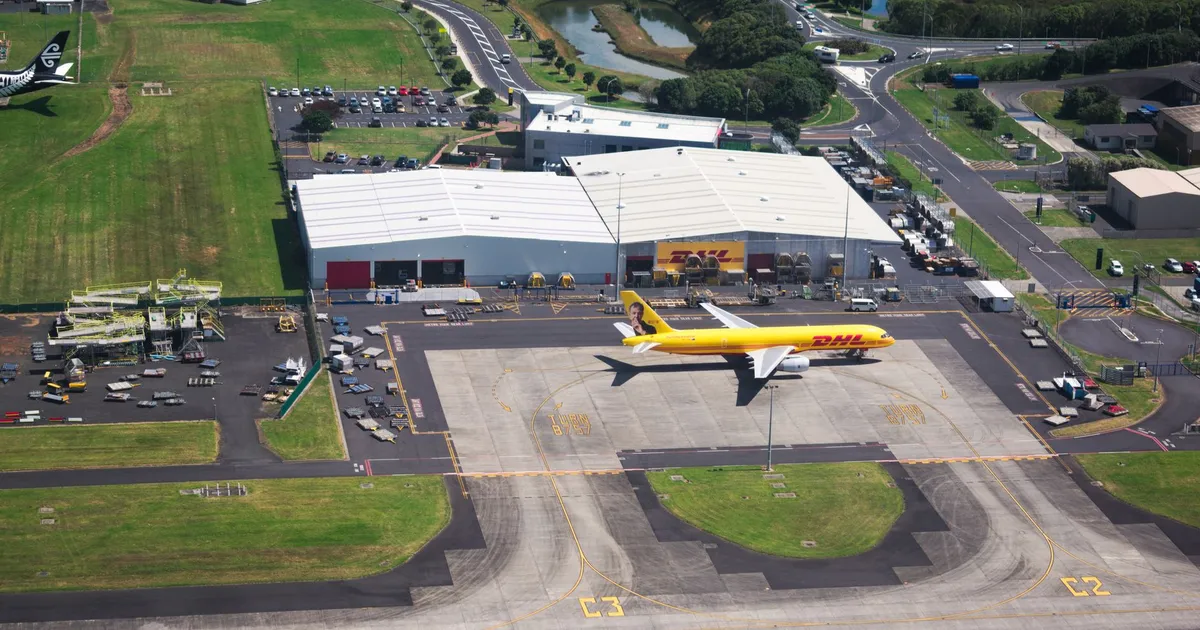
Te Utanganui combines road, rail, and air freight connections, including one of only three 24/7 air freight airports in New Zealand. In November 2023, Palmerston North City Council adopted a masterplan to guide the hub’s expansion to 753 hectares by 2052 across three stages over 30 years. It serves five regions across central New Zealand, from Taranaki to Wellington.
The Chartered Institute of Logistics and Transport has argued that “greater certainty over rail or port investment pipelines could unlock private co-investment in terminals and rolling stock.” That is the theory behind the RIF loan: public money de-risks the project enough for private capital to follow. The RIF’s own investment strategy frames this explicitly as “crowding in” private investment.
On its own terms, this is textbook catalytic investment. The problem is the system surrounding it.
A fund that is already running on fumes
The RIF has $1.17 billion already committed or ring-fenced from its $1.2 billion allocation. The fund is effectively fully subscribed. Some investments are already at heightened risk of default or in default, according to the NZ Herald, with the largest single commitment being a $35 million loan to Wellington’s OpenStar Technologies.
Meanwhile, the national infrastructure pipeline stands at $274 billion as of May 2026, with around $20 billion of initiatives expected to enter construction in the next 12 months. Crown capital investment is projected at more than $61.8 billion over the next five years. The money is being committed. The execution is the problem: only 42.5% of Budget 2025 infrastructure investments were expected to sign contracts within six months of approval.
That is a staggering gap between announcement and shovel.
The structural failure nobody is fixing fast enough
Grant Thornton has warned that “an increasing number of projects are being deferred, descoped or put on hold” and that 67 building consent authorities create systemic inconsistency across the country. A June 2026 BusinessDesk analysis argued that proposed infrastructure funding changes are “a long way from workable,” with councils forced to “say no to growth because the maths does not work.”
The NZ Initiative has concluded that the Infrastructure Funding and Financing Amendment Bill is “directionally correct” but only an optimisation of the current model, not a transformation. Its verdict is blunt: “New Zealand cannot leap directly to a system where investors bear the risk and communities can act on their own initiative. The institutional and cultural distance is too great.”
This is the environment in which a $22 million government loan becomes necessary for a project the government itself calls nationally significant. Private capital is not absent because freight infrastructure is unattractive. It is absent because the consenting, funding, and delivery systems are too fragmented, too slow, and too uncertain for private investors to price the risk.
Smart bet, broken system
The Te Utanganui loan will probably work. The strategic case is strong, industry backs it, and the multimodal freight logic is sound. But every time the government has to lend into infrastructure that should attract private capital on its own merits, it is admitting that the underlying system is not fit for purpose. New Zealand has spent an average of 5.8% of GDP on infrastructure over the last 20 years. The money is there. What is missing is a system that can turn commitment into concrete without the state acting as both cheerleader and banker.
The RIF is nearly empty. The next nationally significant project will need a different answer.
Sources
- $1.2b Regional Infrastructure Fund: Which private companies have benefitted so far
- Investment strategy for the Regional Infrastructure Fund
- Manawatū Projects Play Central Part In New Zealand’s Future Infrastructure Strategy (2025-07)
- Transporting New Zealand Backs Freight-focussed Greater Manawatu City And Regional Deal Proposal (2025-03)
- Distribution hub expansion gains momentum after adoption of masterplan (2023-11-16)
- Cabinet Paper EXP-25-SUB-0095: June 2025 Quarterly Investment Report (2025-10-21)
- Budget 2026 needs to prioritise certainty over stimulus for the construction sector
- What the National Infrastructure Plan means for transport and freight
- Infrastructure funding changes ‘a long way from workable’ (2026-06-08)
- Finance Freedom: Infrastructure Funding and Financing in New Zealand