

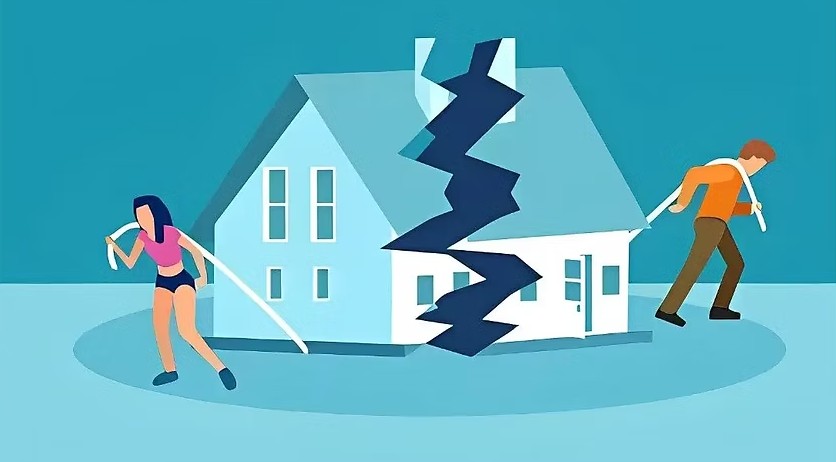
A couple bought a house on Auckland’s North Shore for $2.4 million in early 2022. It’s now worth $1.7 million. They’ve since split up, and there isn’t enough equity left between them to set up two households at the standard of living they once shared.
It’s a story playing out across the country, and it’s hard not to see it as the predictable consequence of years of easy money and government-fuelled property mania finally catching up with ordinary families.
Another couple bought in Hamilton for $850,000. Their home is now worth $670,000. They’ve decided to separate, but they’re stuck underwater on the mortgage, unable to sell even if they wanted to.
A third case involves a person who ran a construction company that went into liquidation six months ago. They’d already decided to separate, and now they’re left with one income, significant debt, and a house that’s dropped too far in value to make moving feasible.
These are three examples cited by divorce coach Bridgette Jackson, of Equal Exes, who says she’s seeing them again and again as separating couples around New Zealand confront the reality of today’s property market. By her estimate, about 60% of her clients end up living together after separation, at least temporarily, simply because there’s no workable alternative.
And the numbers explain why. Since the market peaked in 2021, house prices have fallen roughly 17% nationwide with steeper drops in Auckland and Wellington, the very regions where housing pressure and policy meddling have been most acute in recent years. First-home buyers are finally getting a slightly bigger slice of the pie, which is no bad thing. But for anyone who bought at the top, especially those now forced to sell, the fall has been brutal.
The human cost shows up in plain sight on first-home buyer forums, where people describe situations they never planned for. “In 2021 me and my husband bought our house with a 20% deposit, for a price of $460,000,” one person wrote, before asking whether her husband could sell the house without her consent. Another asked how much longer it was worth hanging on, hoping a market reversal might eventually bail them out.
Jackson notes this isn’t unique to New Zealand; it’s a global problem. But she says the speed and severity of the correction here means Kiwi families are feeling it harder and faster than most. Tellingly, she points out the couples she’s describing aren’t fringe cases or financially reckless people, many are high earners who simply got caught when “the market has simply moved underneath them.” It’s a blunt reminder that no amount of personal responsibility can fully insulate a family from a market this volatile.
According to Jackson, the lack of viable alternatives is the real driver behind why so many separated couples end up staying under one roof. And it’s rarely peaceful. “One of the biggest points of conflict I am dealing with repeatedly is the disagreement over whether to sell,” she said. One partner wants to cut losses and move on. The other refuses to sell into a falling market. The result, she says, is a slow grind: couples trying to hold things together for the kids’ sake until one person simply can’t anymore and walks out with nothing resolved, no agreement, and no plan. “That is when things get messy and expensive. That is when lawyers get involved in the worst possible way.”
Cotality chief property economist Kelvin Davidson adds a data point that confirms just how frozen parts of the market have become: the “days to sell” measure, essentially how long it would take to clear current housing stock at today’s sales pace, is running higher than normal. He suspects it’s even worse in the owner-occupier and mid-to-upper market segments, since movers are less active than usual right now. People are simply staying put, which shrinks the buyer pool for anyone who needs to sell, including separating couples who have no choice in the matter.
For those trying to cohabit through a separation, Jackson says clear written boundaries and house rules are essential. For those going it alone, a real financial strategy is non-negotiable.
She also points to a noteworthy shift: more women are leaving relationships because, in her words, they’re “done carrying the load.” Many of these women sacrificed career progression during the relationship and are now trying to re-enter the property market as single-income buyers, in what Jackson calls the worst property environment in decades. She’s also seeing a rise in older couples separating, people in their 50s, 60s and 70s who’ve decided they don’t want to spend their remaining years unhappy, even though they have far less time and financial runway to recover, especially with their home equity down by a third.
Jackson’s bottom line is straightforward and arguably the only sensible takeaway here: “The housing market is not going to fix this for anyone, and you cannot control it. But how you respond is within your control.”
Paul Sumich, a real estate salesperson at Harcourts, backs this up with what he’s seeing on the ground. In roughly 70% of the separations he handles, both parties want to buy the other out and simply can’t afford to. “There is frustration around that as both have to start again,” he said. He’s blunt about the practical reality: staying together after deciding to split is difficult, particularly with children involved. His advice is simple: see if one party can buy out the other, and if that’s not possible, list the property and move forward. “The potential money lost hits both people, but dragging it out is worse.”
What this story really lays bare is the cost of a housing market that was allowed to run too hot for too long, leaving ordinary, hard-working New Zealand families to absorb the fallout in their most vulnerable moments. The market didn’t ask these couples whether they were ready for a correction. It simply arrived, and they’re the ones left sorting through the wreckage.