

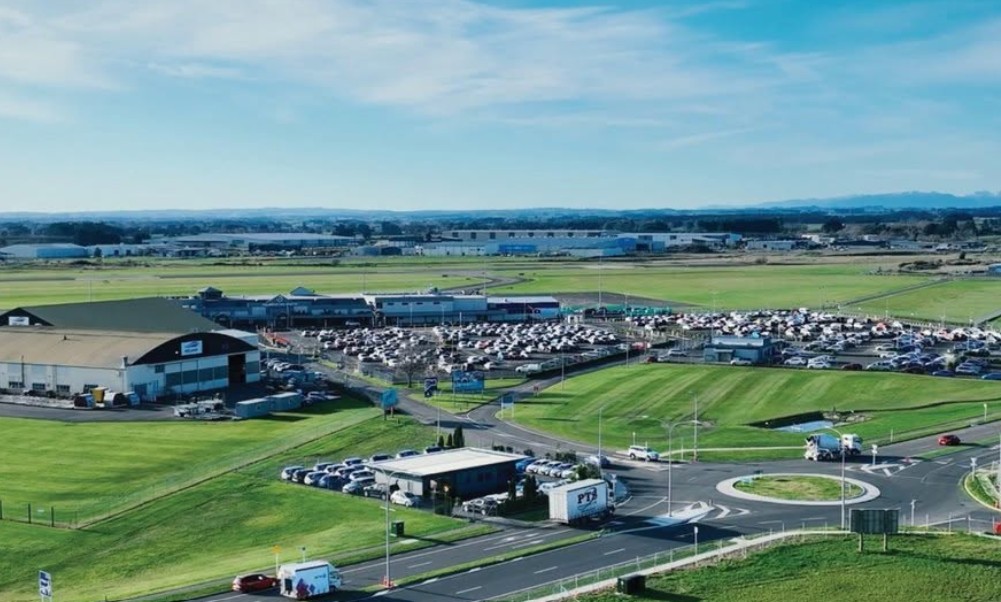
A $22.4 million loan from the Regional Infrastructure Fund is being put forward as the key to unlocking the next stage of Manawatū’s Te Utanganui precinct, and it’s hard to argue the money isn’t earning its keep.
The government has confirmed the funding will go toward developing the next stage of the precinct, part of a $2.6 billion project to connect freight across the lower North Island by air, road, rail, and sea. The hub is expected to be completed by 2050.
Central Economic Development Agency (CEDA) chief executive Jerry Sherman didn’t mince words about how critical the loan is. Without it, the agency driving the project would have been stuck going cap-in-hand to its own shareholders and stakeholders just to fund a business case and, eventually, construction of a rail link connecting Palmerston North Airport to Bunnythorpe.
“This is pretty vital,” Sherman said. “For an economic development agency to drive this work ahead would require us to invest money that we’d have to go back to our shareholders to request or to the stakeholders in this project. That wouldn’t be palatable, so this investment from central government, even as a loan, is quite critical.”
It’s worth noting this isn’t a handout dreamed up in a vacuum, there’s already real private-sector buy-in. Supermarket heavyweights Woolworths and Foodstuffs are among the businesses already connected to the hub, alongside primary sector industry, proving the project has commercial weight behind it rather than just political ambition.
Sherman expects the business case and detailed design for the rail link to be finished within 18 months to two years. He described the agency as “pretty bullish” about pushing the project forward, with spades potentially in the ground by 2030 if things go to plan.
The wider scheme breaks down into nine key components, including a ring road, the rail hub itself, and future land development, and that last piece is already drawing attention from offshore. “We’re even in discussions with a group out of Australia around a data centre, so there’s plenty of interest in the project, but it’s a 25-to-30-year project to full completion,” Sherman said.
KiwiRail executive general manager of property Anna Allen framed the broader regional freight hub as a long-term investment meant to serve the central and lower North Island’s freight needs for decades to come, the kind of generational infrastructure thinking that doesn’t happen without someone willing to put skin in the game early.
Regional Development Minister Shane Jones was blunt about why central government stepped in: the $22.4m keeps the project on schedule and tackles an infrastructure gap he says has been “constraining economic growth” in the lower North Island. Jones pointed out that early-stage infrastructure is expensive and that this kind of public backing is what gives the private sector the confidence to actually invest.
The payoff, according to Jones, isn’t abstract either. 100 to 300 jobs are expected to be created during the freight hub’s early works, a tangible return for taxpayers on a loan designed to grease the wheels of an economy hungry for investment.