

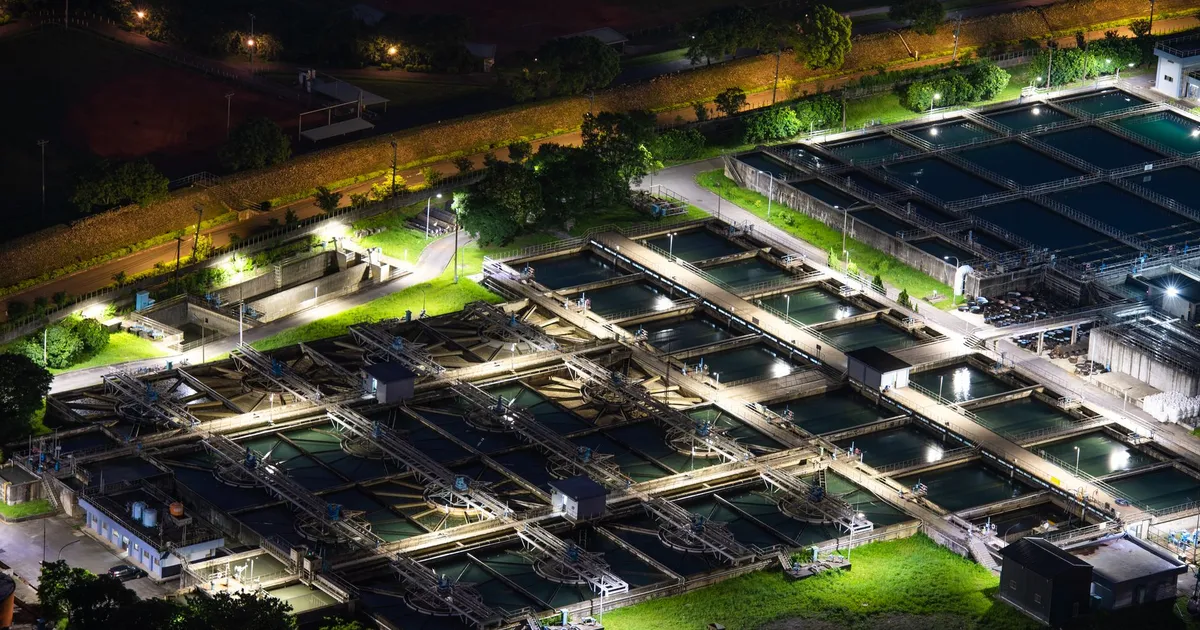
Wellington’s Moa Point wastewater plant is finally running again. After the February failure that sent untreated sewage into Lyall Bay and Cook Strait for nine months, the restart is real progress and deserves to be called that. But the end of the operational crisis is the start of the financial one. Wellington City Council and Tiaki Wai each face criminal charges carrying a theoretical maximum of $100 million, and nobody has yet settled who should pay.
The plant is back, slowly
Tiaki Wai chief executive Michael Brewster was careful not to overclaim. “Today’s restart is an important step, but it is not the end of the recovery,” he said this week. Re-establishing biological treatment takes weeks, and the restart itself slipped a day or two while the ventilation system was commissioned.
The numbers explain the caution. By the time of the restart, more than 14 billion litres of untreated wastewater had been discharged. Full treatment is targeted for February 2027, and full hydraulic capacity, including bypass and outfall upgrades, is not expected until late 2027 or 2028. Wellington is fixing a broken plant, not yet a resilient one.
A tougher law meets a public defendant
In September, Greater Wellington Regional Council laid 10 charges each against the city council and Tiaki Wai, covering alleged unlawful discharges and breaches of an abatement notice both during the UV upgrade from October 2025 and after the February collapse.
The scale comes from a 2025 Resource Management Act amendment that lifted the maximum fine per charge from $600,000 to $10 million. Moa Point is one of the first big tests of that regime, and the defendant is not a negligent factory owner but a council and its water entity.
Greater Wellington director Fathima Iftikar’s position is principled: “No matter how important the service, or who owns or operates it, the obligation to comply with environmental law remains the same,” she said. The regulator gathered more than 1,000 documents and commissioned expert advice before charging. Private businesses held to the same standard would expect nothing less.
Public money chasing its own tail
The problem is where the money goes. The Post’s analysis tallies $53 million in repairs and $438,000 for the Crown Review already spent, and notes that 90% of any fine would go to Greater Wellington itself, a council slated to be disbanded under local government reform. Money would leave an entity that needs every dollar for repairs and a stretched city council, and land with a regulator that won’t exist for long. Ratepayers pay either way.
Mayor Andrew Little told Mike Hosking it was “highly unlikely” any fine would approach $100 million, and that lawyers would need to work out where responsibility actually lies. He is probably right on the first point. Judges are unlikely to impose crippling penalties when the only effect is shuffling public money. That is the uncomfortable lesson for the tougher RMA regime: $10 million a charge is a real deterrent for a private company, and close to a book entry for a public one.
Accountability spread too thin
The deeper issue is the one the Crown Review exposed: years of systemic governance failures across Wellington Water and the city council. Responsibility was split between asset owner, council-controlled organisation and contracted operator Veolia, which ran the plant but was not doing the upgrade work. No other party has been charged at this stage.
Green infrastructure spokesperson Julie Anne Genter argues the failure is “a public-private partnership disaster by design”, citing “fragmented accountability, lack of oversight, loss of institutional knowledge” and wants operations brought in-house. Her diagnosis of blurred lines is fair. Her cure is less convincing. Wellington Water was a fully public entity and still oversaw the decline. The failure was not that a private contractor was involved; it was that nobody owned the asset’s condition clearly enough to be held to account before it broke.
What business should watch
For Wellington firms, the exposure is practical. Any settlement or fine lands in rates or in Tiaki Wai’s funding base, competing with the capital spend the network still needs. Hospitality and tourism operators around the south coast have already absorbed months of closures and reputational damage.
Nationally, the case is a template. Water reform is creating new entities across the country, and Moa Point shows what happens when contracts, ownership and oversight don’t line up. The court will eventually settle the fines, and probably at a fraction of the headline number. The more valuable outcome would be water entities designed so that the next failure has a name attached to it before it happens, not a prosecution after.
Sources
- NZ Herald: Wellington’s Moa Point wastewater treatment plant back up and running after February disaster (2026-11-13)
- NZ Herald: Moa Point disaster: Wellington sewage treatment plant to restart this week (2026-11-10)
- Tiaki Wai: Report to Minister Watts – Response to Crown Review into Moa Point (2026-09-30)
- NZ Herald: Moa Point disaster: Greater Wellington lays charges against city council and Tiaki Wai (2026-09-30)
- The Post: Wellington ratepayers face coughing up millions in fines as Moa Point charges laid (2026-09-30)
- Greater Wellington: Greater Wellington lays charges over Moa Point wastewater discharges (2026-10-01)
- Greater Wellington: Media pack – Greater Wellington lays charges over Moa Point wastewater discharges (2026-10)
- The Post: Moa Point sewage spill: Council-on-council charges necessary – but still nuts (2026-10-01)
- Newstalk ZB: Andrew Little on Greater Wellington Regional Council filing charges for the failures at Moa Point (2026-10-02)
- The Post: Moa Point is a public-private partnership disaster by design (2026-10-04)
Join the discussion
Add useful context, ask a good question, or challenge an idea — keep it specific and respectful.