

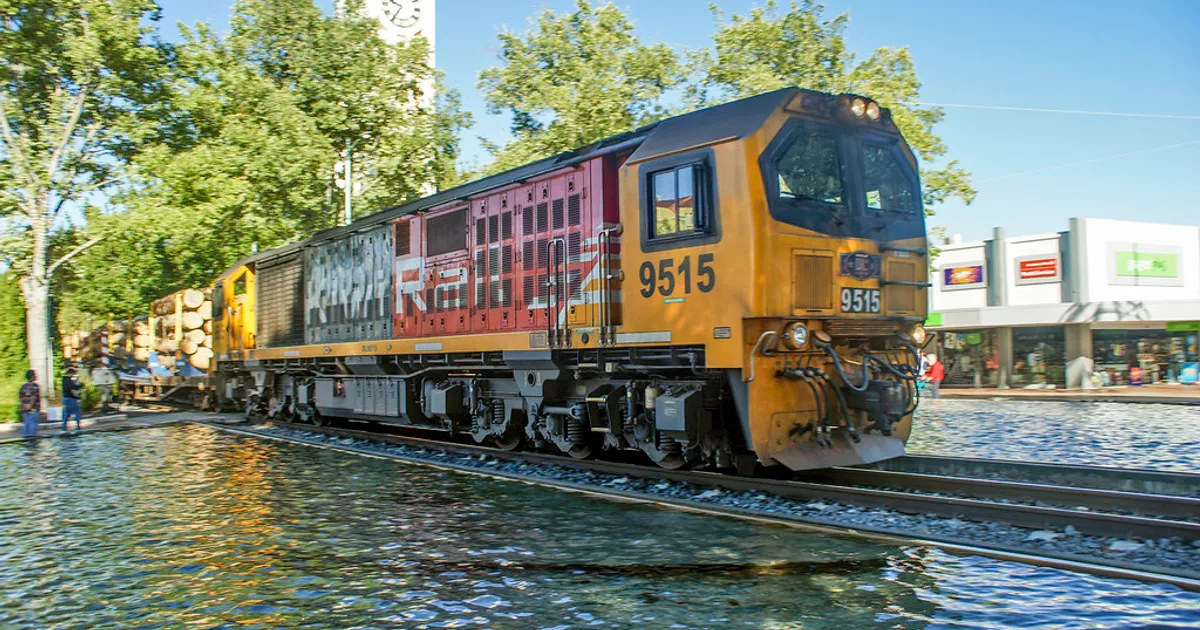
New Zealand has poured more than $3.6 billion of Crown money into rail over the past 15 years. Private operators have tipped in hundreds of millions more. And now, in the middle of the sharpest diesel price shock in the country’s recent memory, the rail network cannot flex to absorb freight that is becoming ruinously expensive to move by road.
Mainfreight CEO Don Braid made the point directly in an RNZ Morning Report interview, expressing frustration that neither KiwiRail nor Auckland Transport is stepping up services to help freight operators manage the crisis. This is not a complaint from the sidelines. Mainfreight has committed $60 million to railhead depot investment and is one of KiwiRail’s anchor commercial customers. When the network’s biggest advocate says the system is not performing, the rest of the freight industry is thinking it louder.
The arithmetic is punishing
The Middle East conflict that erupted in late February has driven diesel prices up more than 85% in five to six weeks. By late March, the average price hit $3.27 per litre, more than 50 cents above the 2022 Ukraine war peak that was itself a record.
National Road Carriers Association general manager James Smith laid out the maths: New Zealand burns roughly 11 million litres of diesel daily, meaning the price increase costs the economy approximately $14 million per day, with $7 million of that falling on trucks alone. For operators, fuel has overtaken labour as the single biggest cost, now accounting for 30% of operating expenses, up from 8-10% before the conflict.
NZ Trucking Association CEO David Boyce warned that operators “run pretty lean and mean on their pricing” with almost no room to absorb the increase. Since more than 90% of New Zealand freight moves by road, every surcharge flows straight through to consumer prices.
The alternative exists on paper
This is precisely the scenario where rail should prove its worth. The Crown invested over $2.1 billion in KiwiRail between 2008 and 2016, followed by a $1.56 billion Rail Network Investment Programme for 2021-24. Fonterra has put $130 million into rail hubs in Hamilton and Mosgiel. These are not theoretical assets. They are physical infrastructure that should be generating resilience value right now.
Mainfreight is already advising customers that longer lead times enable use of rail, coastal shipping, and sea freight to reduce per-shipment costs. The modal alternatives exist. They are simply not available at scale when operators need them. Even Braid admitted in the FY2024 results that Mainfreight “could have perhaps used rail more than road”, a candid acknowledgement that even committed rail customers default to trucks when the service is not competitive.
A government narrowing the network at exactly the wrong time
The Government Policy Statement on Land Transport 2024 directs rail investment toward the Auckland-Hamilton-Tauranga corridor, the so-called Golden Triangle. Braid has pushed back publicly: “There’s an enormous amount of freight that travels by rail across the width and breadth of the country.”
Then there is Cook Strait. If rail-enabled ferries are not part of the replacement fleet, Mainfreight alone would need 5,700 additional truck and trailer journeys annually. Braid has warned that without rail ferries, “you’d almost have to say the total rail network is vulnerable” because disconnecting the two islands destroys the commercial viability of both networks.
The government’s argument, that investment should concentrate where returns are highest, is fiscally sound in normal conditions. But this is not normal. New Zealand has no domestic refining capacity since Marsden Point closed in 2022, around 20% of world oil passes through the Strait of Hormuz, and diesel stock sits at just 46.4 days with a large share still on the water. The case for freight resilience is not hypothetical. It is playing out in real time.
Listen to the people moving the freight
Braid drew a direct parallel with the pandemic: “When the Government finally involved business to understand what was happening at the coalface, then we found remedies and answers. I’d urge this Government to do that.”
This is not an argument for throwing more money at KiwiRail. It is an argument for extracting value from what has already been spent. Billions of dollars of rail infrastructure, public and private, should be absorbing exactly the kind of shock that is currently hammering every business that moves goods. That it cannot do so is not a fuel problem. It is a management and policy problem, and every day it persists costs the economy $14 million.
Sources
- RNZ Morning Report: Mainfreight CEO frustrated at KiwiRail, Auckland Transport
- NZ Herald: Mainfreight says it should have done better, frets about government’s intentions for rail
- NZ Herald: Diesel price surge – freight firms add fuel surcharges as costs jump $14m a day
- NZ Herald: Transport giant Mainfreight wants rail on new Interislander ferries
- News Anyway: Diesel price NZ – How a war in the Middle East made NZ pumps the most expensive in recent memory
- 1News: Willis outlines worst-case scenario for NZ if Middle East war drags on
- NZTA: New Zealand Rail Plan
- Wikipedia: KiwiRail
- RNZ: Fuel costs could drive New Zealand trucking businesses to the ground
- TRANSPORTtalk: Mainfreight flags cost pressures as diesel prices surge
- RNZ: New Zealand prices of anything attached to fuel will rise, logistics boss warns