

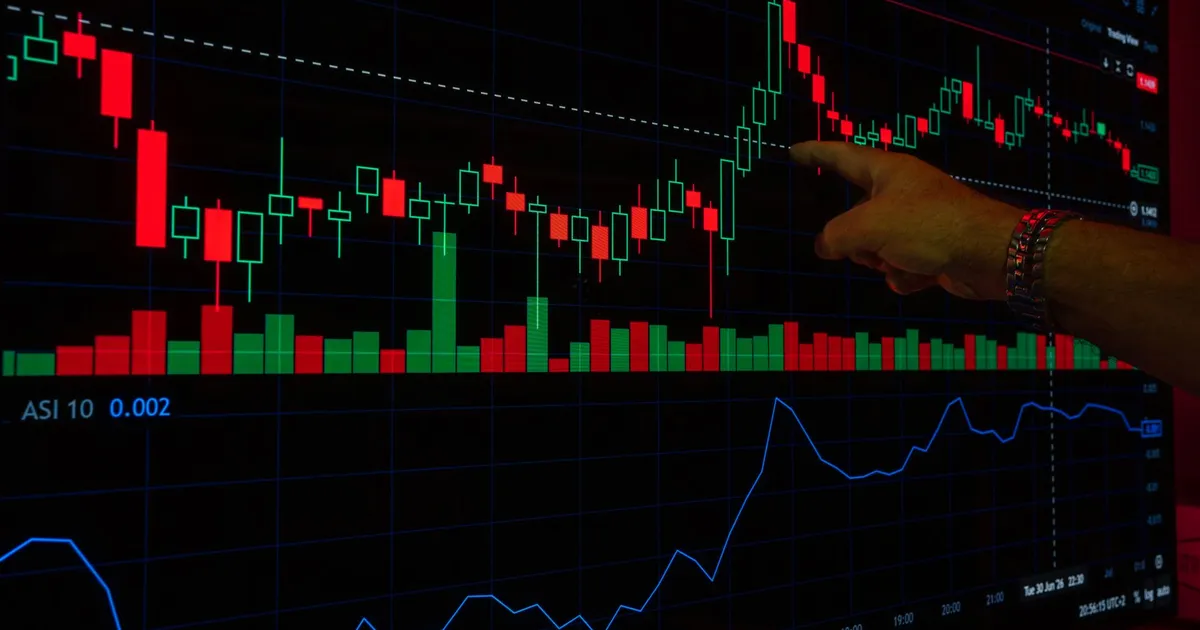
The Nasdaq fell 6.3% on Thursday, erasing more than US$2 trillion in market value after anti-AI candidates won seats in the US midterms. By Friday the worldwide selloff in AI stocks had steadied. That pause does not settle anything.
What the week proved is that a political result in Washington can move the retirement savings of almost every working New Zealander, without anything changing in the domestic economy. For business owners, directors and anyone running a workplace scheme, that is no longer an abstract portfolio question. It is a governance one.
Offshore exposure is the default setting
KiwiSaver is now a large, mostly offshore pool of capital. Reserve Bank data shows total assets reached $155,055 million in June 2026, with $95,115 million, or 61%, held overseas. Overseas equities and trust units alone account for $69,044 million.
The risk dial has also turned up. The FMA’s latest annual report shows growth funds now hold 49% of KiwiSaver assets, or $68 billion, up from 47.5% a year earlier. Balanced funds slipped to 27% and conservative funds to 15%.
This has been building for years. FMA research published in 2025 found the share of funds in the highest-volatility risk category quadrupled between 2021 and 2024, from around 10% to more than 40%. Money in those funds rose from $6.8 billion to $51.5 billion over the period, helped by the 2021 decision to move default members out of conservative funds and into balanced ones.
That shift was sensible policy. Young savers parked in conservative funds for decades were leaving serious money on the table. But higher growth allocations today mean more global equities, and global equities now mean a small number of very large American technology companies.
How much tech sits in the top ten
RNZ’s analysis of the top-10 holdings of high-growth funds found wide variation. Milford’s aggressive fund held 26% in tech names such as Nvidia, Microsoft, Apple and Broadcom. Generate’s focused growth fund held 22.5%, Quay Street 21.6%, Kernel 20.16%, Simplicity 19.4% and Pathfinder 17.5%. Kernel founder Dean Anderson argued the volatility reflected speculation about what a Democratic Congress might do, and that the answer was diversifying beyond US-only exposure.
The passive point matters most. Index funds do not choose to own more tech. They own more because tech has become a bigger share of the index. Members of a passive fund are effectively buying more of the AI trade the more expensive it gets.
Milford paid for being careful
The cost of resisting that trend is real. Milford’s long run at the top of the KiwiSaver tables ended because it stayed underweight as gains concentrated in a handful of mega-caps. Chief investment officer Wayne Gentle cited concentration, geopolitics, inflation and debt as reasons for caution. Head of KiwiSaver Murray Harris noted Nvidia makes up about 9% of the relevant index, against Milford’s 3 to 3.5% holding. Over 10 years, its active growth fund captured 91% of market gains but only 77% of the falls.
That is the trade-off in plain numbers. Caution costs you in a melt-up and pays you back in a rout. Neither side is obviously wrong, which is precisely why it should be a deliberate choice rather than an accident of index construction.
The bull case is not foolish
There is a credible counter-argument. Aurellan has made the case in Businessdesk that New Zealand equities, listed property and cash have provided ballast during tech drawdowns, and that today’s giants are far more profitable and cash-generative than the speculative firms of the dot-com era. That is fair. Nvidia is not Pets.com.
Fisher Funds has taken a more cautious view, arguing that AI-fuelled exuberance has left benchmarks driven by a handful of richly valued stocks. Both can be true. Strong businesses can still be priced for perfection.
What boards and employers should be asking
Nobody should be switching funds on the back of one bad Thursday. That is how savers lock in losses. The better questions are structural. Do members in default and growth funds understand how concentrated their underlying exposure has become? Are providers disclosing look-through sector weightings clearly, not just top-10 lists? And are trustees making active decisions about concentration, or simply inheriting whatever the index hands them?
The Reserve Bank’s next KiwiSaver asset release is due on 26 November, and it will show how much of this quarter’s swing landed in Kiwi balances. Whatever the number, the lesson stands. New Zealand built a compulsory-feeling savings system and pointed it at Wall Street. That was mostly the right call. Now the people overseeing it need to own the consequences.
Sources
- Stuff: Worldwide selloff AI stocks halts other US stock (2026-11-07)
- RNZ: How exposed is your KiwiSaver to market wobbles? (2026-11-06)
- RNZ: Tech stocks end long-time top KiwiSaver performer’s golden run (2026-10-30)
- FMA: KiwiSaver Annual Report 2026 (2026)
- FMA: Increased risk profile of KiwiSaver funds 2021-2024 (2025-07-16)
- Businessdesk: Aurellan ponders KiwiSaver’s growth-assets exposure
- Fisher Funds: All aboard the AI train?
Join the discussion
Add useful context, ask a good question, or challenge an idea — keep it specific and respectful.