

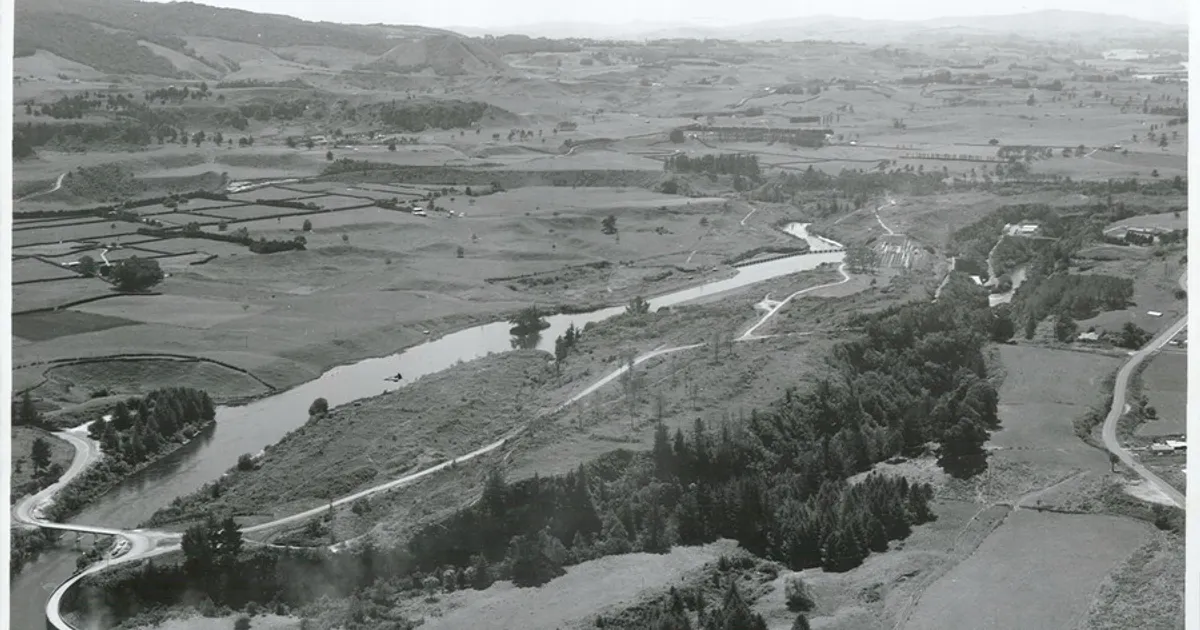
The Waikato River’s hydro dams were supposed to be the line the gold clam could not cross. That assumption is now dead. Biosecurity New Zealand has confirmed the clams at Ātiamuri Hydro Station, the first detection outside the controlled area that runs upstream from Whakamaru Dam.
Ätiamuri sits above both the Maraetai and Whakamaru dams. For the first time since the clam was found at Bob’s Landing near Lake Karāpiro in 2023, it has moved up through the hydro lakes. What was a biosecurity nuisance is now an infrastructure problem with a growing footprint.
Nobody can explain how it got there
Officials admit they do not know the pathway. Because dams are a physical barrier, the most likely explanation is a boat, waka or piece of gear moved from the lower river without being checked, cleaned and dried.
“Juvenile clams can be smaller than a grain of sand. You don’t necessarily have to see one to spread one,” National Corbicula Programme Manager Lisa Hardegger says.
That is precisely the problem with a containment strategy built on voluntary behaviour. If the threat is invisible, asking people to look for it has obvious limits. Yet no specific restrictions apply to ballasted boats on this stretch of river, even though ballast tanks are flagged as a high-risk vector capable of holding water full of juvenile clams.
The system was slow from the start
This is not the first sign of a sluggish response. Back in 2025 the Waikato River Authority complained that “we should have heard about this way earlier”, arguing the clam had received a lighter response than agricultural pests. Corbicula was not on the country’s biosecurity watch lists before it turned up in 2023, and at that point still was not on the notifiable species list.
A pest that was classified late, contained by goodwill and now found beyond its boundary is not a story of bad luck. It is a story of a regulatory system that underweighted an economic threat because it looked like an environmental one.
The bill lands on whoever owns the pipes
The biology explains why. In 2024, officials noted a single hermaphroditic clam can produce around 400 juveniles a day and up to 70,000 a year. By then Watercare had already spent close to $100,000 since 2023 keeping the clams away from its Waikato Water Treatment Plant.
Mercury runs nine hydro stations on the river, and by 2025 the clam had been detected in three of them, Karāpiro, Maraetai and Waipapa. At the time, Mercury’s then-head of generation operations Matt Kedian said the clams had “not caused any damage or increased frequency of maintenance activities”. That was reassuring, but it described the start of the curve, not the end.
The stakes were spelled out in 2023, when Mercury’s then-environment manager Gavin Williamson told MPs that a 1% drop in output at Karāpiro alone would equal the annual electricity use of 4,000 homes. Newsroom also reported that larvae can slip through intake filters, and that even dead clams leave shells glued to pipes, forcing machinery to be stripped, cleaned and reassembled far more often than normal.
In 2023, WSP’s then-technical principal for ecology Emily Jones warned that “the greatest risk is that the clams could clog in-water infrastructure”, noting the species has clogged nuclear plant cooling intakes in the United States. She urged asset owners to install sentinel screens or plates ahead of key infrastructure, and said manual scraping or pigging is usually the best removal method, cautioning that overseas heat and chlorine treatments do not necessarily translate to local conditions.
Eradication was never on the table
In 2025, Ian Duggan, then a University of Waikato invasion biologist, said eradication “was impossible”, pointing out it has never succeeded anywhere the clam has invaded. That makes the Ātiamuri breach more serious, not less. The only lever left is slowing the spread, and that lever has just slipped.
Tūwharetoa Māori Trust Board chief executive Rakeipoho Taiaroa says the board wants to “understand the extent of this incursion” and ensure tangata whenua are involved in decisions affecting their waters. With Ātiamuri sitting on the path towards Taupō, that concern is shared by every tourism and boating operator upstream.
What river businesses should do now
Any firm moving boats, dive gear, irrigation kit or machinery around the catchment carries real exposure. It is illegal to knowingly move the clams or water containing them, and a contractor traced as the source of the next jump would wear the reputational damage.
Asset owners should treat sentinel monitoring as routine maintenance, not a science project, and start pricing a higher cleaning cycle into budgets. Tourism and recreation operators should assume the voluntary era is closing. If check, clean, dry cannot hold the line, mandatory ballast rules and tighter movement controls are the logical next step, and it is better to shape them now than to have them imposed after the clam reaches Taupō.
Sources
- RNZ: Invasive clams spread outside Waikato River’s controlled area (2026-11-27)
- Scoop: Invasive Freshwater Clams Detected At Ātiamuri Hydro Station, Outside Waikato River Controlled Area (2026-11-27)
- Scoop: River Users Urged To Be Vigilant After Gold Clam Found At Ātiamuri (2026-11-29)
- NZ Herald (Waikato News): Freshwater gold clam detected at Ātiamuri Hydro Station outside controlled area (2026-11-29)
- NZ Herald (Rotorua Daily Post): Freshwater gold clam detected at Ātiamuri Hydro Station outside controlled area (2026-11-29)
- Newsroom: Golden clam infestation calls biosecurity priorities into question (2025-03-31)
- Otago Regional Council: Environmental Implementation Committee 7 November 2024, Corbicula fluminea update (2024-11-07)
- Waikato Times: A clam-filled future for the Waikato River (2025-04-11)
- WSP: Infrastructure owners urged to watch for invasive clam (2023-07-19)
- Tūwharetoa Māori Trust Board: Gold Clam Discovery Raises Alarm for Taupō Moana & Waikato River (2026-11-28)
Join the discussion
Add useful context, ask a good question, or challenge an idea — keep it specific and respectful.