

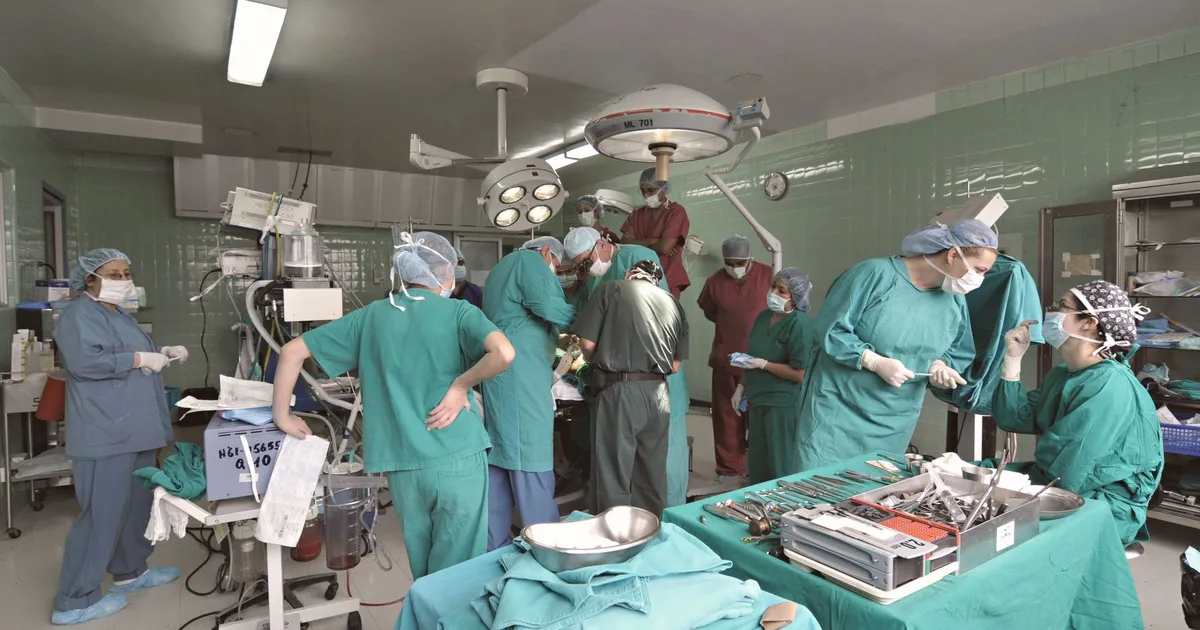
Forte Health’s $100 million expansion is nearing completion on Christchurch’s Kilmore St, taking the private hospital from five operating theatres to nine and from 22 beds to 61. Read it as a property story and you miss the point. This is private capital building surgical capacity that the public system increasingly leans on, and doing it with its own money.
Four more theatres and an overnight stay
The new building shifts what Forte can actually do. Dr Ian England, chief executive of the $1.1 billion Allevia Hospitals, which half-owns Forte’s operator, says the project responds to growing demand. “This changes the hospital from being short-stay to one where patients will be able to stay one to two nights,” he told the Herald.
That means spinal, joint, urology, general and radiology services, plus a special care unit for complex, longer-stay work such as joint replacements, bariatric and cancer surgery. These are precisely the procedures that clog public waitlists. Mainland Capital owns the property under a 30-year lease, Naylor Love is building it, fit-out starts early 2027 and the addition is due to open later that year.
The price tag grew on the way
One number deserves a closer look. When Forte announced the facility in June 2025, it put the cost at more than $60 million. Seventeen months later the project is reported at $100 million, roughly two-thirds higher. The public material doesn’t break down whether that reflects scope creep, construction inflation or simply a broader accounting basis that includes fit-out and equipment.
It matters, because cost escalation of that size would sink plenty of public projects in a funding round. Here the capital is still flowing, which says something about how confident the backers are in the demand on the other side.
Full before the paint dried
That confidence has history. Forte opened its fifth theatre in January 2025, adding room for 1800 more surgeries a year, a 25% lift. At the time, then-chief executive Michael Woodhouse said the hospital would “very quickly be full again” because demand for theatre time was extremely high.
Crucially, Woodhouse said in 2025 that the case for expansion wasn’t reliant on publicly funded cases. That is the right way to underwrite a hospital. Insured and self-paying patients carry the base load, and public contracts become upside rather than a dependency on the whims of a cash-strapped Health NZ.
A public system running short of theatre time
The upside is real, though. As at June 2024, almost 3000 people had waited more than a year for public surgery, while Health NZ’s savings target had crept to $2 billion. Health NZ data to 2023 showed publicly funded inpatient surgeries done privately had doubled since 2015 to 12%.
This is not ad hoc. A Health NZ Official Information Act release from May 2025 laid out internal advice and modelling on outsourcing electives, confirming private capacity is now a planning lever, not an emergency valve. Whatever either side says publicly, hospitals like Forte are structurally embedded in how the public system keeps waitlists moving.
Doctors are putting their own money in
The funding model is telling too. Mainland Capital’s earlier capital raise for the project was pitched largely at medical professionals and people connected to the sector, and was reportedly oversubscribed. When surgeons back the bricks they operate in, they are telling you how they read the public pipeline.
The equity question is real
None of this is costless. In 2024, health systems expert Professor Robin Gauld warned the common sentiment was that the public system “is not going to provide for you unless you have a high priority case”. His research found the chance of a public referral being declined was rising about 5% a year, while outsourcing sat at roughly 10% of publicly funded electives.
That is a fair critique of a two-tier drift. But the answer isn’t to resent private investment. It is for Health NZ to buy capacity smartly, on longer contracts with clear volume and price terms, rather than scrambling for theatre slots each winter. Taxpayers get surgery faster, and operators get the certainty to keep building.
Auckland is next
The Herald also reports Allevia has separate plans for new theatres at its Epsom facility in Auckland. That turns Forte from a Christchurch project into the leading edge of a national pattern. For employers watching staff sit on waitlists, for insurers pricing cover and for investors hunting defensive assets, the signal is the same. Private capital has decided surgical demand is structural, and it is pouring concrete accordingly. The open question for 2027 is whether the public system plans around that capacity or keeps renting it at the last minute.
Sources
- NZ Herald: Christchurch private hospital Forte Health’s $100m expansion: From five to nine operating theatres (2026-11-05)
- Forté Health: Forté announces new hospital facility (2025-06-16)
- Forté Health: New theatre opens with new jobs and increased surgery capacity (2025-01-12)
- Hospital Management: Forté Health opens operating theatre to boost surgery capacity (2025-01-13)
- The Press: A ‘widening gap’: Private hospitals grow while public sector struggles to keep up (2024-11-22)
- The Press: Space for another 1800 surgeries in Christchurch after hospital’s expansion (2024-10-16)
- BusinessDesk: Mainland Capital delivers $50m raise for Christchurch private hospital expansion
- The Post: Reading the (waiting) room: Private hospitals grow to meet demand (2024-11-15)
Join the discussion
Add useful context, ask a good question, or challenge an idea — keep it specific and respectful.