

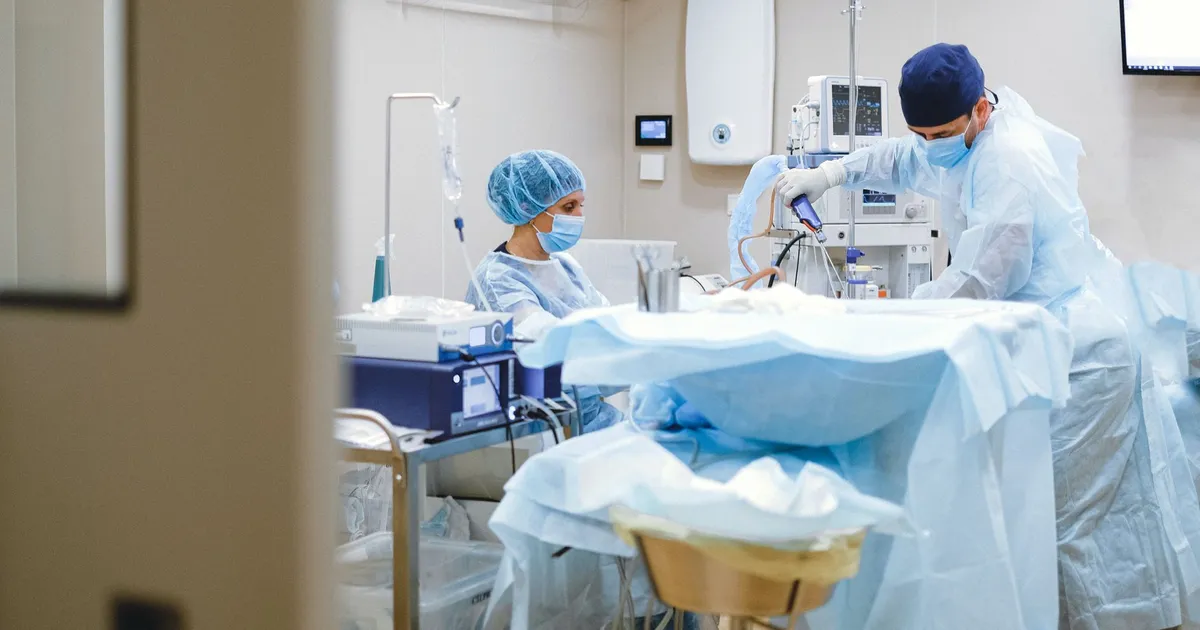
The building that once housed One NZ’s national headquarters at Smales Farm is being turned into a surgical hospital. Evolution Healthcare will spend $52 million converting 5000sq m of the site into a new home for Shore Surgery Specialist Hospital, with six theatres, short-stay beds, a sterilisation hub and space set aside for future inpatient beds and radiology. It is one piece of a $526 million national programme covering eight projects that are recently completed, under way or about to start.
This is private money building physical capacity at a time when the public system is struggling to keep pace with demand. For business owners whose staff are waiting months for a hip or a hernia repair, that matters.
Offices out, operating theatres in
The location was chosen with care. Smales Farm sits in a designated medical zone directly across the road from North Shore Hospital, near urgent care, imaging and a pharmacy. Evolution is building next to existing public infrastructure rather than competing with it. Work starts soon and is due to finish by the fourth quarter of 2027. The existing Shakespeare Rd site will stay open.
The wider programme includes the $185m Wakefield Hospital upgrade in Wellington, completed in 2025, and a further $33m Wakefield expansion that adds three digital theatres and an endoscopy suite by early 2027.
The state became the anchor customer
The capital is flowing because the demand is guaranteed. Private hospitals were already doing nearly 70 percent of elective procedures by early 2025, about 224,000 operations a year, most of them under Health NZ or ACC contracts. Health Minister Simeon Brown’s Elective Boost then turned spare private theatre time into policy. In January 2026, the Herald reported that Brown had directed Health NZ to outsource whatever volume was needed to hit targets, with five-year contracts to start and deals of up to ten years to follow. The target is 95 percent of patients waiting less than four months by 2030. At that point just over 60 percent met the measure.
Long contracts make a $52m fit-out a sensible investment. That is how infrastructure normally gets financed, and it is a sensible use of a market that already exists.
Public hospitals are consumed by acute demand
The public system is not idle. It is full. The Health and Independence Report 2025 shows ED presentations rose 5.3 percent to 1,467,543, with only 73.9 percent of patients seen within six hours. Acute bed-days climbed from 72.7 percent of all hospital bed-days in 2020 to 76.1 percent in 2025. Each extra acute bed-day leaves less room for planned surgery. Population growth was only 0.7 percent, so the pressure comes from ageing and more complex conditions rather than headcount.
Money is not the only constraint. Vote Health reaches $33.031 billion in 2026/27, up 8.4 percent, and capital appropriations total $3.731 billion. In March 2026, Westpac’s analysis noted that public investment was largely focused on maintaining existing services rather than expanding capacity. Economist Paul Clark argued at the time that partnering lets public hospitals focus on “more acute and life-saving care” while fast-turnaround electives shift to private providers.
That is the right division of labour. Taxpayers pay for procedures, and private balance sheets carry the building risk.
The transparency problem is real
The model still has weaknesses, and supporters of the approach should say so. In 2025, Health NZ refused to disclose what it pays private hospitals under the national contract. A Deloitte study found outsourcing costs had nearly doubled from $162m to $317m since 2019. Three companies, Southern Cross, Healthcare Holdings and the Queensland government-owned Evolution, held 70 percent of the outsourced market. Six months into Elective Boost, Health NZ had no outcome data.
A concentrated market with secret prices is the kind of arrangement a pro-market reader should be wary of. Competition only disciplines pricing when someone can see the prices.
The workforce is the other limit. Back in 2025, then-Otago professor Robin Gauld warned that without more specialists and theatre staff, outsourcing is “a zero sum game”. Hospital employment dipped to 107,400 in 2025 from 109,900 the year before. New theatres need people to staff them.
Capital wants the rules to last beyond one election
Evolution chief executive Simon Keating has pointed to the biggest risk himself. He says private investors want a long-term, cross-party health plan before committing more, and that policy uncertainty remains the main barrier to further expansion.
That should get attention in Wellington. The $526m is being spent on the strength of contracts already signed. The next $526m depends on whether a future government keeps the arrangement in place. If Labour and National can agree on a durable outsourcing framework with published prices and reported outcomes, the Smales Farm conversion will be the first of many. Without that agreement, it may be the peak of the cycle.
Sources
- NZ Herald: Evolution Healthcare’s $526m national expansion: private hospital for Smales Farm’s ex-telco headquarters (2026-09-27)
- NZ Herald: Elective surgery waits: How private hospitals plan to cut backlogs (2026-01-27)
- RNZ: Is private healthcare the answer to public funding woes, or making it worse? (2025-02-18)
- RNZ: Health NZ under fire for secrecy over private hospital contracts (2025-08-26)
- Ministry of Health: Health and Independence Report 2025 (2026-08)
- Budget 2026: Vote Health Estimates of Appropriations 2026/27 (2026)
- Westpac Economics: Healthcare in New Zealand, the changing role of the private sector (2026-03-10)
- NZPSHA: Healthcare in New Zealand, the changing role of the private sector (2026-03-10)
- Figure.NZ: Employee count in the hospitals industry in New Zealand (2025-10-30)
- NZ Doctor: Private investors call for long-term health plan (2026-05-06)
Join the discussion
Add useful context, ask a good question, or challenge an idea — keep it specific and respectful.