

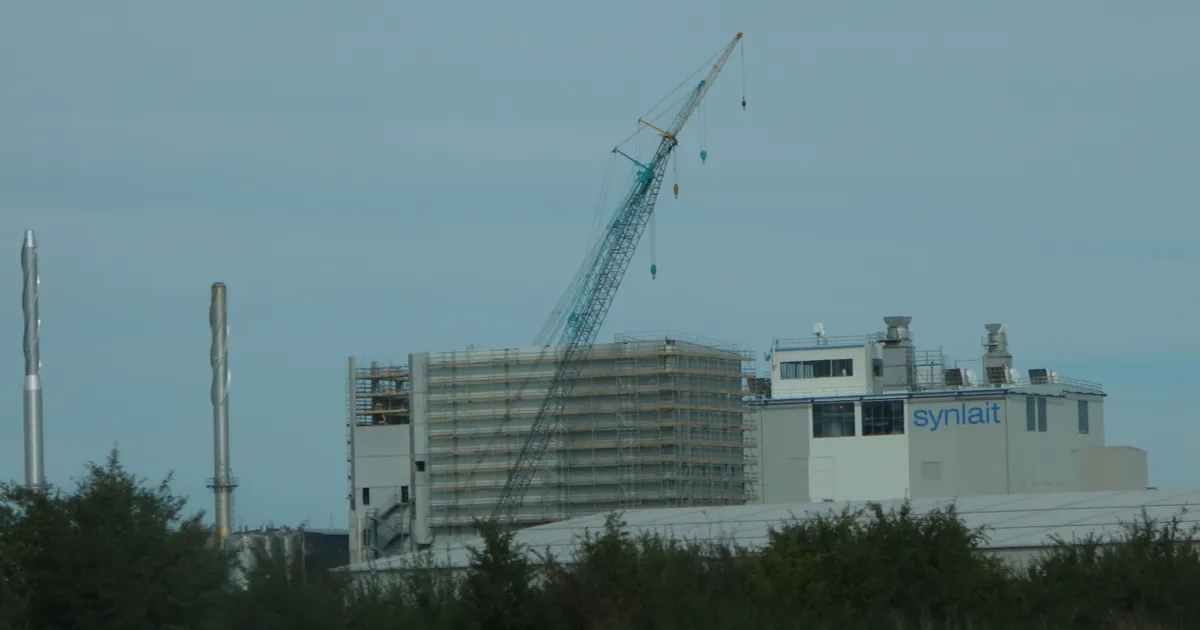
Synlait wants shareholders to focus on the second half. That is understandable, because the full year is ugly. The Canterbury dairy processor’s net loss widened to $75.4 million for the year to 31 July 2026, up from a $40 million loss the year before and at the top end of its own guidance.
The split within the year is the headline management prefers. An $80.7 million first-half loss was followed by a $5.2 million profit in the second half, which chairman George Adams put down to a return to “operational stability”. A profit is a profit. But $5.2 million against an $80 million crater is a pulse, not a recovery.
A plant failure that took a year to digest
The damage traces back to manufacturing problems at the Dunsandel plant in 2025, which strained relations with anchor customer a2 Milk and forced a costly inventory rebuild that bled into FY26. The first half was, in the words of then-CEO Richard Wyeth, “the perfect storm”. The comparable period a year earlier had delivered a $4.8 million profit.
What stands out is where the pain landed. According to the half-year investor presentation, Advanced Nutrition gross profit collapsed from $58.8 million to $7.4 million, and Ingredients fell from $14.3 million to $1.5 million. Consumer and Foodservice actually improved. The premium, specialised end of the business, the part that was supposed to justify Synlait’s strategy, was the part that broke.
Debt turned a bad season into a survival question
Operational problems are survivable. Operational problems on top of heavy borrowing are something else. Net debt rose 88% to $472.1 million over the first half, and the interim financial statements recorded operating cash outflows of $183.4 million. Bank facilities were renewed for just nine months, majority shareholder Bright Dairy stepped in with a $130 million shareholder loan, and directors ran a formal going concern assessment.
That is not the language of a company having a soft year. It is the language of a company managing its lenders. The sale of North Island operations to Abbott for $307 million was the release valve, cutting senior debt and buying time.
Sector commentator Keith Woodford did not mince words in June, writing that Synlait was “in critical financial trouble” and “desperately in need of new equity”, with Bright Dairy the obvious but not straightforward source.
The underlying number is kinder, but read both lines
There is a fairer reading of the result, and it deserves airing. Synlait’s August performance update guided underlying EBITDA of $36 million to $41 million and an underlying net loss of $19 million to $24 million, well short of the reported figure. Much of the headline loss reflects one-off costs, impairments and conservative tax accounting rather than day-to-day trading.
Acknowledging that is not the same as dismissing it. One-off costs are still real cash or real destroyed value, and they happened because the operating model failed. Investors and lenders should read both lines. Neither alone tells the truth.
Acting CEO Leon Fung is not pretending otherwise. The results are “a long way from where we want them to be”, he says, but they “show improvement” and the company is “resetting the fundamental issues that have underpinned Synlait’s poor performance.” His “Stabilise, Simplify and Scale” roadmap, which he said in August remained on track, is sensible. It is also, at this point, mostly the first word.
Premium manufacturing punishes mistakes
The sharpest diagnosis came earlier this year from Dr Nic Lees, senior lecturer in agribusiness management at Lincoln University. In February 2026, Lees argued that Synlait’s inventory rebuilds and margin-diluting milk sales were “not signs of poor management” but the predictable cost of stabilising a complex system. “In a premium manufacturing model, recovery itself is expensive,” he wrote, adding that when conditions changed, “leverage turned a strategic bet into a financial liability.”
That is the lesson for business owners well beyond dairy. Dairy has broadly been one of the stronger parts of the export economy, yet Synlait lost more money this year than last. Commodity tailwinds do not fix a fragile cost structure, customer concentration or an overstretched balance sheet. A specialised plant cannot easily pivot to lower-value work without losing efficiency, and winning back a major customer after a supply failure is slow and costly. Add debt, and a single production problem can become an asset sale.
What happens next
The second-half profit proves the plant can run. It does not prove the business can earn a return on the capital sunk into it. FY27 is the real test: a full year of stable production, a sustained reset with a2 Milk, and a balance sheet that no longer depends on the goodwill of its majority shareholder. Until Synlait delivers all three, the recovery remains a promise, and the question Woodford raised about fresh equity will not go away.
Sources
- NZ Herald: Synlait losses: Annual loss widens to $75.4m despite second-half profit (2026-09-27)
- RNZ: Synlait’s $80.6 million loss after ‘perfect storm’ (2026-03-23)
- Synlait: Half Year 2026 Investor Presentation (2026-03-23)
- Synlait: Condensed Interim Financial Statements for the six months ended 31 January 2026 (2026-03-23)
- Farmers Weekly: Synlait faces a challenging and confusing future (2026-06-22)
- Synlait: Performance update and FY26 results date (2026-09-28)
- The Post: Synlait expects $70m to $75m loss, but remains upbeat about recovery plan (2026-08-27)
- The Post: What Synlait’s losses say about the limits of value-added dairy (2026-02-05)
Join the discussion
Add useful context, ask a good question, or challenge an idea — keep it specific and respectful.