

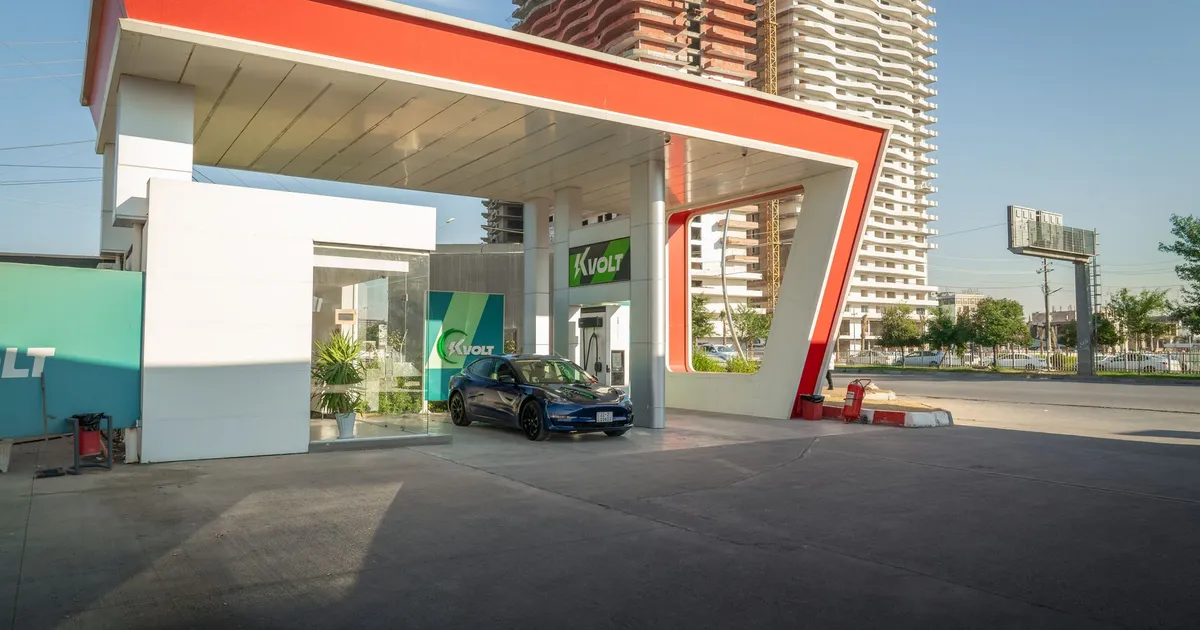
Fuel at a record price has done what years of policy argument struggled to do. Plug-in hybrid and battery EV registrations hit 3,317 in October, up 174.1% on a year earlier, lifting EVs to 22.7% of new light vehicle registrations from 8.9% in October 2025. No rebate drove this. Buyers did the sums at the pump and in the showroom, and the sums changed.
That is a clean market signal, and businesses should read it as one. The shift reaches beyond what goes in the car park. It affects fleet replacement timing, dealer stock and the resale value of every petrol vehicle on a company balance sheet.
The pump did the persuading
Average 91-octane petrol broke its record of roughly $3.50 a litre in October, according to fuel monitor Gaspy, driven by record shipping and refining costs. Price parity at purchase has arrived too. Mazda’s top-spec petrol CX-5 costs about $3,000 more than its electric sibling, the CX-6e, which starts at $58,990 before on-road costs.
“When you’re getting an equivalent amount of car while saving on running costs, it’s hard for the consumer to stick with petrol,” AA principal policy advisor Terry Collins told The Post.
The Motor Industry Association thinks buyers now see expensive fuel as a lasting condition. “When the Iran conflict started there was a bit of panic and not enough stock to meet demand. But there’s growing reports and belief that higher fuel prices aren’t just a spike, they’ll be around for a while yet,” MTA spokesperson Larry Fallowfield said.
The wider market is healthy, which makes the shift more telling. Total light vehicle registrations rose 11.5% to 23,289, the second-best month of 2026, while diesel registrations fell 27.8%. Year to date, Drive Electric counts 26,016 EV registrations against 9,410 in the same period last year.
Chinese supply did the rest
Dave Boot, owner of EV City, told Mike Hosking the surge is “twofold”. Fuel prices matter, but so do the more than 30 new Chinese EV models that arrived over the past year. The brand data backs him up. Chinese marques went from 5.4% of the market in January 2024 to 22.7% in October 2026. They now hold 57% of the EV market and 60% of PHEVs, against just 12% of petrol. The BYD Shark is now the country’s fourth-biggest selling commercial vehicle.
This is competition doing its job. More models and lower prices produced a market that moved on its own.
Demand is running ahead of the numbers
Dealers and importers should note Boot’s warning about a lag. Orders surged in March, but many of those vehicles had not been built yet and took up to six months to land and register. October’s figures are still catching up with underlying demand. Anyone planning stock from registration data alone is probably planning too low.
Demand is also broad. Almost 60% of battery EVs registered in October went to private owners. Rental and company buyers still took 71.1% of total registrations, so the fleet decisions being made now will shape the used market for years.
The petrol fleet is the real exposure
The October numbers have a consequence most coverage has missed. Chinese EVs priced around $30,000 now compete with used petrol cars, not just other new vehicles. That threatens a market built on imported Japanese depreciation.
“If a three-year-old petrol car costs $27,000 while a comparable new car costs $40,000, buying used may make sense. But if a credible new EV costs as little as $30,000, that calculation changes,” said Dr Kenny Ching, senior lecturer in management and international business at the University of Auckland. The likely result is a squeeze on the whole used-car price ladder.
The evidence is already showing up. Trade Me data shows petrol vehicles losing value faster than equivalent models did a decade ago, while hybrids and diesels hold up. Simplicity chief economist Shamubeel Eaqub says hybrid and EV prices “are holding, while petrol car prices are falling.”
For an SME with a dozen petrol utes and hatchbacks, that is balance-sheet depreciation that has nothing to do with mileage or condition. Waiting another replacement cycle may mean trading in at a worse number.
Workshops face a skills reckoning
The automotive sector employs more than 68,000 people across about 15,000 businesses and contributes roughly $8 billion to GDP. EVs need battery, power electronics and software expertise rather than oil changes and exhaust work. Workshops that retrain early will win that work. Those that don’t will watch it leave.
Price the trade-in, not just the fuel bill
Nobody had to subsidise October’s result. Expensive fuel, cheaper models and real competition did it. The practical question for business owners is no longer whether EVs stack up. It is how much a petrol fleet loses each quarter the replacement decision is deferred, and whether dealers will have the stock ready when that decision is made.
Sources
- RNZ: EV registrations up 174.1% on a year ago (2026-11-02)
- The Post: Here’s the $3.50 a litre question: does an EV stack up? (2026-10-17)
- Autofile: Fuel prices driving market shift (2026-11-03)
- MTA: Electric Vehicles Ride Fuel Price Wave (2026-11-02)
- Drive Electric: Latest New Zealand Sales Figures (2026-10-01)
- Newstalk ZB: ‘Twofold’: High fuel costs not the only thing behind ‘exploding demand’ for EVs (2026-11-03)
- MTA vstat: New Zealand’s changing car market, by the numbers (2026-11-01)
- MTA vstat: NZ Vehicle Registration Statistics, October 2026 (2026-11-01)
- RNZ: Cheap Chinese EVs could soon shake up NZ’s used car market. Are we ready? (2026-10-06)
- University of Auckland: Cheap EVs could reshape used car market (2026-10-12)
- RNZ: Why your car might be losing value faster than it used to (2026-10-29)
Join the discussion
Add useful context, ask a good question, or challenge an idea — keep it specific and respectful.