

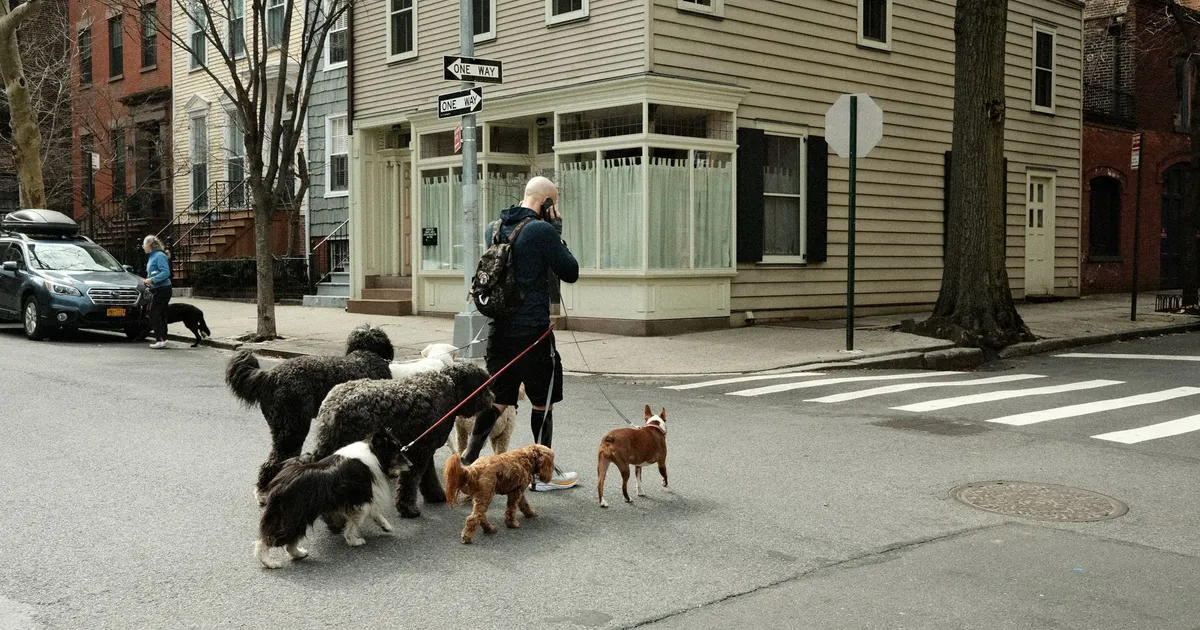
Six professional dog-walking operators have now been served abatement notices, with three more under investigation. On its own it sounds like a minor local spat. It is really a textbook case of how councils can take a cheap-to-start service business and bury it in compliance cost, while the problems their own data identifies carry on largely untouched.
The operators are not mincing words. The Stuff report quotes walkers describing the crackdown as “utter bullshit”. Strip away the language and the complaint is a fair one. Enforcement has moved from rulebook to reality, and it has landed on the people least responsible for the trouble.
The rules arrived in 2026
Auckland’s regional dog rules took effect on 1 January 2026. Under the council’s Policy on Dogs, updated in June 2025, members of the public can walk a maximum of four dogs at once, no more than two off-leash. Qualified walkers can apply for registration and approval to walk up to 12.
When the Governing Body adopted the rules in 2025, councillor Josephine Bartley said the council had “listened to public feedback” and recognised commercial dog walking as a “growing industry” that needed regulating through registration. On paper, that was a reasonable compromise. The industry had itself asked for a licensed professional category with a 12-dog ceiling.
The trouble is the fine print. When Auckland consulted walkers on additional conditions in 2025, 66 percent of 83 respondents opposed rules stopping walkers being close to each other, 83 percent opposed restrictions on marketing and branded uniforms, and 84 percent opposed limits on dogs using footpaths unless transported by vehicle. Staff recommended adopting all 13 conditions anyway. Telling a small business how it may brand its uniforms is not a safety measure. It is regulators doing what regulators do when given a new category to manage.
Christchurch bills by the head, not the risk
Christchurch has the same four-dog cap, two off-leash, under its 2025 policy and bylaw. Its exemption process, which opened in May 2026, costs a one-off $175. That sounds modest until you read the detail: the exemption attaches to the individual, not the business.
A firm with five walkers on staff needs five applications and $875 before anyone clips on a lead. Hire a sixth, pay again. Staff turnover becomes a recurring compliance bill. That is the wrong design. Compliance costs should scale with risk, and a well-run business with trained staff is lower risk, not higher. Instead, the cost scales with headcount, penalising exactly the operators who grow.
To its credit, the council said it would not initially enforce the four-dog limit, while still expecting compliance with rules such as carrying a leash for every dog and picking up waste.
The complaint data points elsewhere
Here is the uncomfortable bit for councils. Back in 2024, the Professional Dog Walkers Association, through then-spokesperson Ben Spick, cited Auckland data showing only 0.7 percent of complaints, roughly 10 cases, related to walking multiple dogs. Roaming dogs accounted for 38 percent.
Auckland’s own 2024-25 animal management report told the same story in 2025. Of 39,374 service requests, roaming dogs were the largest category at 16,739. Infringement notices jumped 173 percent to 17,430, and 10,149 of them were simply for unregistered dogs. The enforcement surge was about owners who do not register or contain their animals, not businesses walking packs.
The pattern is not unique to Auckland. Marlborough’s 2023-24 report recorded 189 of 243 infringements were for failure to register. Any operator working across council boundaries faces a patchwork of rules aimed at a problem they are not causing.
There is a real safety case, and a smarter fix
This is not a story of councils inventing a threat. Christchurch’s review followed a terrier mauled to death by four loose dogs during a professional pack walk, reported in 2024. That was serious, and regulation was warranted.
But the response should target competence, not arithmetic. At the time, Checkers Dog Walking owner Julia Knoef pointed to Wellington, where commercial walkers complete a course, pass an exam on bylaws and the Dog Control Act, and are assessed by a dog control officer. That model tests whether someone can handle dogs safely. A blanket cap with per-person fees and uniform rules tests whether someone can fill in forms.
What happens next
The six abatement notices will not be the last, and the three pending investigations will show whether councils intend to use their new powers as a backstop or a revenue-and-paperwork habit. For any business owner, the lesson travels well beyond dogs. Low-barrier trades are only low-barrier until a council decides otherwise. Councils that want safer parks would get more value chasing the thousands of unregistered and roaming dogs in their own reports than squeezing the handful of operators already trying to do it properly.
Sources
- Stuff: ‘Utter bullshit’: professional dog-walkers slam council crackdown (2026-10-17)
- Auckland Council: Policy on Dogs (2025-06-26)
- RNZ: What you need to know about Auckland’s new dog rules (2025-06-30)
- Auckland Council: Agenda of Regulatory and Safety Committee, 2 September 2025 (2025-09-02)
- Christchurch City Council: Dog walking businesses, dog limit and exemption update (2025)
- RNZ: Dog walkers fear new rules will put them out of business (2024-10-23)
- Auckland Council: Animal Management Annual Report 2024-2025 (2025-08-29)
- RNZ: Christchurch council to review dog walking bylaws (2024-08-13)
Join the discussion
Add useful context, ask a good question, or challenge an idea — keep it specific and respectful.