

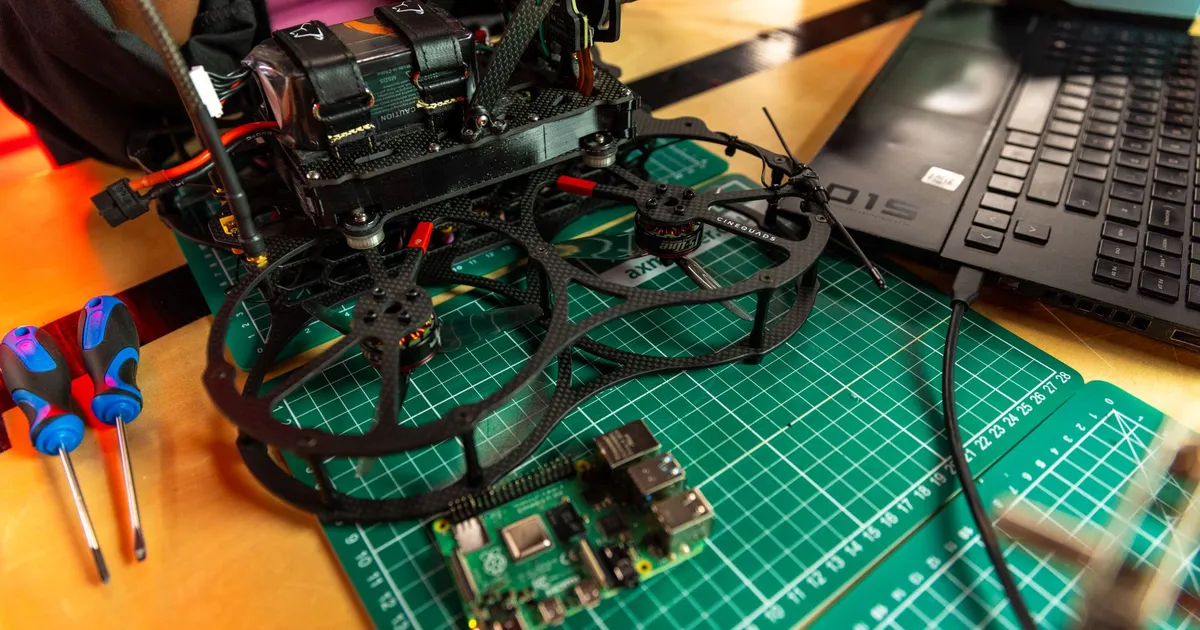
From workshop to warfighting
Philip Solaris, chief executive of Obsidian Systems, calls his Auckland operation “the Skunk Works of robots”, a nod to Lockheed Martin’s legendary secretive innovation arm. It sounds like bravado. It isn’t. His company was approached several years ago to supply drones to Ukraine, and the hardware was ready to go.
That deal never happened, and the reason is instructive. The then-Labour government, Solaris told RNZ, was “very reticent to have what they call ‘dual use capability’.” By the time restrictions eased, the Ukrainian buyer was manufacturing its own drones. As Solaris put it, “of course all our craft are dual use because we want to do humanitarian and environmental operations as well as defence.” That policy window has closed, and the current government’s posture is materially different.
The procurement pipeline is real money
The numbers behind the shift are substantial. The NZDF’s Industrial Base Statement commits $100 million to $300 million for long-range remotely piloted strike aircraft, $50 million to $100 million for uncrewed maritime vessels, and up to $50 million for uncrewed counter aerial systems.
In July 2026 the government began the process of purchasing long-range one-way strike drones, calling for information from local industry, with a review, trial and selection targeted by the end of March 2027. Separately it is doing market research on unarmed long-range uncrewed aircraft for maritime surveillance, with a further $100 million to $300 million allocated. For a domestic manufacturing base built out of workshops in Mount Maunganui and rural Auckland, that is a transformational amount of guaranteed demand.
Syos leads the local pack
The frontrunner is Syos Aerospace of Mount Maunganui. In February 2026 the NZDF contracted Syos to supply 14 air, land and sea drones for Army and Navy trials covering supply transport, maritime patrols and route reconnaissance, spanning ground vehicles, surface vessels and ISR and effector drones.
Defence Minister Judith Collins said in February 2026 that “having cutting-edge drone technology developed and supported by local businesses will reduce supply chain risk and strengthen our resilience.” Syos drones are already deployed in Ukraine, and the company has been shortlisted as one of seven firms for Project NYX, a UK Ministry of Defence programme to develop AI wingman drones for Apache attack helicopters, reported as a $229 million contract opportunity.
Why small and fast beats big and slow
The competitive edge here is not scale, it is speed. The Newsroom analysis from March 2026 captured the strategic logic bluntly: it is now about rapid adoption of modern technology and production that can supply within the region to de-risk the supply chain. The Russia-Ukraine conflict has proven the model. Defence primes are now working collaboratively with SMEs precisely because the pace of drone development has outrun their internal processes. A small Kiwi firm that can iterate a design in weeks is worth more than a giant that takes years.
There is a second, under-reported export angle. The US is scaling drone manufacturing hard but depends heavily on Chinese-made components. As a Five Eyes partner with Western supply chains, New Zealand is positioned as an alternative supplier. The NZDF has signalled it will favour modular and open architecture designs that allow domestic integration, with supply chain resilience described as a central factor in procurement.
The bigger economic bet
This is not a niche. A Deloitte study commissioned by MBIE in April 2025 found New Zealand’s advanced aviation sector generated $0.53 billion in revenue in FY2024 and directly supported 2,000 full-time jobs. Drone payload capacity has jumped from 10kg in 2019 to 50kg in 2024, making agricultural spraying, stock management and precision horticulture viable at scale. The Space and Advanced Aviation Strategy cites a forecast that drone technologies could benefit the economy by $4.6 billion to $7.9 billion over 25 years.
Solaris flags one real risk. Citing the 2025 Tibet earthquake, where unregulated drone deployment damaged heritage sites and eroded public trust, he warned that “the professionalism wasn’t part of it.” The lesson for a sector moving fast into high-stakes work is that reputation is fragile. Get the discipline right, and a handful of Kiwi workshops could turn a defence pivot into a durable, high-value export industry. That is the opportunity now on the table.
Sources
- The incredible world of Kiwi-made drones (2026-08-17)
- Defence Force to test air, land, and sea drones from Mount Maunganui company (2026-02-26)
- How NZ military plans to ramp up drone use (2026-03-23)
- NZDF Industrial Base Statement: Uncrewed Systems (2025)
- Mount Maunganui’s Syos shortlisted for $229m wingman AI drone UK military contract