

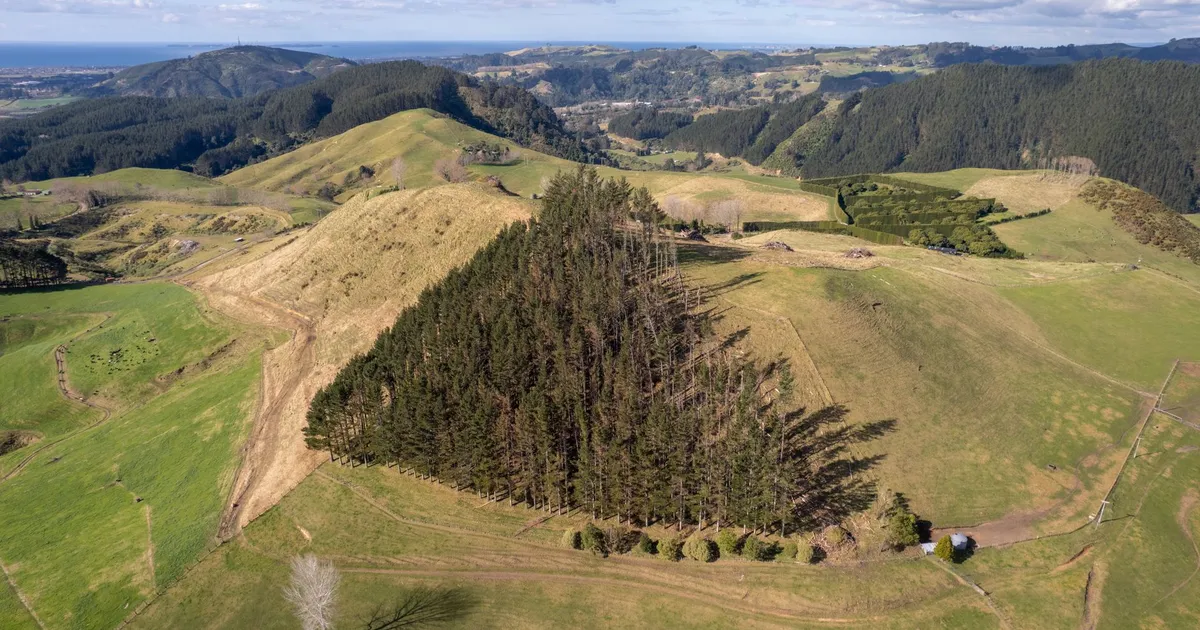
Central Hawke’s Bay is losing productive farmland at a pace that makes the government’s 2025 regulatory fix look like it was written to fail. Four sheep and beef properties totalling over 3,100 hectares have been sold to overseas buyers for forestry conversion in the space of roughly five months, all OIO-approved, all destined for radiata pine. The combined price tag sits at approximately $30 million.
The buyers are Kauri Forestry Limited Partnership, representing a multi-generational German/Swiss family business, and Singapore-owned JD Droxford Ltd. The properties include 1,500-hectare Waipuna Station at Elsthorpe sold for more than $13 million, 800-hectare Te Manuiri Station at Omakere and a 480-hectare Waipukurau farm sold for $8.6 million and $5.2 million respectively, and a 344-hectare cattle property on Nilsson Road near Kairakau for $3.76 million. Every one of them received OIO consent on the grounds of capital investment and increased exports.
The fix that was not a fix
The government’s Climate Change Response (ETS Forestry Conversions) Amendment Bill became law on 23 September 2025, taking effect on 31 October 2025. It restricts conversion of LUC class 1-6 farmland to exotic forest registered in the Emissions Trading Scheme. That sounds comprehensive until you look at where the conversions actually happen.
Official LINZ data published in May 2025 shows 157 approved OIO applications for overseas forestry conversions since 2011, covering 118,133 hectares. In 2024, approximately 71% of farmland acquired for forestry conversion was classified as LUC 6, the marginal hill country that defines most of New Zealand’s sheep and beef heartland. The new rules still permit up to 15,000 hectares of LUC 6 conversion per year. That is not a ban. It is a quota generous enough to keep the pipeline flowing.
Federated Farmers president Richard Dawkins has argued the bill was inadequate, noting that 88% of previous conversions were on LUC 6 land and above and that two-thirds of sheep and beef farms sit on exactly the kind of land the rules still allow to be converted.
The ETS subsidy makes the economics unanswerable
This is not a story about foreign capital outmuscling local buyers on a level field. It is a story about policy-created arbitrage. New Zealand’s ETS provides unlimited 100% carbon offset payments to planted forestry. As Beef + Lamb NZ chair Kate Acland has observed, New Zealand is one of only two countries in the world to offer this. The other is Kazakhstan.
The numbers make the incentive obvious. In 2022, IKEA parent company Ingka Investments paid $88 million for 6,113 hectares near Gisborne, converting 4,907 hectares from sheep and beef to radiata pine. The farm had been generating just $59,000 in annual revenue after expenses from pastoral operations. A subsequent Ingka application projected just 2.3 direct full-time equivalent jobs per annum over 30 years for a further 506-hectare acquisition. That is the employment base that replaces a working farm.
Acland has warned that for every 100,000 hectares planted in forestry, close to one million stock units are lost. Since 2017, more than 260,000 hectares of sheep and beef farmland has been purchased for forestry conversion.
The downstream damage compounds quietly
The business impact extends well beyond the farm gate. Steeper hill country is breeding country that supplies finishing operations on the flats. Remove the breeding farms and the entire pastoral supply chain contracts. Shearers, stock agents, fertiliser companies, rural merchandise firms like PGG Wrightson and Farmlands all lose clients. Rural school rolls fall. Small towns lose the economic base that keeps the mechanic, the vet, and the pub viable.
The OIO keeps approving these sales by citing capital investment and export receipts as benefits to New Zealand. But when a farm generating $59,000 a year gets replaced by 2.3 jobs over three decades, the definition of “benefit” is doing a lot of heavy lifting.
Policy settings reward exactly what they claim to prevent
The peak year for approved forestry conversions was 2022, with 35 applications covering 27,777 hectares. The government legislated in 2025 to slow the flow. But the LUC 6 loophole, the unlimited ETS subsidy, and the OIO’s narrow benefit test mean the structural incentives remain intact. European and Asian capital will keep buying New Zealand hill country for pine because the policy settings make it rational to do so.
Four farms in five months in one district is not an anomaly. It is the system working as designed. If the government genuinely wants to stop productive farmland disappearing under radiata pine, it needs to close the LUC 6 gap, cap the ETS forestry subsidy, and rewrite the OIO benefit test to account for what a region actually loses when a working farm becomes a carbon sink. Until then, the next four sales are already in the pipeline.
Sources
- NZ Herald: Fourth Hawke’s Bay farm in five months sold to overseas buyers for forestry
- NZ Herald: Large Hawke’s Bay sheep and beef farm to be converted to forestry; sold to overseas buyer
- NZ Herald: Two more Central Hawke’s Bay farms sold to overseas buyers for forestry
- MPI: Limits to restrict farm-to-forest conversions (2025-10-31)
- NZ Herald: Government’s farm-to-forest ban doesn’t go far enough – Richard Dawkins
- Farmers Weekly: ETS brakes forestry, but pressure on farmland remains
- Rural News Group: Productive farmland still being lost to forestry – Kate Acland