

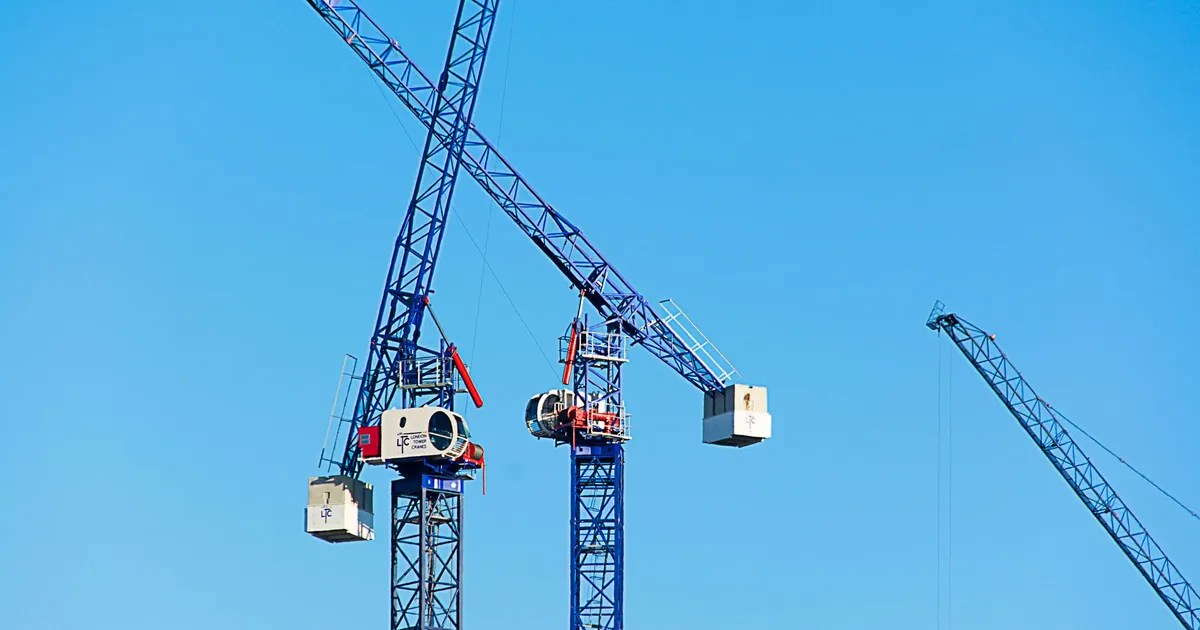
When the crane goes up on the new Dunedin Hospital inpatient building next month, it will mark the start of the most consequential construction project the lower South Island has seen in a generation. Not because of what it means for healthcare, though that matters too, but because of what a single $2.1 billion build does to every other construction job in the region.
At peak, the inpatient building alone will support more than 900 full-time-equivalent workers and pump around $100 million a year into Dunedin’s economy. That is an extraordinary concentration of activity in a market where residential building is shrinking and non-residential work nationally fell from $14.1 billion to $12.1 billion between 2023 and 2024.
The project that ate the pipeline
MBIE’s National Construction Pipeline Report forecasts Otago and Southland residential building activity declining further through to 2030, reaching $1.7 billion across the region. Against that shrinking backdrop, a single project worth $2.1 billion is not a welcome addition to the market. It is the market.
Auckland accounts for 44% of forecast building consents through to 2030. The South Island’s share is a fraction of that. The Te Waihanga Pipeline Snapshot puts the national infrastructure pipeline at $274 billion total value, with $21.5 billion in committed spend for 2026. The Dunedin hospital is nationally significant but regionally dominant, and that distinction matters.
For firms in the southern supply chain, the hospital offers visibility through to 2031. For everyone else, it means tighter labour, higher costs, and longer lead times on anything from a commercial fitout to a house renovation.
A contract Treasury doesn’t trust
Health NZ signed the inpatient building contract with Australian construction giant CPB Contractors in September 2025, structured around a collaborative model rather than a fixed-price approach. Treasury’s March 2026 assessment was unsparing: “A project of this scale is inherently risky and the contract engages a delivery model that is untested in New Zealand, posing ongoing risk of cost escalations.”
Treasury also acknowledged the government had limited options, conceding that “an arrangement with less risk for the Crown could not have been negotiated without significant delays.” The project sits on Treasury’s high-profile high-risk investment list.
The budget has already grown. Health Minister Simeon Brown approved an extra $174 million in contingency funding in May 2026, pushing the total envelope to $2.1 billion. Dunedin City councillor Dr John Chambers noted “the budget increase was not surprising given medical inflation and building inflation over the past 10-12 years.” He is probably right, and that is precisely the problem.
The crowding-out nobody wants to talk about
Dan Lowe, Partner and Property and Construction Services Lead at Grant Thornton New Zealand, identified the structural issue in May 2026: “An unreliable and inconsistent pipeline of work: this is by far the biggest problem facing the construction sector.” He also pointed out that New Zealand ranks in the top 10% per capita for infrastructure spending but bottom 10% for delivery.
The Dunedin hospital is both a solution and a symptom. It provides the certainty that Master Builders say businesses need to invest in people, training, and capability, but only for firms inside the supply chain. When 900-plus FTEs are absorbed by one project, wages for skilled tradespeople rise across the region. Smaller commercial and residential projects compete for a shrunken labour pool, and the hospital wins that competition almost every time.
Lowe put the procurement dynamic bluntly: “The public sector is driving a race to the bottom on price, it risks putting many private consultancies, construction partners and suppliers close to the brink.” The collaborative contract model on the hospital is an attempt to break that pattern. Whether it breaks the cost pattern too is the question Treasury keeps asking.
What southern businesses should be planning for
The timeline is now set. Primary steel and base isolators start in July 2026. Fitout begins March 2027. Practical completion is targeted for late 2030, with the building operational in early 2031. The outpatient building should be operational by October 2026.
For developers, property investors, or anyone planning a significant build in Dunedin or wider Otago, the message is straightforward: budget for tighter labour and higher costs through at least the late 2020s. For materials suppliers, plant hire companies, and specialist subcontractors, the hospital is a decade-long anchor tenant if you can get in.
The risk is what happens when it ends. A region that organises its construction workforce around a single mega-project faces a cliff when that project completes. Dunedin has waited since 2018 for this build. It should already be thinking about what comes after 2031.
Sources
- Hospital build kitty boosted to $2.1b (2026-05-30)
- Treasury warns of ‘risky’, ‘untested’ Dunedin hospital contract (2026-03-10)
- New Dunedin Hospital Construction Contract Signed (2025-09)