

When the country’s biggest industrial landlord commits $110 million to rooftop solar and battery storage, the interesting question is not whether it helps the climate. It does. The interesting question is why it took this long, and what finally tipped the economics.
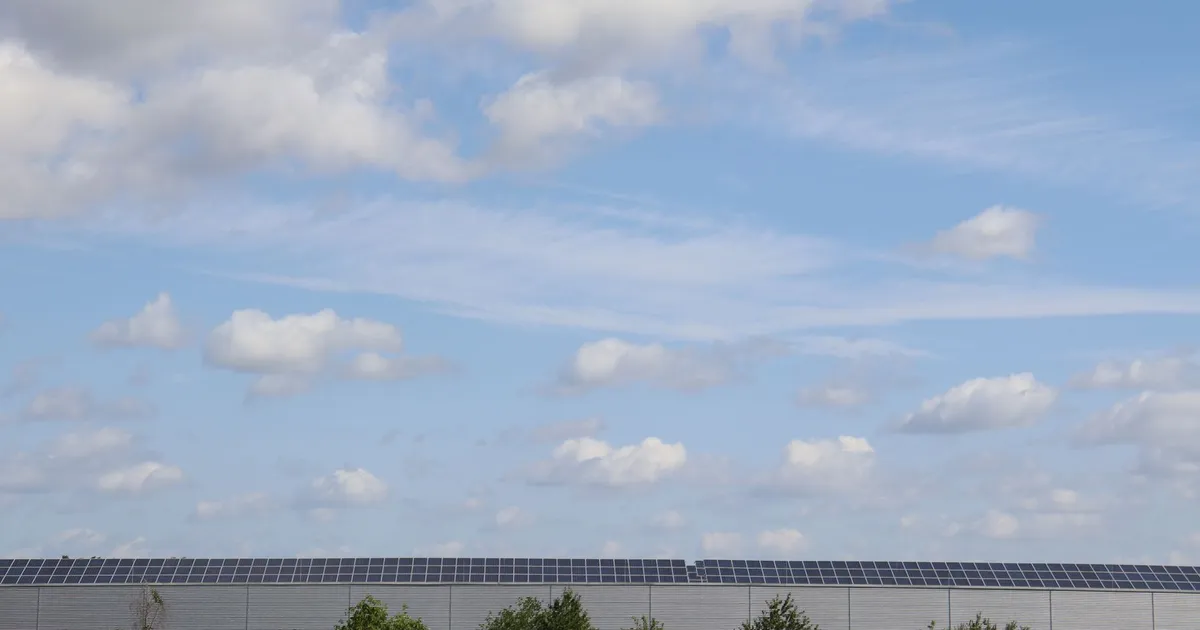
Calder Stewart announced today that it will roll out up to 170,000 solar panels across its national industrial property portfolio over the next decade, creating up to 85 megawatts of generation capacity with integrated battery storage. At full build-out, the system will generate enough electricity annually to power between 15,000 and 20,000 homes. This is not a pilot. The company already has solar operating across 17 industrial sites covering more than 152,000 square metres of roof space, generating 3.6MW at peak. The $110 million is an acceleration of something already working.
The grid got too expensive to ignore
The economics are brutally simple. Generating power on a warehouse roof and feeding it straight to the tenant below bypasses the most expensive components of an industrial electricity bill. Calder Stewart energy manager Ben Krieble put it plainly: “Because generation is on the roof, there are no lines charges, no network transmission losses and no levies attached to that portion of electricity.”
Network losses alone typically add 5% to 10% to industrial power bills. That is money businesses pay for electricity that physically disappears in transit. Meanwhile, household electricity prices rose 11.7% in the March 2026 quarter year-on-year, driven by rising network charges. Industrial users face the same pressure, compounded by the fact that industrial electricity consumption jumped 12.2% in Q4 2025. More demand, higher prices, growing absolute costs. Onsite generation is the obvious escape route.
Zero capex for tenants, decade-long price certainty
Calder Stewart’s model is deliberately frictionless for occupiers. The landlord funds, builds and owns the solar and battery infrastructure. Tenants keep their existing electricity retailer but receive a portion of power directly from the roof at lower cost. Critically, Calder Stewart is offering power pricing arrangements extending more than a decade, giving manufacturers and logistics operators cost certainty that no standard retail electricity contract can match.
Director Sam Stewart framed the opportunity: “Industrial rooftops have long been an underused asset despite their scale and proximity to large energy users.”
For tenants, the proposition is straightforward. Lower power costs, no capital outlay, long-term price visibility. Battery storage will extend the benefit by shifting daytime solar surplus into morning and evening peak periods when grid power is most expensive.
A landlord that generates power is a different competitive proposition
The solar programme sits within an enormous development pipeline. Calder Stewart holds more than 900 hectares of zoned industrial land across Auckland, Canterbury, Otago and Southland. Its Hornby Quadrant in Christchurch alone is expected to generate 70MW of rooftop solar, enough to power 9,350 homes. The Milburn Quadrant near Dunedin will add up to 50MW of rooftop solar, with planned wind generation expected to deliver several hundred megawatts more.
At 85MW of distributed solar across a national portfolio, Calder Stewart is becoming one of New Zealand’s larger power generators, with a captive customer base sitting directly beneath its panels. That is a competitive moat no rival industrial landlord currently offers.
The system benefits everyone pays for less infrastructure
This is not just a private commercial play. A January 2026 EECA/Jacobs report estimated New Zealand’s demand-side flexibility potential at 1,700 to 1,900 MW, representing roughly 25% of current peak demand and nearly $3 billion in avoided infrastructure investment. Every megawatt of industrial solar with battery storage that shaves peak grid demand reduces the infrastructure spending that flows through to every electricity bill in the country.
New Zealand’s grid already hit 96.4% renewable generation in Q4 2025. The problem was never the source of electrons. It is the cost of moving them around and the infrastructure required to meet peak demand. Distributed industrial solar addresses exactly that constraint.
The policy lesson nobody in Wellington wants to hear
This $110 million investment was not triggered by an emissions trading scheme price signal, a regulatory mandate, or a sustainability target. It was triggered by the structural economics of rising grid costs meeting falling solar costs. The emissions reduction is a byproduct of a commercial decision.
That distinction matters. For every dollar spent on compliance frameworks and reporting obligations, the fastest path to industrial decarbonisation remains making the alternative cheaper than the status quo. Calder Stewart just proved the alternative is cheaper. The question for every other industrial landlord in the country is simple: what are you doing with your roof?
Sources
- RNZ: Industrial leader goes all-in on solar (2026-06-16)
- NZ Herald: Calder Stewart to invest $110m in rooftop solar and battery rollout (2026-06-16)
- ODT: $3b Otago inland port project ‘shovel-ready’ (2026-06-16)
- ODT: Inland port development nearing start (2026-06-16)
- DETA: The $3B Opportunity – Industrial Demand-Side Flexibility (2026-01)