

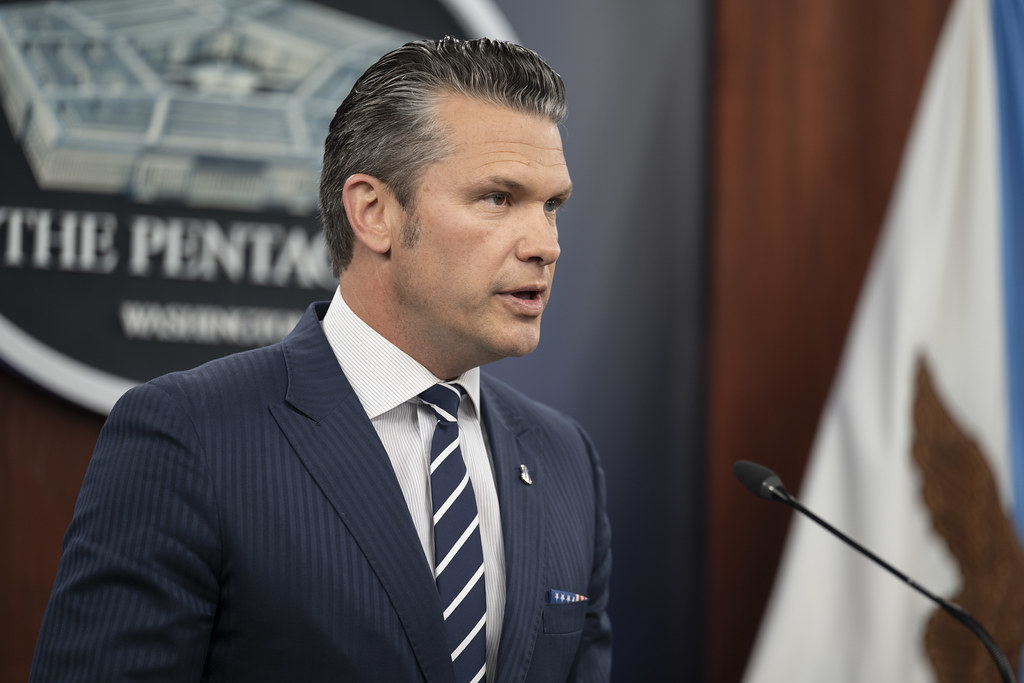
U.S. Defence Secretary Pete Hegseth has sought to reassure allies in the Asia-Pacific that Washington remains committed to the region, even as the conflict with Iran places further strain on American military resources.
Speaking at the Shangri-La Dialogue in Singapore, Hegseth pushed back against concerns that the United States was shifting its attention away from Asia. His comments followed questions over a suspended $14 billion weapons package for Taiwan, which has fuelled doubts about whether Washington can meet several security commitments at once.
Japan’s defence minister, Shinjiro Koizumi, said some countries could try to exploit those doubts and “drive a wedge” between the U.S. and its allies.
Hegseth rejected that suggestion, saying America’s wider responsibilities did not mean it was abandoning the Pacific.
“We can do two things at one time,” he said, adding that Washington was continuing to work closely with regional partners while also trying to prevent Iran from obtaining a nuclear weapon.
The defence secretary said the U.S. remained in a strong position to replenish its weapons stockpiles if needed. He also renewed pressure on Asian allies to increase military spending, urging them to work towards allocating 3.5% of their gross domestic product to defence.
Hegseth praised Japan, South Korea, Australia, and the Philippines for strengthening their military capabilities and expanding cooperation with Washington. He also criticised countries he viewed as contributing too little, describing New Zealand as a “freeloader” during a later exchange.
New Zealand’s defence minister rejected the criticism, saying the country was “not a freeloader” and was moving to address years of under-investment.
Hegseth’s tone towards China was more measured than at last year’s summit. While he acknowledged concerns over Beijing’s military build-up, he said Washington was not seeking unnecessary confrontation.
“We do not approach this challenge with needless confrontation but with the posture of measured and deliberate strength,” he said.
China did not send its defence minister to the summit for the second year running, opting instead for a lower-level delegation. The decision has added to uncertainty over how Beijing wants to manage its increasingly tense relationship with Washington.