

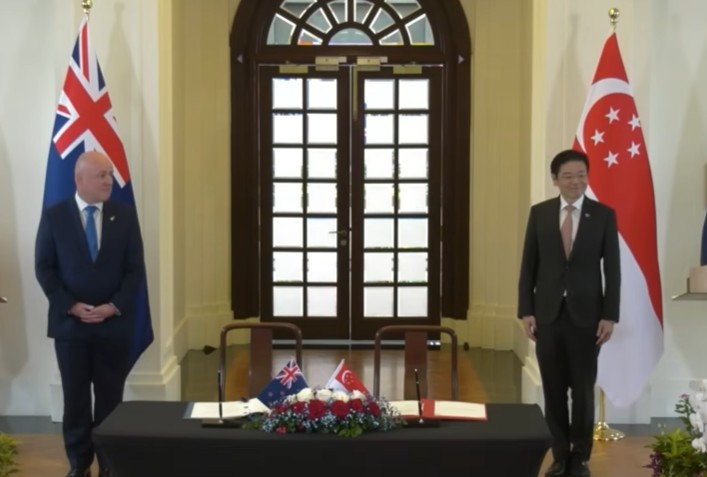
A newly signed world-first agreement between New Zealand and Singapore has been announced; this means that the fuel supply continues uninterrupted, even during crises.
Around one-third of New Zealand’s fuel is refined in Singapore.
The agreement, initially reached last October, comes as ongoing conflict in the Middle East continues to disrupt oil supplies, alongside broader strains in the global rules-based order.
The New Zealand–Singapore “fuel-for-food” agreement prevents either country from placing export restrictions on an agreed range of goods, including fuel, food products, construction materials, and medicines.
New Zealand Prime Minister Christopher Luxon and Singapore Prime Minister Lawrence Wong both attended the formal signing of the agreement in the Asian city-state.
“The past few months have shown we live in a volatile world – Kiwis are seeing that every time they fill up their car,” Luxon said.
“That is why we are hustling in the world to protect New Zealand and build our resilience in uncertain times.”
“With a third of New Zealand’s fuel refined in Singapore, this agreement turns trust into action, and right now, that’s keeping fuel flowing to New Zealand when it matters most.”
Luxon and Wong both said the agreement delivers a clear message to the international community. Wong said it reflects a commitment to avoid turning inward when individual countries face difficult times.
“This is the first agreement of its kind for both our countries and also globally, and it marks another breakthrough and sends a very clear signal: even under strain, trusted partners will keep faith with one another,” Wong said.
“Even in times of crisis or shortages, we will keep essential goods flowing – food, fuel and other critical supplies. We will not shut each other out.”
“In difficult times, every country will be tempted to look inward, but when that happens, supply chains break down, and everyone ends up worse off.”
“This agreement is our answer. It’s a commitment that we will do things differently, that we will keep markets open and stand by one another, especially when it matters most.”
Luxon also placed the deal in the context of a changing world and an evolving global order.
“We’re moving increasingly from a multilateral world that relied on rules to a multipolar world that relies on power,” Luxon said.
“The way we have power and influence is by working together.”
The two leaders said the agreement is open for other countries to join. Wong said the arrangement was “not meant to be exclusive.”
“We welcome other countries to join us, and if they are able to meet the same standards, then it will start to expand a network of trusted partners who can provide similar assurances to one another.”
Meanwhile, Luxon said New Zealand and Singapore were “inventing new trade architecture” and were open to broadening it further.