

Armenia, long a steadfast ally of Russia in the South Caucasus, is playing host to more than 30 European leaders and Canada’s prime minister for back-to-back summits in Yerevan this week.
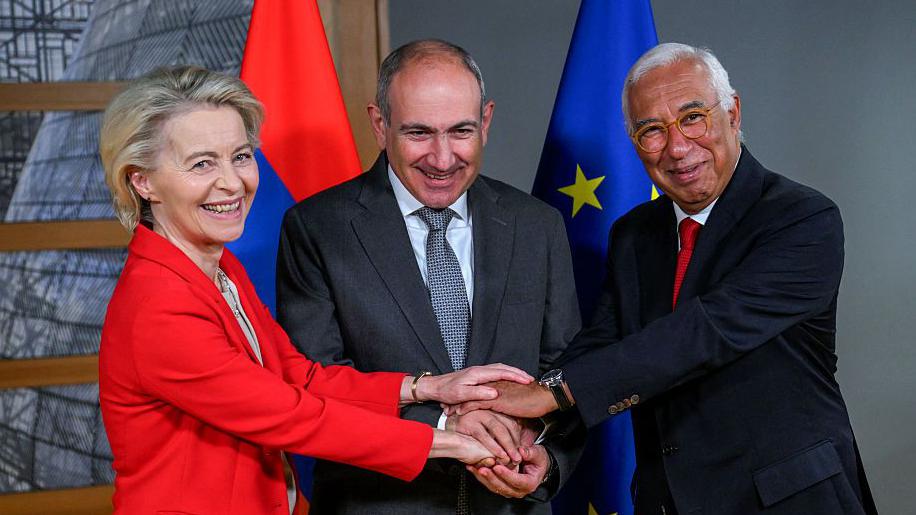
The gatherings, including Monday’s European Political Community forum and Tuesday’s first-ever EU-Armenia bilateral meeting with Ursula von der Leyen and António Costa, underscore Yerevan’s accelerating drift towards the West for a nation of under three million people deeply embedded in Vladimir Putin’s Eurasian Economic Union, complete with a Russian military base on its soil.
The pivot traces back to Armenia’s heavy reliance on Moscow for cheap energy, highlighted by Putin during Nikol Pashinyan’s 1 April Kremlin visit. Russia supplies gas at $177.50 per 1,000 cubic metres, far below Europe’s $600 rate.
“The difference is large, it is significant,” the Russian president said. Yet betrayal in the 2023 Nagorno-Karabakh war changed everything. Azerbaijan’s swift offensive displaced over 100,000 ethnic Armenians, while Russian peacekeepers stood idle and the Moscow-led security bloc offered no help.
“We realised that the security architecture that we are in was not working,” said Sargis Khandanyan, chairman of Armenia’s parliamentary foreign relations committee, speaking to the BBC. The EU’s 2022 border mission helped shift public sentiment.
“The physical presence of the European Union shifted the perceptions of our citizens,” Khandanyan added. “We realised there is a public demand for closer relations with the EU.” By March 2025, parliament launched EU accession steps amid surging support.
Peace efforts with Azerbaijan have quickened, including a landmark U.S.-brokered deal for a major trade corridor along Armenia’s Iranian border. But tensions simmer. Baku suspended ties with the European Parliament over refugee return demands, while Russia imposed a mineral water import ban just before the summits.
Putin warned of incompatible EU ties. “It is not possible to be simultaneously in a customs union with both the European Union and the Eurasian Economic Union,” he said. “It is simply impossible by definition.”
Hybrid threats loom large, from cyber hacks traced to Russia to disinformation spikes, prompting a new EU mission ahead of June elections.
“Armenia’s democratic institutions are functioning and have made real progress, but they are under pressure,” noted Council of Europe secretary general Alain Berset. Europe offers aid and visas, but no firm membership timeline or Russian gas replacement, leaving Yerevan’s balancing act precarious.