

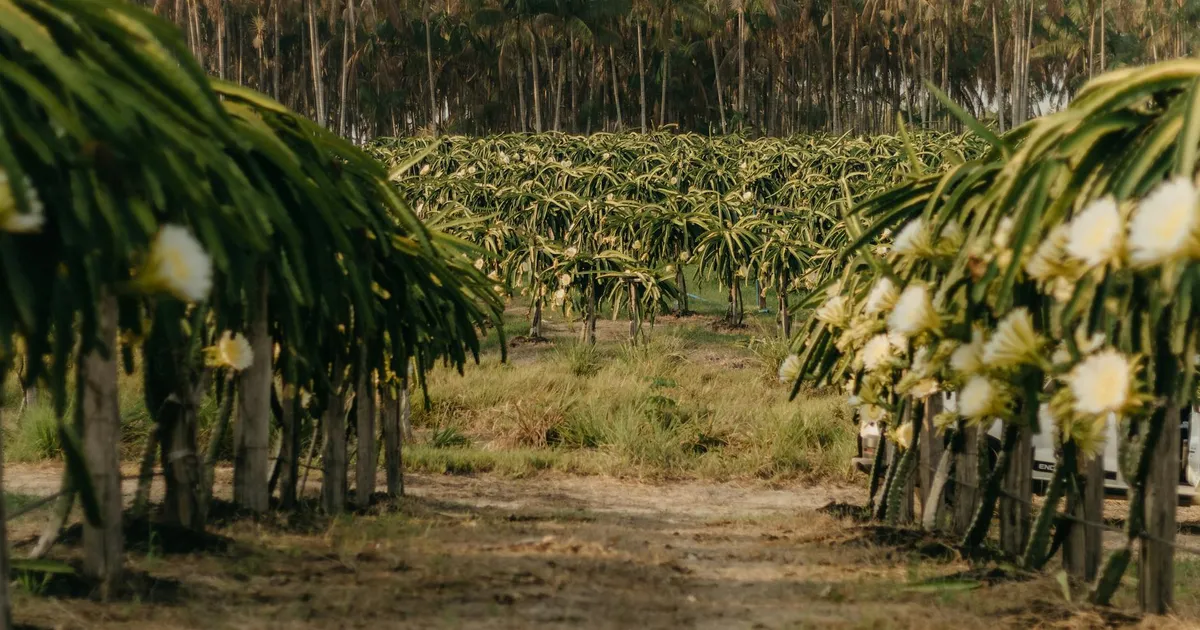
Ten years in the lab, now heading for the orchard
Most people think of dragon fruit as a Southeast Asian commodity. Vietnam alone ships to over 60 countries, and the global industry is worth USD $1.2 billion, growing at 4.5% annually. New Zealand has no business competing on volume in that market. But it might not need to.
Plant & Food Research has spent over a decade collaborating with Vietnam’s Southern Horticultural Research Institute, producing three new canker-tolerant cultivars with improved flavour, colour, and texture. Canker disease has devastated plantations in several countries, and these are believed to be the first canker-tolerant varieties to reach commercialisation. VentureFruit holds exclusive global commercialisation rights and is targeting 250 hectares planted by 2030, with consumer product expected by 2027.
That timeline is aggressive. It is also, given Northland’s climate trajectory, arguably not aggressive enough.
The climate is already doing the work
The Northland Regional Council’s Future Foods analysis lays out the numbers plainly. The region is projected to be up to 1.1°C warmer by 2040 and up to 3.1°C warmer by 2090, with fewer frosts and 13 to 75 extra growing days above 25°C per year by 2090. Dragon fruit, bananas, cherimoya, and pineapple are all flagged as viable future crops. The council estimates banana domestic market potential alone at $140 million per year.
Northland already grows avocados, feijoas, passionfruit, and tamarillos commercially. Dragon fruit extends that base into higher-value territory. A pilot trial at Plant & Food Research’s Kerikeri site, established in 2020, has demonstrated the crop can handle the region’s conditions using raised mounds, large pots, and tunnel cover systems. Researchers have also developed a new T-bar growing system with the potential to double yield compared to traditional methods.
The Zespri playbook is the whole thesis
Nobody involved pretends New Zealand can compete with Vietnam on price. The play is premium, proprietary, and controlled. Dr Michael Lay-Yee of Plant & Food Research has pointed to Zespri’s integrated operating model as the template for maintaining margins and preventing commoditisation. The NZ Herald framed the opportunity in similar terms, noting the chance for proprietary cultivars to underpin a controlled production model where all parties in the supply chain benefit.
The flavour gap gives NZ genuine differentiation. Dr Lay-Yee described standard varieties as “probably a bit bland for the western palate”. The new cultivars address that directly. And dragon fruit’s processing versatility strengthens the case further: it contains antioxidants and prebiotic fibre, can be processed into energy bars and ice cream, and by-products have pharmaceutical applications.
Dr Satish Kumar, Principal Scientist at Plant & Food Research, also noted a structural advantage: new dragon fruit cultivars can be identified in about 8 years, compared to 15 years for apples and pears. That faster iteration cycle means NZ can stay ahead of competitors if it commits to the programme.
What the optimism is glossing over
Morgan Rogers, General Manager at VentureFruit Global, is candid that dragon fruit is “largely seen as a commodity product” internationally. Kate James, VentureFruit’s Business Development Manager, acknowledges that “international trade in dragon fruit is still considered to be in the niche and novelty category” with unresolved storage, shipping, and market access challenges.
On the ground, the December 2024 Tuputupu Grow Northland report is the most honest assessment available. Luke Beehre, the programme’s lead, acknowledged that “knowledge is fragmented and greater collaboration is required to accelerate best practice” in Northland’s protected cropping sector. Capital investment requirements, reliable water supply, and pest management are all identified as barriers to scale.
Then there is the finance gap. Protected cropping infrastructure requires significant upfront capital, and there is no indication that rural lending products or government support programmes are calibrated for subtropical crop diversification. Growers looking at tunnels, irrigation, and new growing systems face a familiar problem: the opportunity is visible, but the capital pathway to reach it is not.
Early movers will capture the margin, or wear the risk
The pattern here is one New Zealand horticulture has seen before. Zespri’s SunGold kiwifruit created extraordinary value for early adopters who committed capital before the model was proven at scale. The same dynamic is now forming around dragon fruit, with one critical difference: the climate signals driving this shift are not optional. Northland’s growing conditions are changing whether growers diversify or not.
Beehre framed protected cropping as “the door for Northland growers to do things we simply couldn’t do before”. That door is open. The question is whether policy settings, lending frameworks, and industry coordination can move fast enough to let growers walk through it before the window narrows. Right now, the gap between the commercial opportunity and the infrastructure to capture it is the biggest risk on the table.
Sources
- RNZ: Kiwi scientists working with Vietnamese partners on new dragon fruit (2019-11-18)
- NZ Herald: Dragon fruit: New Zealand’s new commercial crop? (2024-01-17)
- RNZ: New dragon fruit varieties may be opportunity for Far North growers (2023-03-06)
- NZ Herald: Year in Review – Dragon fruit: New Zealand’s new commercial crop? (2024-12-30)
- Northland Regional Council: Future Foods – Tai Tokerau Northland Opportunities
- Scoop: New Report Highlights Strong Potential For Protected Cropping In Northland (2024-12-19)
- Rural Delivery: Dragon Fruit
- Plant & Food Research: Collaborating for Impact in the Dragon Fruit Industry