

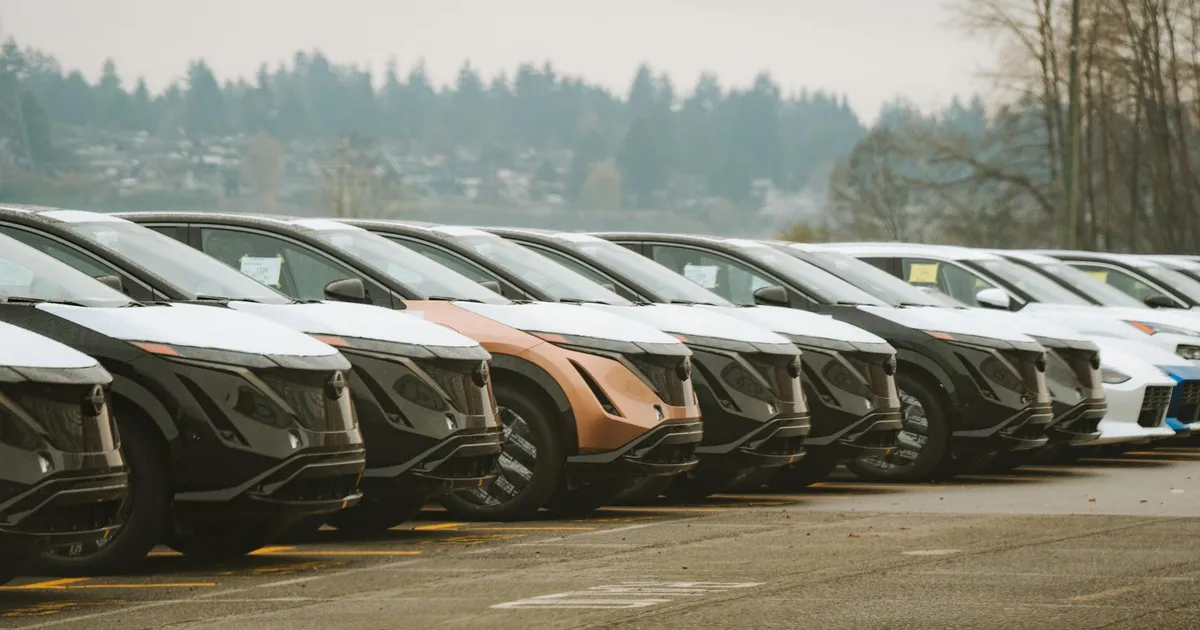
The numbers that should worry every legacy distributor
March 2026 was the month the New Zealand car market tilted. Total new registrations hit 14,910 units, up 25.1% on March 2025, the strongest March in four years. But the composition of those sales tells a sharper story. Fully electric registrations jumped 286% to 2,303 units. Monthly BEV volumes nearly quadrupled from a two-year average of 800 to 3,100. Plugin penetration reached 26%, matching the 2023 peak that required government rebates to achieve. This time there are no rebates.
And the brands capturing that demand are not the ones most fleet managers have on their procurement lists. Chinese brands BYD, Dongfeng, Chery, GWM, MG, and Jaecoo collectively took nearly 25% of the passenger market in March, with over 2,300 registrations. BYD surged 539.6% to 646 units, climbing 16 places to fourth overall. Dongfeng and Chery cracked the top 20 for the first time.
Incumbents are out of stock because they chose to be
The supply gap is not an accident. It is the result of ordering decisions made months ago by distributors who bet on subdued demand continuing. Motor Industry Association chief executive Aimee Wiley put it plainly: “New Zealand is a long lead-time market, and supply pipelines were set against more subdued demand, so available stock has been drawn down quickly.” The MIA warned that buyers wanting new EVs will likely face waiting lists stretching months.
GVI owner Hayden Johnston described the shift in buyer behaviour: “It’s gone from, ‘I’ve been researching these models and I’d like to drive them’ … to, ‘What EVs have you got? Ok, we’ll buy it.'” When customers stop caring about the badge and start asking what is physically on the lot, the brand with stock wins. Right now, that brand is more likely to be Chinese.
BYD’s New Zealand General Manager Warren Willmot was characteristically direct: “Before the war we would sell 300 BYDs a month. Now we are selling 200 to 300 in a weekend, nationally.” He added that if he had another 2,000 cars, he would have sold them.
The newcomers moved fast while legacy brands planned meetings
Dongfeng expanded from three Armstrong’s locations to seven retail sites by February 2026, adding Hamilton, Tauranga, and two more Auckland outlets. Its pricing is designed to undercut everything: the Dongfeng Box starts at $29,990, making it the cheapest new EV in New Zealand. The Vigo compact SUV at $37,990 sits where most fleet buyers shop.
Jaecoo, the Chery sub-brand, is launching its J5 EV at $42,990 with 402km range, a 7-year warranty, and 28-minute fast charging. It has already taken 150 New Zealand orders before deliveries begin. GAC, China’s fifth-largest manufacturer producing over two million vehicles annually, launched here in December with three models and plans three more in 2026. NIO is planning its own New Zealand entry. The pipeline is accelerating, not slowing.
Fleet buyers cannot afford to wait for the brands they know
This matters beyond showroom traffic. Fringe Benefit Tax exemptions for company EVs capture roughly 30% of new EV sales, making fleet procurement a major demand channel. Fleet managers whose shortlists feature Toyota, Nissan, or European marques are now staring at empty order books. The alternative is a Dongfeng at $29,990 backed by a growing dealer network, or a BYD that just won the 2026 Consumer NZ People’s Choice award for car ownership based on reliability, satisfaction, and trust. That award removes the last easy objection for risk-averse procurement teams.
For service providers, the challenge is different but equally urgent. The medium EV SUV segment alone now contains 53 variants. Independent workshops and fleet service operations will need tooling and training across a far wider range of platforms than anyone budgeted for two years ago.
The market will not wait for permission
The current surge is driven by fuel anxiety and geopolitical uncertainty, not policy. That makes forecasting harder, as Wiley acknowledged: “Current market performance is occurring against a backdrop of uneven economic conditions, with continued softness in household spending and private investment.” The MIA has called for a stable, evidence-based regulatory framework rather than the stop-start incentive cycle that saw PHEV uptake swing from 10.6% to 1.7% in a single year when rebates were axed.
But the brands that moved fastest did not wait for policy certainty. They shipped cars, signed dealers, and priced aggressively while legacy distributors calibrated their forecasts. New Zealand’s EV fleet only just passed 100,000 units. The market is still small enough that speed beats scale. The lesson for every distributor, fleet operator, and service provider is the same: the brands that showed up with stock are the brands that won the quarter. The ones still building their business cases are already behind.
Sources
- AutoTrader: EV and PHEV demand surges as new vehicle registrations jump 25% in March (2026-04-03)
- Motoring NZ: EV demand will outpace supply (2026-04-03)
- RNZ: EV ‘fomo’ drives sales to their highest level in years amid fuel crisis, dealer says (2026-04-04)
- CleanTechnica: New Zealand Car Yards Empty As Electric Vehicle Sales Surge (2026-04-06)
- AutoTalk: Dongfeng expands NZ dealer network (2026-02-28)
- Car Expert NZ: Jaecoo confirms sharp pricing for electric SUV (2026-03-20)
- EVs and Beyond: Jaecoo J5 EV records 150 New Zealand orders (2026-03-25)
- Autocar NZ: GAC confirms New Zealand debut with petrol, hybrid, and EV lineup (2025-12-15)
- BusinessDesk: Chinese EVs reshape New Zealand market as electric vehicle maker NIO plans entry (2026-04-04)
- Rich Little Ragdolls: NZ Electric Vehicle Registration Statistics 2026 (2026-03-15)
- AutoTrader: BYD NZ reports sales surge as fuel prices climb and brand earns Consumer NZ recognition (2026-04-02)
- Motoring NZ: Battery-reliant fleet hits milestone, what next? (2026-03-09)
- EVDB: NZ’s EV Market Highlights of 2025 (2026-01-15)