

Bronwyn Tremel wants manual tree felling gone. Her husband Mykhailo (Misha) Tremel, 39 and a father of two, was crushed by a falling pine on a Clevedon block in June 2022. Speaking to Morning Report this week, she was blunt: “We need manual tree felling abolished”.
It is easy to file this as a grief story. It is also a business story. The economics of manual felling were already shaky. The coroner’s findings make them close to indefensible for any contractor working on blocks where a machine could do the job.
A machine would likely have saved him
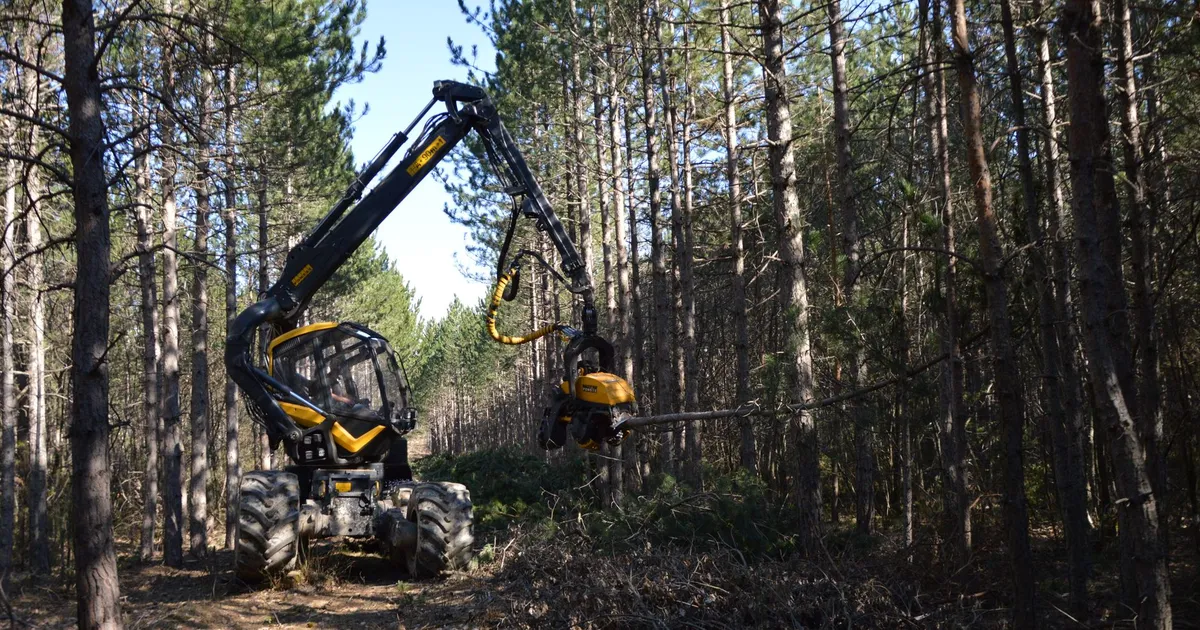
Coroner Rachael Schmidt-McCleave found Tremel’s death would likely have been prevented had a logging machine been used. She cited expert advice that manual fellers are 300 times more likely to die at work than the general workforce.
Tremel was felling windthrown trees, a category the industry and WorkSafe had already strongly recommended be harvested by machine because stems under unpredictable load can move without warning. The coroner wants WorkSafe to consider explicitly banning manual felling of wind-damaged, hung-up or otherwise upset trees, alongside mandatory observers, trauma kits, first aid training and site-specific emergency plans that identify the nearest helicopter landing point.
None of that is exotic. Most of it is what a well-run crew should already be doing.
A tiny workforce carrying half the deaths
The numbers explain why this keeps coming back. A 2024 Forest Industry Contractors Association analysis found that of 51 forestry deaths between 2013 and 2023, 24 were manual tree fallers. That is nearly half the toll from a workforce FICA estimated at about 167 full-time equivalents nationally.
The risk was concentrating, not spreading. At the time, FICA recorded that six of the last seven forestry fatalities were manual fallers, even though manual felling handled only about 15% of harvest volume, roughly 10,000 trees a day. Mechanisation has been steadily removing machine-operator deaths. What remains is the chainsaw.
The approved code of practice that took effect in July 2025 made the same point in aggregate, putting forestry’s fatality rate at 20 times the average for other industries. It recorded 40 deaths in 2015-2024, down from 49 in the previous decade. Progress, credited largely to machines, but still a toll no other sector would tolerate.
Contracting out does not contract out the risk
The Clevedon case also shows where liability lands. Tremel was engaged by Turoa Logging on a site run by Pulley Contracting, felling trees owned by Sharewood Forestry. In 2025 the two companies were ordered to pay more than $335,000 in fines and reparation. WorkSafe’s then area investigation manager Paul West said at the time that businesses “cannot contract their way out of responsibility”.
The more telling detail is what happened next. Turoa Logging stopped hiring contract tree fallers entirely. No regulator told it to. It simply concluded the work was not worth the exposure.
That is the market doing what the rule-makers have not. Every forest owner and principal contractor in the chain should be asking the same question, because the duty of care runs all the way up to whoever owns the trees.
Regulation stalled, so the market moved first
Cabinet agreed in principle in May 2021 to develop new forestry regulations. MBIE and WorkSafe told the coroner that work has been on hold since 2022. A centre-right reader should be wary of reflexive bans and prescriptive rulebooks. But four years of drift is not deregulation, it is indecision, and it leaves operators guessing about where the line will eventually fall.
The pressure is not all in one direction. The industry’s own safety council has warned that rising fuel costs could tempt contractors back toward motor-manual felling because it is cheaper to run than heavy machinery. With diesel prices where they are, that temptation is real. It is also exactly the wrong trade: saving on fuel while loading up on fatality risk, prosecution risk and reputational damage.
What contractors should do now
There will always be steep, small or awkward blocks where a machine cannot reach, and a blanket ban would hurt those operators hardest. The sensible position is narrower. Windthrown and compromised trees should come down by machine, full stop. Where manual felling remains, the coroner’s controls should be treated as the floor, not a wish list.
For contractors, the capital decision has effectively been made for them. Mechanised and winch-assisted felling is the safety answer, and it is also the answer to a shrinking pool of certified fallers. Whether WorkSafe acts on the coroner’s recommendations or Wellington finally dusts off its 2021 plans, any formal rule will mostly codify what the smarter operators have already worked out. The ones still running chainsaws into windthrow are not saving money. They are deferring a bill.
Sources
- RNZ: Wife of forestry worker fatally crushed by falling tree calls for manual felling to be abolished (2026-11-18)
- NZ Herald: Assisted machine tree felling would have likely prevented Mykhailo Tremel’s death – Coroner (2026-10-25)
- RNZ: Coroner calls for tougher safety standards after forestry worker crushed under falling tree (2026-10-26)
- RNZ: Companies fined over death of Clevedon forestry worker (2025-03-05)
- WorkSafe: Safe practice for forestry and harvesting operations – Approved Code of Practice (2025-07-28)
- FICA: Data analysis of all recorded manual tree falling fatalities 2013 to 2023 (2024-10-30)
- Safetree: Fuel price pressures and the risks of returning to motor-manual felling
Join the discussion
Add useful context, ask a good question, or challenge an idea — keep it specific and respectful.