

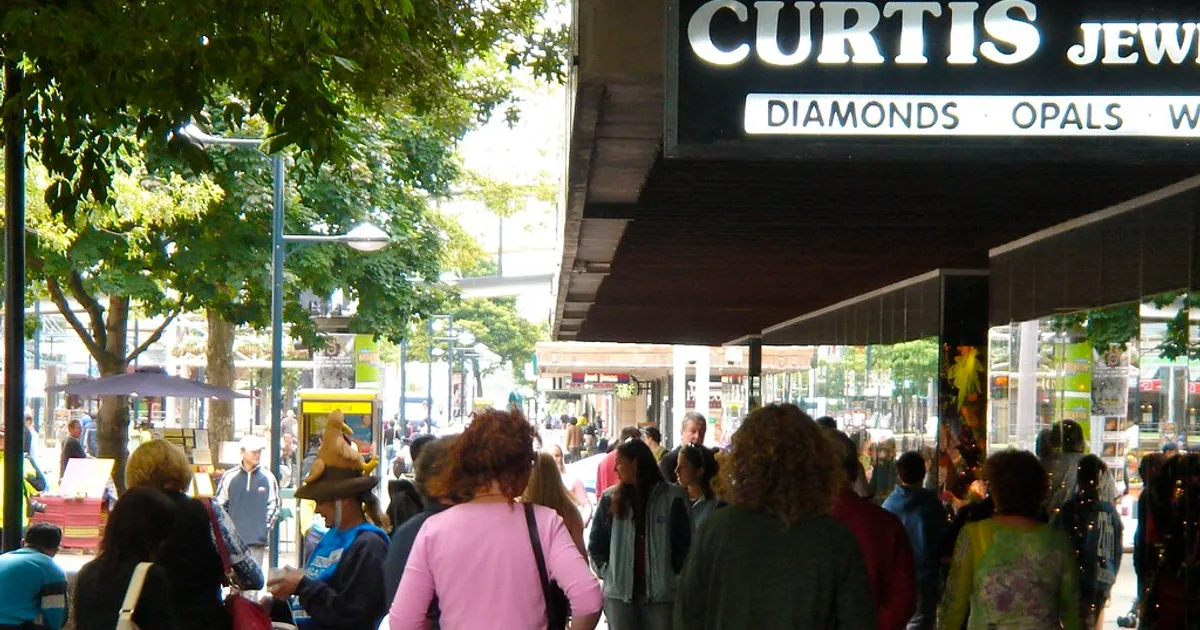
Forget the occupancy percentages for a moment. The clearest sign that central Christchurch retail has turned is that a prospective tenant offered an existing Cashel Mall retailer $250,000 in key money to walk away from its lease. No stock, no goodwill, no fit-out. Just the right to occupy the space. The answer was no.
That is what genuine scarcity looks like. And it is happening in a CBD that much of the country quietly wrote off during years of rebuild fatigue.
The numbers back up the anecdote
Colliers puts central Christchurch retail occupancy at 96%, with vacancy in the precinct bounded by Oxford Terrace, Lichfield, Manchester and Hereford streets falling from 5.6% in 2025 to 3.9% this year. Of 48,271 sqm of retail frontage in that zone, just 1,905 sqm sits empty.
JLL’s figures, using a wider lens, point the same way. Total Christchurch retail vacancy dropped to 6.1% in the first half of 2026, with the CBD at 5.2% and suburban centres tightening to just 2.0%. JLL singles out Cashel Street as the standout, as local and international brands commit to frontage.
The tenant list reads like a mall directory in a much bigger city. The North Face, Hikoco, Adidas, Asics, Lindt and Kookai have all moved into high-traffic CBD premises, while local institution Scorpio Books has expanded into a neighbouring former sandwich shop in Shades Arcade.
Landlords hold the cards now
For most of the post-quake era, the leverage sat with tenants. Incentives were generous, rent-free periods were standard and landlords were grateful for anyone willing to sign. That has flipped.
“Landlords are naturally holding a firmer line on both rent and incentives,” Colliers retail leasing broker Annabelle Bramwell says. CBRE reports that any vacated prime space on Cashel Street is “quickly backfilled”, and that average prime CBD rents now sit above NZ$1,000 per sqm per year.
The trajectory is steep. In 2024, The Press reported prime rents had jumped 40% in a year to average NZ$875 per sqm. Property investor Richard Peebles reckons CBD rents have roughly doubled over eight years, though he is candid that the base was dismal, recalling the “pre-Riverside days where we couldn’t bribe people to take the tenancies”. He estimates 10 or 12 tenants are actively hunting for Cashel Mall space, and calls the key-money offer “quite extraordinary.”
Why this is not a sugar hit
The obvious catalyst is One NZ Te Kaha stadium. CBRE says seven new retailers contacted it seeking CBD premises in the days immediately after the stadium’s April opening weekend. Colliers investment sales broker Marius Ogg describes “a halo over the CBD in terms of performance, occupancy, and the high regard for Christchurch from outside the region.”
But the stadium is the accelerant, not the whole fire. Peebles points to office worker numbers forecast to climb from 50,000 to 55,000 over the next three to four years, steady resident population growth, and a 22% year-on-year jump in summer tourist numbers, which he notes came before the stadium even opened. Those are structural drivers. They do not evaporate after one concert season.
Supply is coming too, but slowly. JLL flags a NZ$130 million, 18-building mixed-use development at 192 Cashel Street, yet it will deliver only about 650 sqm of boutique retail. That is a drop in the bucket against the queue of tenants circling.
The one number worth watching
There is a note of caution, and it is worth stating plainly. CBRE recorded a 1.1% decline in retail sales in the precinct over the 12 months to May 2026, even as leasing competition intensified. Rents and the scramble for space may be running slightly ahead of trading performance. Retailers paying top dollar for Cashel frontage need the foot traffic to convert.
Recovery is also not uniform. Back in 2024, the same Press report noted City Mall was in strong demand while Cathedral Square had vacant ground floors. Prime is prime, and the fringes still lag.
What other cities should take from this
While CBDs elsewhere in the country explain away empty shopfronts with talk of remote work and online shopping, Christchurch has quietly built the conditions retailers actually want: anchor infrastructure delivered, office workers returning to a compact core, and visitors with a reason to come. The pieces took far too long, but they are now in place.
For retailers eyeing the South Island, the window for cheap entry has closed. Expect firmer lease terms, fewer incentives and, on the best strips, the kind of key-money deals once associated with Sydney or Melbourne. For landlords and investors, the question is no longer whether the Christchurch CBD works. It is how quickly new retail floor space can be delivered to meet demand that, for once, is outrunning supply.
Sources
- NZ Herald: Christchurch retail boom: Big-name stores sign leases as jostle for Cashel Mall sites hots up (2026-11-08)
- OneRoof: Space ‘at a premium’ in Christchurch CBD (2026-10-10)
- JLL: Christchurch Retail Market Dynamics Q2 2026 (2026-08-12)
- The Press: ‘Christchurch is the place to be’: More buildings coming as rents rise (2024-09-08)
Join the discussion
Add useful context, ask a good question, or challenge an idea — keep it specific and respectful.