

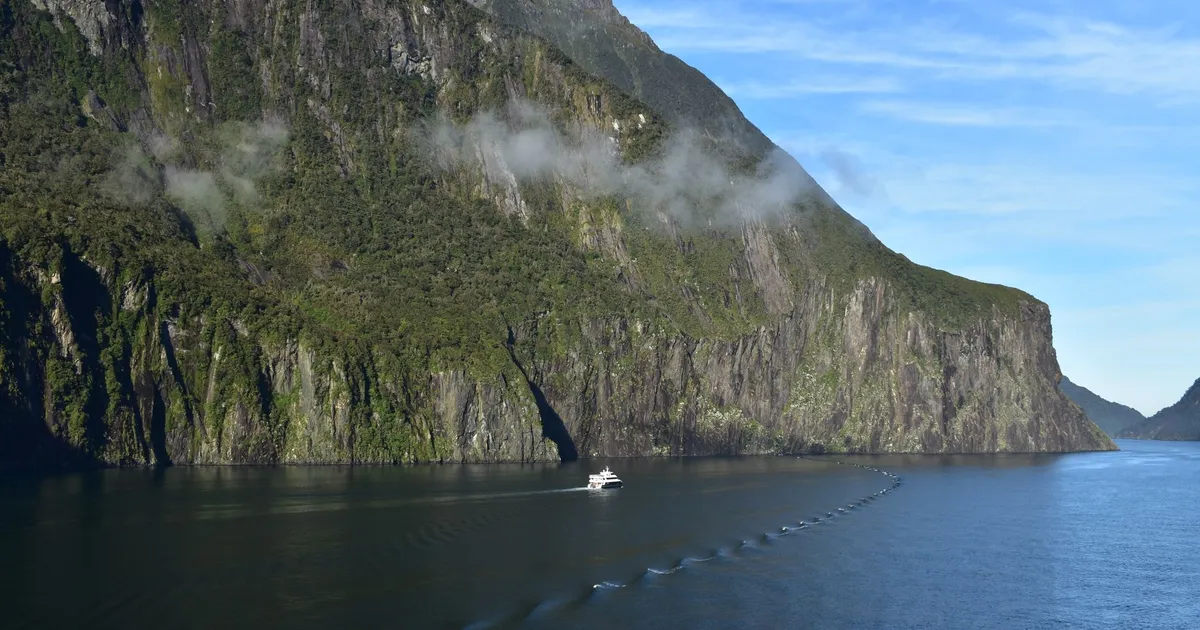
New Zealand has a tourism growth target with a hole in it. The government wants to lift international arrivals from 3.51 million in 2025 to 4.78 million by 2034, and Tourism and Hospitality Minister Louise Upston frames it plainly as economic growth, jobs and incomes. Fair enough. But the country is selling its most dangerous postcard spots harder than it is planning to get people out of them, and when the plan fails, the bill lands on the operators and councils least able to carry it.
The numbers at Milford are grim
In June, NEMA chief executive Dave Gawn told MPs that a 2024 estimate of a 4-5 percent survival rate for a tsunami at Milford Sound remained unchanged, with up to 4,000 visitors in the sound at once. He called the lack of exit routes “one of our biggest risks”. NEMA’s answer is two more years of research. Alert boards have gone up at Homer Tunnel. Evacuation infrastructure has not.
The 2025 risk assessment released under the Official Information Act was blunter. It found the Alpine Fault probability had been reassessed from 27 percent to 75 percent, that a landslide-induced tsunami could kill up to 2,500 people, and that few or none could escape before the first wave. Officials judged the societal risk “intolerable”, more than double that calculated for Whakaari. The same document noted visitor numbers had climbed from 462,000 in 2014 toward an expected 1 million by 2030, and that the Crown’s own promotion of the fiord heightened its responsibility.
That last point matters. The Crown markets the destination, sets the growth target, and then treats safety as a local operational detail.
A new law that forgot the tourists
The Emergency Management Act replaced the old CDEM Act in September. University of Otago researchers writing in Newsroom note it contains no explicit language on tourists or international visitors, leaving agencies to squeeze them into a “disproportionately affected communities” category. Tourists are not a community. They speak dozens of languages, arrive with no local knowledge and leave within days.
That is not a theoretical weakness. A 2023 Natural Hazards study found near-source tsunamis, precisely the Milford scenario, usually cannot be predicted with enough lead time to protect tourists, who are far less aware of local hazards than residents.
Advisory guidance is not a plan
What exists instead is a patchwork. MBIE’s Destination Management Guidelines encourage regions to build risk and crisis management into planning, but they are advisory, unfunded and unmonitored. DOC manages hazards at its own sites, and a 2021 DOC review found seasonal risks like avalanche were handled competently. That review predates the far worse tsunami modelling.
The gaps underneath are structural. A 2024 Resilience Challenge policy brief found civil defence groups and regional tourism organisations lacked funding to link operators with formal emergency management, and that in small towns tourism staff often doubled as search-and-rescue or volunteer firefighters with no extra support. Research published in 2025 in the Journal of Sustainable Tourism examined how disaster management networks at Piopiotahi form, or fail to form, largely on goodwill.
Goodwill is not a business continuity strategy.
Who actually wears the cost
Here is the commercial reality. If a mass-casualty event hits a Crown-promoted site, the first responders are the bus driver, the cruise skipper and the lodge manager. The first funder is a small district council. The first repricing comes from insurers, who will look at a 75 percent fault probability and a single-digit survival estimate and adjust premiums, exclusions and appetite for every operator in a high-risk zone. The reputational hit to the national brand would be shared by every exporter trading on it.
None of that is an argument against growth. Tourism is worth backing; the post-Covid rebound pushed total tourism spending to $37.7 billion in the year to March 2023. It is an argument against growth that quietly transfers catastrophe risk from the agency setting the target to the businesses delivering it.
The question the bed tax debate skips
This campaign’s tourism argument has been about levies and bed taxes, which is a debate about how to raise money. The prior question is what the money is for and who owns the risk. A pro-growth government should want this settled, because unpriced risk is exactly what scares off investment in regions like Fiordland.
The fix need not be a new bureaucracy. Name visitors explicitly in emergency planning, make destination risk plans a funded condition of the 2034 target rather than a suggestion, and decide whether international visitor levy money builds egress at sites the Crown itself advertises. Whichever party forms the next government should answer that before the next 4,000 people sail into the fiord on a sunny afternoon.
Sources
- Newsroom: Campaign Cut-through: Boosting tourism without protecting visitors is a risky bet (2026-11-01)
- RNZ: NEMA investing in new research about dangers if tsunami hits Milford Sound (2026-06-17)
- NEMA: Milford Sound Tsunami Risk Assessment – Released under Official Information Act (2025-03-12)
- Natural Hazards: Reducing the vulnerability of tourists to tsunami – challenges for decision-makers (2023)
- DOC: Milford Opportunities Project – Hazards and Visitor Risk Review Report 2021 (2021)
- Resilience Challenge: Tourists, tourism destinations, and natural hazards – Policy Brief (2024-08)
- Stats NZ: Tourism satellite account, year ended March 2023 (2023)
Join the discussion
Add useful context, ask a good question, or challenge an idea — keep it specific and respectful.