

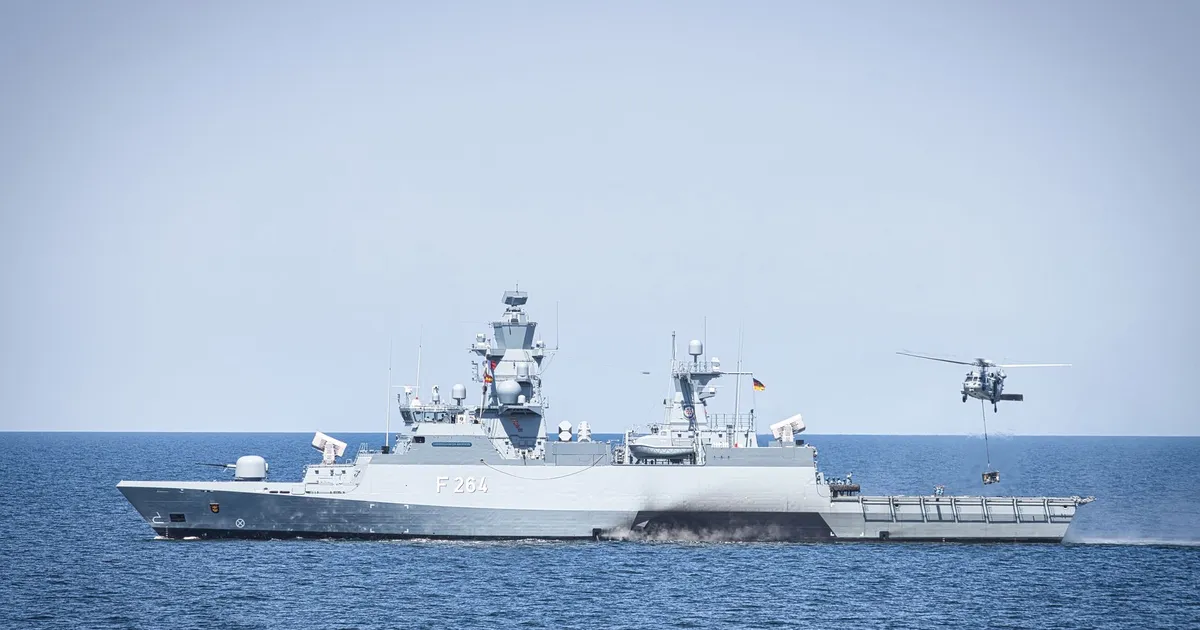
NZ First wants to cancel the Navy’s frigate replacement, and the lazy reading is a party hunting for savings. It isn’t. Ron Mark, NZ First’s returning candidate and a former defence minister, has confirmed the party would scrap replacement frigates reported at $6-8 billion, while the same platform would lift defence spending to 3% of GDP by 2032. The money does not disappear. It moves, away from legacy warships and toward drones, munitions and, if NZ First gets its way, local manufacturers.
With the election a week away, that turns the fate of HMNZS Te Kaha and Te Mana into a coalition bargaining chip worth an estimated $22 billion over the next 30 years.
Ukraine rewrote the cost curve
Mark recently spent several weeks in Ukraine, and it shows. NZ First’s six-year plan points to Ukraine’s success using uncrewed surface and subsurface drones against Russia’s navy. The plan, as reported by the NZ Herald, questions “the value of committing billions to legacy capital ships vulnerable to low-cost autonomous weapons”, notes the government has already spent more than $500 million extending the old frigates’ lives, and proposes pre-funded contracts for domestic firms able to pivot to drone and munitions production in a crisis.
Mark is not diplomatic about the people who will advise against him. He told Newsroom defence chiefs “polish their arse on a seat in Wellington” instead of learning Ukraine’s lessons in asymmetric warfare.
The underlying point is hard to dismiss. A sea drone that costs a fraction of a frigate and can threaten one has changed the arithmetic of naval spending everywhere, not just in the Black Sea.
The Navy’s allies say drones need a mothership
The strongest rebuttal comes from friends, not rivals. Vice-Admiral Steve Moorhouse, fleet commander of the UK’s Royal Navy, told senior New Zealand counterparts a frigate-less fleet is not an option “unless you’re comfortable that your sensor platform with a really expensive radar could be taken by somebody.” The same briefing cited NZDF analysis suggesting a hybrid of frigates and uncrewed vessels could deliver up to three times the capability of a traditional fleet at reduced cost.
That hybrid is the likeliest landing point. The UK’s Type 31 and Japan’s Mogami-class, already chosen by Australia, are the named contenders, and the formal process still has Cabinet advice due by the end of 2027, with no option ruled out.
Three parties, three different bets
NZ First is not the only party unsettling the plan. Labour’s defence spokesperson Damien O’Connor has cast doubt on whether the $12 billion capability upgrade adopted in 2025 under then-defence minister Judith Collins was ever properly funded. He also rejected Ukraine’s offer to help develop military drones, saying “We shouldn’t engage in that at this point.”
That is an awkward stance given more than a dozen countries, including New Zealand’s Five Eyes partners, have taken up that offer in some form this year. National’s Paul Goldsmith said officials have been weighing the drone opportunities Ukraine raised, which puts National in the middle: keep the frigate process, bolt drones on.
The real fight is over who gets the contract
For business, the headline split between frigates and drones matters less than where the procurement dollar lands. In 2025, the Defence Capability Plan earmarked $300-600 million for frigate sustainment through 2028, against just $50-100 million for uncrewed persistent surface surveillance vessels. That ratio tells you where the system’s instincts sit.
A conventional frigate buy sends the bulk of capital offshore, with local industrial participation negotiated around the edges. NZ First’s model inverts that. Dr Del Carlini made the sharpest version of the case in August, arguing for putting “a billion dollars, incentives and government support into local companies“, potentially through a joint venture with Ukraine, to “turn a cost into an industry”.
That is industrial policy, and centre-right readers should treat it with the usual scepticism about governments picking winners. But defence is one of the few sectors where the state is the only customer anyway. The question is not whether the government spends, it is whether it buys a finished product from abroad or seeds a domestic capability with export potential.
What happens next
NZ First is right that the cost curve has shifted and wrong if it thinks a modern navy can run on drones alone. The probable outcome of coalition talks is a smaller crewed fleet paired with far more uncrewed capability than officials had planned, and a bigger share of the budget pointed at local suppliers.
Marine engineers, autonomous systems developers and precision manufacturers should be paying attention now. Whatever coalition forms next month, the 2027 Cabinet decision will be shaped in the negotiating room, and the firms with credible capability on the table will be the ones that get written into it.
Sources
- Newsroom: NZ First would cancel $6-8b replacement frigates (2026-10-28)
- Newsroom: How coalition talks could sink legacy warships (2026-10-29)
- NZ Herald: NZ First’s defence plan: Enforce ‘warrior’ mentality, no diversity hires and spend 3% of GDP (2026-10-21)
- Newsroom: UK Navy pitches ‘hybrid’ drone and frigate model for NZ military (2026-09-15)
- Ministry of Defence: Maritime Fleet Renewal
- RNZ: Labour rejects Ukraine drones offer, questions Defence upgrade plan (2026-10-22)
- Ministry of Defence: Defence Capability Plan 2025 (2025)
- Just Defence: Dismantling our Navy could turn NZ into a formidable defence force (2026-08-10)
Join the discussion
Add useful context, ask a good question, or challenge an idea — keep it specific and respectful.