

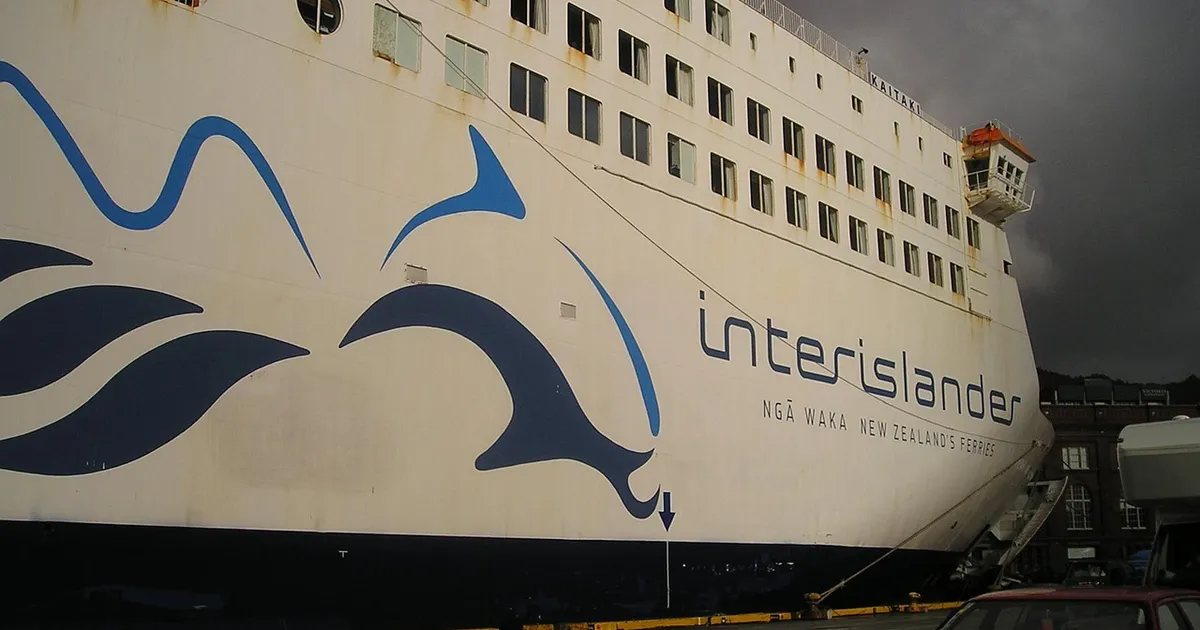
The Cook Strait ferry replacement has already spent its allowance. The programme, run by Crown company Ferry Holdings, hit the Government’s $1.7 billion funding ceiling in June, forcing the removal of ‘value-for-money, sustainability and safety enhancements’ from scope. In the same month, an independent Gateway review gave the programme an Amber rating and found ‘no clear economic framework such as a cost-benefit analysis’ behind it.
Put those two facts side by side and the fiscal discipline story gets thin. A cap tells you how much you are willing to spend. It tells you nothing about whether you are buying the right asset for the country’s most important freight crossing.
The cap held because someone else paid
The Final Approval business case shows the money going on $596m for two ferries, $403m for Wellington port works and $426m for programme management and contingency. Another $37.5m was committed this month for Picton rail-yard upgrades and auto-mooring, taking Picton infrastructure to $530m. Total costs sat above the $1.747 billion envelope Cabinet set in March 2025.
The gap was closed with other people’s balance sheets: $110m from Port Marlborough, $100m from CentrePort, $10m from the Transport Agency, and roughly $220m more in third-party contributions still being negotiated. The business case states that ‘all the Crown funding ($1.704 billion) is required to deliver the programme’. There is no margin left inside the official envelope.
Worse, a November 2025 document noted Port Marlborough’s $110m, funded by a Marlborough District Council loan, was ‘up to the maximum of its affordability.’ The ‘within cap’ headline rests partly on ratepayers who are already tapped out.
Discipline to the minister, blind spots to the reviewers
Minister for Rail Winston Peters told RNZ the approach was deliberate: ‘We have only added cost where the taxpayer and ratepayer was not paying, where it added commercial value, and where we could be assured it would not delay the programme.’ It was, he said, ‘easy to remove costs, but very hard to add them.’ The trimmed extras remain reconsiderable ‘subject to affordability.’
The reviewers were less flattering. They found ‘limited evidence of a structured investment logic linking problem definition, options assessment and the preferred solution’, and said the absence of measurable objectives constrained any assessment of whether the solution would meet the underlying business need. Commercial, financial and management delivery each scored 3 out of 4. Translation: the team can probably build what it has chosen. Nobody can show it chose well.
That is a materially different claim from ‘we stayed on budget’, and it should worry anyone who has ever signed off a capital project.
The warnings were already on file
Treasury’s November 2025 report on key Cabinet decisions showed the ‘maximum-reuse, minimum-viable’ programme rated ship costs at High confidence but Wellington infrastructure at only Medium, because CentrePort’s work rested on pre-concept design. The latest documents show CentrePort did not know the condition of many of the assets it planned to reuse. That is exactly what a proper feasibility and cost-benefit study surfaces before an envelope is locked.
In March 2026, an unredacted briefing revealed the $596m vessel price excluded delivery, contingency and exchange-rate costs that could lift it to $716m. Ferry Holdings chief executive Sandip Ranchhod said at the time that contingency was only drawn if required, and that $313m had been set aside for overruns. Seven months later, the contingency-heavy budget is maxed out.
Same failure, second generation
This programme exists because iReX collapsed. Back in 2021, Treasury’s advice on iReX recorded KiwiRail signing a Letter of Intent with a South Korean shipyard while Treasury’s own assessment was squeezed to meet KiwiRail’s timetable, and flagged cost-management concerns from the outset. The core complaint then, weak business case and uncertain costs, is the core complaint now.
In 2025, an analysis in The Conversation argued New Zealand ‘tends to underestimate costs, create unfeasible timelines, then shows dismay when projects blow up.’ It noted almost 80% of past ferry cost escalation came from seismic wharf upgrades rather than ships, and that the Infrastructure Commission ‘lacks similar teeth and independence’ to Infrastructure Australia. Two ferry programmes in, the port side is again the soft spot.
Freight carries the risk
The Cook Strait is State Highway 1 and the main trunk line on water. The same 2025 analysis warned a gap in rail-ferry capacity could sever the interisland rail link for almost five years, pushing freight onto roads, with ageing-fleet maintenance then projected to nearly double to $65m a year. Every exporter, retailer and manufacturer moving goods between islands is exposed if the 2029 delivery slips or the deferred safety work returns as a future bill.
The centre-right instinct to cap spending is right. But a cap is a constraint, not an analysis. With $220m of third-party money still unsigned and a Crown envelope with zero headroom, the Government should commission the cost-benefit work the reviewers asked for now, while scope can still change cheaply. Otherwise the next Gateway review will be writing the iReX obituary for a second time.
Sources
- RNZ: Ferry replacement project hit government’s $1.7b ceiling in June (2026-10-29)
- ODT: Ferry replacement project reached $1.7b ceiling mid-year (2026-10-29)
- The Post: Unredacted briefing blunder reveals hidden Cook Strait ferry costs (2026-03-18)
- Treasury: Cook Strait Ferry Replacement programme – key decisions (2025-11-06)
- Treasury Report: KiwiRail – advice on Project iReX (2021-06-30)
- The Conversation: NZ will soon have no real interisland rail-ferry link – why are we so bad at infrastructure planning? (2025-07-03)
Join the discussion
Add useful context, ask a good question, or challenge an idea — keep it specific and respectful.