

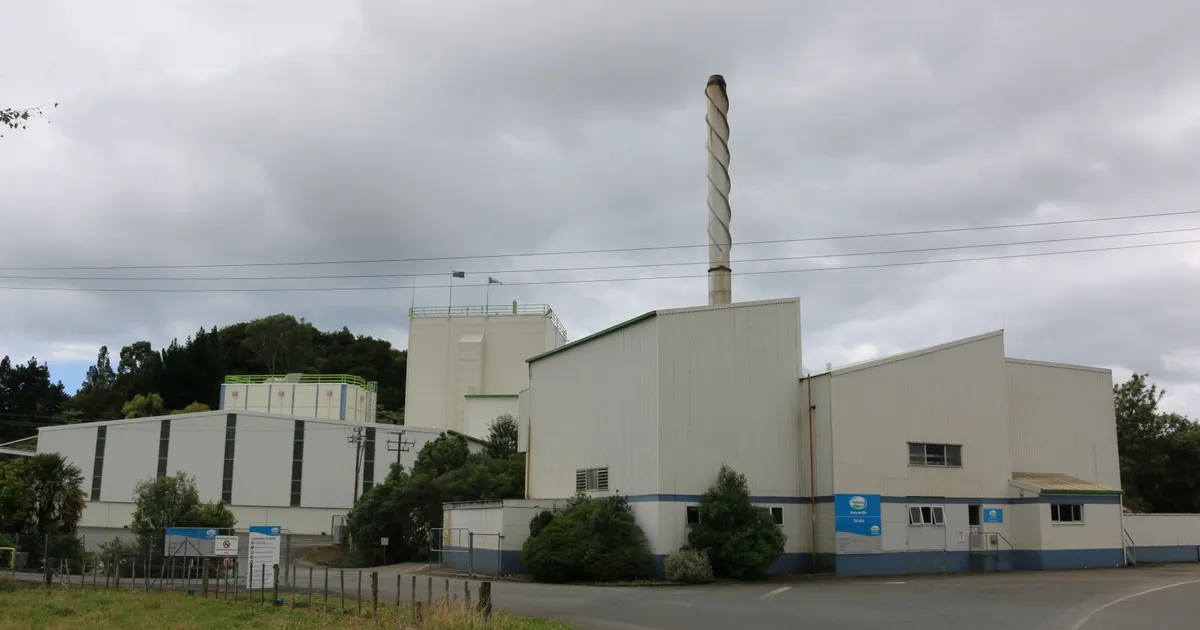
Fonterra has moved its energy complaint from the cost line to the continuity line. In this year’s Mood of the Boardroom, managing director co-operative affairs Matt Bolger warns that prolonged energy outages could threaten dairy processing. Coming from the company behind $25 billion in FY2026 export earnings, that is not a household-bill gripe. It is a supply-chain risk sitting under New Zealand’s largest export sector.
From expensive to unavailable
The shift in language matters. In August 2024, when hydro lakes ran low and gas tightened, wholesale prices doubled over three weeks to exceed $900/MWh. BusinessDesk reported prices trading above $800/MWh, up from roughly $150/MWh. Fonterra’s then-COO Anna Palairet said at the time the co-op was “confident that energy remains available to process milk”, but that the situation was adding significant cost “as we cannot simply pause operations.”
That last line is the whole story. Milk does not wait. A factory that loses power at peak season is not deferring production, it is losing it. In 2024 the concern was margin. In 2026 Fonterra is openly questioning availability.
Contracts, not just tariffs, are on the line
Bolger’s broader pitch is about growth: strong US demand for New Zealand dairy protein, rising capital and IT spend, and a $1 billion investment in South Island value-add ingredients. Those premium ingredient customers pay for reliability. A multinational food company that misses a production run because a New Zealand supplier could not keep its plant running will remember.
That risk is sharper because the country’s trade position is narrow. Bolger estimates New Zealand has access to only around 14% of global dairy consumption at tariffs below 10%. When you cannot win on market access, you win on dependability. Lose that and the premium goes with it. And with $19.6 billion of the $25 billion flowing back into the domestic economy, roughly 78 cents in every export dollar, the exposure is not just Fonterra’s.
The co-op has already spent its way to the limit
This is not a company asking someone else to fix its problems. Fonterra’s FY25 annual report showed it retired its last coal boiler in November 2024, committed $150 million to electrify North Island sites including a $64 million electrode boiler at Whareroa, and spent $104 million in FY25 on energy security and decarbonisation out of $635 million in essential capex.
Here is the irony business readers should notice. Electrification cuts emissions and coal risk, but it ties more of the processing base directly to the grid. Every electrode boiler that replaces a coal boiler makes Fonterra more dependent on transmission and generation it does not control. The co-op has done the decarbonising the policy settings asked for, and in doing so has concentrated its exposure in exactly the system it is now worried about.
A structural problem with regulatory fingerprints
Fonterra’s view that this is beyond its own engineering is on the record. In a July 2026 submission, the co-op told the Electricity Authority the transmission pricing methodology is “no longer fit for purpose,” arguing stable, affordable access is fundamental to export competitiveness.
The Authority itself has seen the warning signs. In 2025 it flagged the decline of the Pohokura gas field, the country’s largest, as a structural pressure on supply, and tightened stress-testing to require participants to report hedge cover each quarter. Monitoring risk is useful. It is not the same as reducing it.
Exposure depends on your contracts
The 2024 spike also showed the damage is uneven. Pan Pac closed pulping operations, ANZCO forecast its power costs would double, while Alliance was insulated by long-term supply contracts. For any energy-intensive exporter, hedging and contract structure is now a competitive differentiator, not back-office housekeeping. Energy has climbed business worry lists more broadly, and boards that have not stress-tested a multi-day outage are behind their largest peer.
What happens next
The fix is not another subsidy round. It is faster consenting for generation and transmission, a pricing regime that rewards firm supply, and a credible plan for the gas cliff before it arrives rather than after. When the country’s biggest exporter says it has spent hundreds of millions and still cannot guarantee its plants stay on, the policy debate needs to stop treating electricity as a consumer affordability issue. It is export infrastructure, and it should be regulated like it.
Sources
- NZ Herald: Fonterra warns prolonged energy outages could threaten dairy processing (2026-10-25)
- RNZ: Power price rises hitting export competitiveness – Fonterra (2024-08-12)
- BusinessDesk: Fonterra ‘significant cost’ from high energy prices (2024-08-08)
- Fonterra Annual Report 2025 (2025)
- Fonterra submission to Electricity Authority on Transmission Pricing Methodology amendments 2026 (2026-07-24)
- Electricity Authority: Electricity hedge prices and conditions for this winter (2025-06-11)
- Stuff: Energy is now a top-two business worry, and many firms say they could last only days in an outage
Join the discussion
Add useful context, ask a good question, or challenge an idea — keep it specific and respectful.