

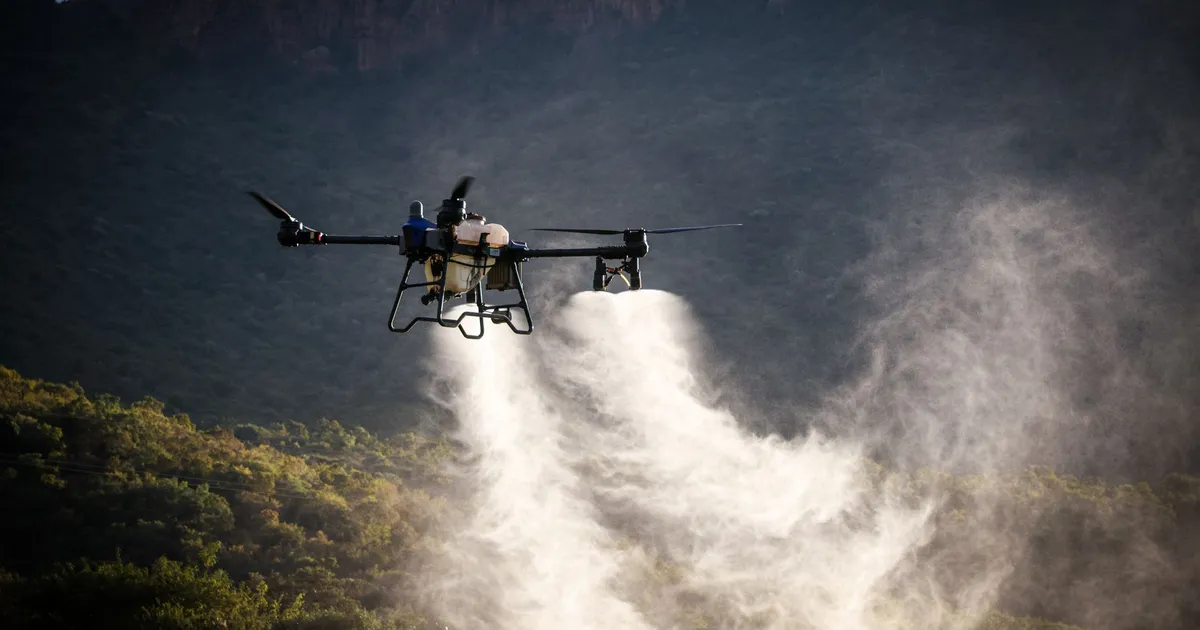
Christchurch R&D firm SPS Automation has unveiled a drone that matters less for what it is than for what it does to the cost of land management. The BFD 70, shown at the 2026 New Zealand Aerospace Summit, will sell for around $150,000 when it launches in early 2027. It is designed to fly over rough high country, identify a wilding pine, judge its size, apply the right dose of herbicide and move on to the next tree, all without a person at the controls.
That is expensive, slow and dangerous work that has long depended on ground crews and helicopters. Automating it is about as clear a productivity case as New Zealand gets.
Bigger tank, longer day, no pilot in the seat
The BFD 70 measures 4.5 metres rotor tip to rotor tip, has a 160kg maximum takeoff weight and carries up to 50kg of spray, against 12kg for its predecessor. A 350cc two-stroke engine gives two hours at full payload or up to 12 hours lightly loaded. Nvidia-powered AI, stereoscopic cameras and lidar handle navigation. An operator can set it to clear an area of, say, five square kilometres and let it work.
First jobs will be forestry release spraying, clearing grass competing with new plantings, plus wilding pines, pampas, gorse and broom. Chief executive Scott Spooner says BFD officially stands for Big Friendly Drone. The in-house version is less suitable for print.
The trial numbers already look good
This is not a prototype from nowhere. SPS Automation’s smaller AC-16 was, according to a 2025 report, priced at around $85,000. In a February 2026 trial with Central Otago District Council and the local wilding conifer group, an AC-16 swarm sprayed more than 300 conifers across 500 hectares at Loganburn in under three days, with a follow-up survey recording a 100% kill rate. One drone surveys and maps every tree, then an algorithm plans the swarm’s flight paths.
In Southland, Spooner told RNZ, a 500-hectare block that would have taken a ground crew two weeks was done in two days. He is careful not to oversell it: “There is enough work for ground crews, helicopters and drones, but we can target a lot of really complicated areas very effectively.” The company is also building swarm software to let one pilot run 10 or more drones, potentially around the clock.
That honesty helps the business case. Nobody is pretending robots alone will clear the high country. The point is that each dollar of labour stretches further.
The Crown is spending more, so efficiency matters more
Budget 2026 added $79 million over three years, lifting total programme spend to $109 million. That works out to roughly $36 million a year, more than double the 2025/26 run rate of about $15 million. Prime Minister Christopher Luxon put the cost of doing nothing at $3.6 billion over 50 years, and an MPI cost-benefit analysis found every dollar spent on control returns more than $30.
With returns like that, the constraint is not whether to spend but how far the money goes. If drones cut hectares-per-crew-day costs, the same $109 million buys more cleared land.
The work is also changing shape. Around Lake Tekapo, LINZ now uses drones to find the last isolated stragglers after big infestations have been knocked down. “At this stage, every tree matters,” says LINZ biosecurity leader Tracey Burton, adding that surveillance and follow-up control will remain essential as seedlings keep appearing. Drone imagery sends ground crews straight to the tree, cutting search time. Heavy spraying and precision detection run on the same imaging and AI stack.
Red tape was the bigger cost
The hardware has been ahead of the rules. Certification for lower-risk routine drone work can take up to nine months and cost thousands of dollars. In August, Regulation Minister David Seymour and Associate Transport Minister James Meager announced plans to replace that with simple advance notification to the CAA, with new rules due by mid-2027. Seymour’s argument is blunt: overseas competitors spray “at a fraction of the cost compared to Kiwi farmers.”
That is the right call. Safety and environmental protections should stay, but a nine-month queue for routine spraying is a tax on productivity with no obvious public benefit.
AgriTechNZ chief executive Brendan O’Connell says work that took six hours with a tractor on hilly ground can now take about an hour with a drone, and that farmers buy technology that is affordable and makes the job easier.
What forestry and farm operators should do now
Forestry companies, high country stations, councils and biosecurity contractors should be pricing drone work into their 2027 plans, not treating it as an experiment. The BFD 70 lands around the same time as the regulatory relief, and the trial data is already in. A Canterbury-designed, Timaru-built machine is poised to make one of the country’s costliest land problems cheaper to fix. That is a win worth backing, and a template other rural sectors should copy.
Sources
- NZ Herald: Christchurch firm’s giant drone to use AI for forestry, targeting wilding pines (2026-10-06)
- Otago Daily Times: Sky’s the limit for use of drones (2025-09-23)
- RNZ: Country Life – Drilling down into drones on farm (2026-07-04)
- RNZ: Government doubles funding for wilding pine control efforts under a Budget 2026 boost (2026-05-24)
- Beehive: Plans to reduce CAA certification requirements for agricultural drones (2026-08)
- NZ Herald: From drones to data, how AI is transforming New Zealand farming (2026)
Join the discussion
Add useful context, ask a good question, or challenge an idea — keep it specific and respectful.