

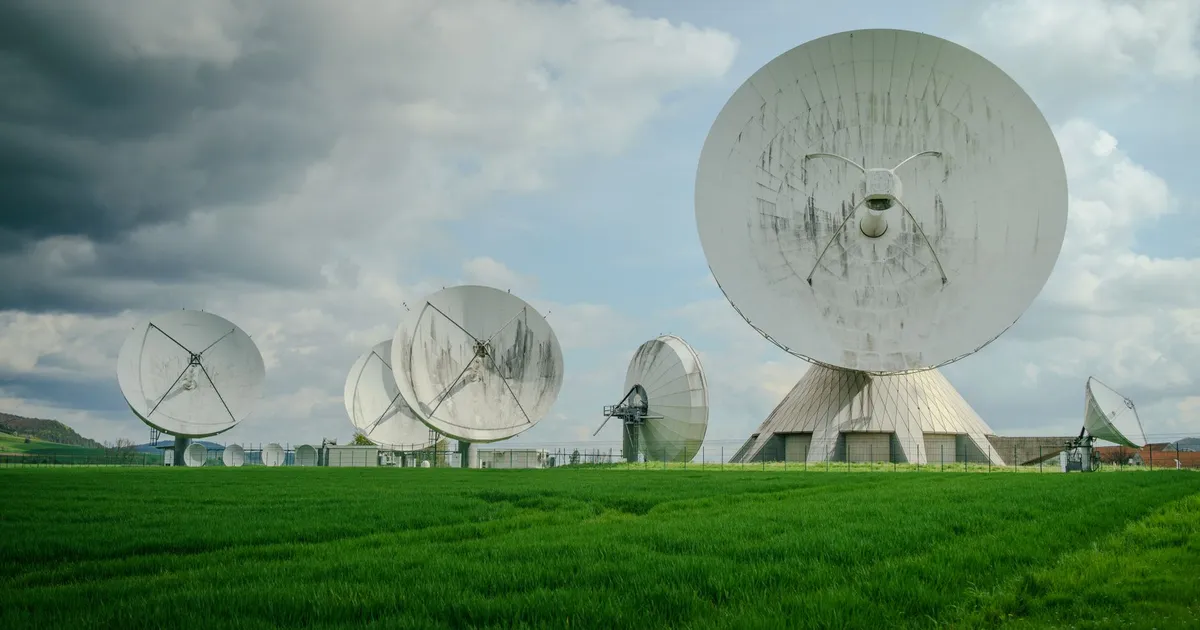
Ask most people about New Zealand in space and they’ll say Rocket Lab. The more useful answer for business is a paddock south of Invercargill. There, SpaceOps hosts antennas for Lockheed Martin, Norway’s KSAT and Italy’s Leaf Space, and expects to turn over about $5 million this year with 11 staff.
That is the sector’s real commercial model. It doesn’t chase sovereign ambition. It sells specialised capability that global aerospace firms can’t easily get anywhere else.
Geography turned into a product
SpaceOps runs ground stations at Awarua and Warkworth. It holds more than 700 radio licences, and a new $4.55 million headquarters is under construction at Awarua. The site traces back to 2004 and a €200,000 European Space Agency grant. It has since grown to 32ha, funded entirely by company profits.
The public money that did arrive came as a loan. In September 2025 the government announced a Regional Infrastructure Fund loan of up to $2.25 million towards the build. At the time, Great South said SpaceOps expected to double its highly skilled workforce within five years. That is the right structure: back a profitable operator’s expansion with repayable capital, not a grant.
The numbers outgrew the hype
The sector-wide data is stronger than most business owners realise. In 2025, MBIE reported that New Zealand space revenue rose from $1.75 billion in 2019 to $2.68 billion in FY24. That is a 53% rise, against global growth of 40.6%. The sector directly supported 7,000 FTE jobs, earned 29% of its revenue offshore, and ran an R&D intensity of 11%, against a national average of 1.4%.
Space operations, the bucket SpaceOps sits in, accounted for $597 million of that revenue. The industry is also spread across the country rather than concentrated in one city, with Auckland, Christchurch and Wellington all hosting meaningful clusters. The government’s 2024-2030 strategy targets doubling the sector by 2030.
BERL put the logic bluntly in April 2025. New Zealand has no NASA, and a state-funded space programme “is not our lane, nor where we are economically competitive“. BERL counted 27 specialist space companies at the time, and every one of them fits the same pattern: niche technology sold into someone else’s supply chain.
Titanium, thrusters and solar sails
The case studies make the point better than any strategy document.
Auckland’s Zenith Tecnica prints titanium structures for NASA’s Psyche mission and for the US Space Development Agency’s missile-tracking constellation. Its process melts Canadian titanium powder costing over $1,000/kg in 50-micron layers. The firm has just changed hands, and long-time customer Lanteris was bought by Intuitive Machines for US$800 million in January. When your customers are being acquired at that price, your capability is worth something.
Christchurch’s Dawn Aerospace had already won a contract with Starlink rival Lynk back in 2023, after a raise at a $170 million valuation. By August 2025 it held a binding US$17 million contract with Oklahoma’s space authority. That deal was supported by an export credit guarantee covering 50% of a Kiwibank working capital facility. Again, the state shares risk on a commercial loan rather than writing cheques.
In 2024, Callaghan Innovation reported that Astrix Astronautics’ Copia solar array was 20 times more space efficient than conventional designs. Astrix was then the only New Zealand firm making and exporting satellite power systems.
The dual-use question needs a board answer
There is one wrinkle worth flagging. SpaceOps is wholly owned by Great South, which is funded by Southland’s four councils. Its work touches GPS infrastructure, Lockheed Martin’s SouthPAN project and, by founder Robin McNeill’s own account, a “covert operation” related to NZDF security.
McNeill says the company has no policy on military-linked work and doesn’t need one: “We’ve got enough other things to do without spending ages developing a policy that we don’t need.” Great South chief executive Chami Abeysinghe, who sits on the SpaceOps board, points to compliance with spectrum law and treaties.
That compliance is fine as far as it goes. But a ratepayer-owned company in an increasingly dual-use industry should have a written position its owners have signed off. The point is to protect the business from a future controversy, not to restrict it. A short board policy is cheap insurance on a growing asset.
Where the next contracts come from
The lesson for business is that New Zealand’s space advantage is a supply-chain story. Machinists, electronics firms and engineers with tight tolerances can sell into it without ever going near a launch pad. The sector grew faster than the global market by doing unglamorous things exceptionally well.
The constraints from here are practical. SpaceOps’ land and airspace dispute with neighbouring developer Calder Stewart shows physical growth won’t always be welcome. Skills will also bind before demand does. Doubling the sector by 2030 is plausible, but only if councils, lenders and regulators treat these firms as the export businesses they already are.
Sources
- ODT: ‘We’re globally important’: Inside the rise of a Kiwi space company (2026-11-01)
- ODT: Loan to aid South’s space sector (2025-09-02)
- BERL: New Zealand’s ascent in the space industry (2025-04-02)
- NZ Herald: Satellite parts maker Zenith Tecnica under new ownership – what’s next (2026-07-13)
- NZ Herald: Christchurch’s Dawn Aerospace wins major contract with Starlink rival Lynk (2023-05-08)
- NZ Export Credit: Enabling Space Innovation – Working Capital Support for Dawn Aerospace (2025-08)
- Callaghan Innovation: Astrix – unique inflatable space deployment (2024-12-10)
Join the discussion
Add useful context, ask a good question, or challenge an idea — keep it specific and respectful.