

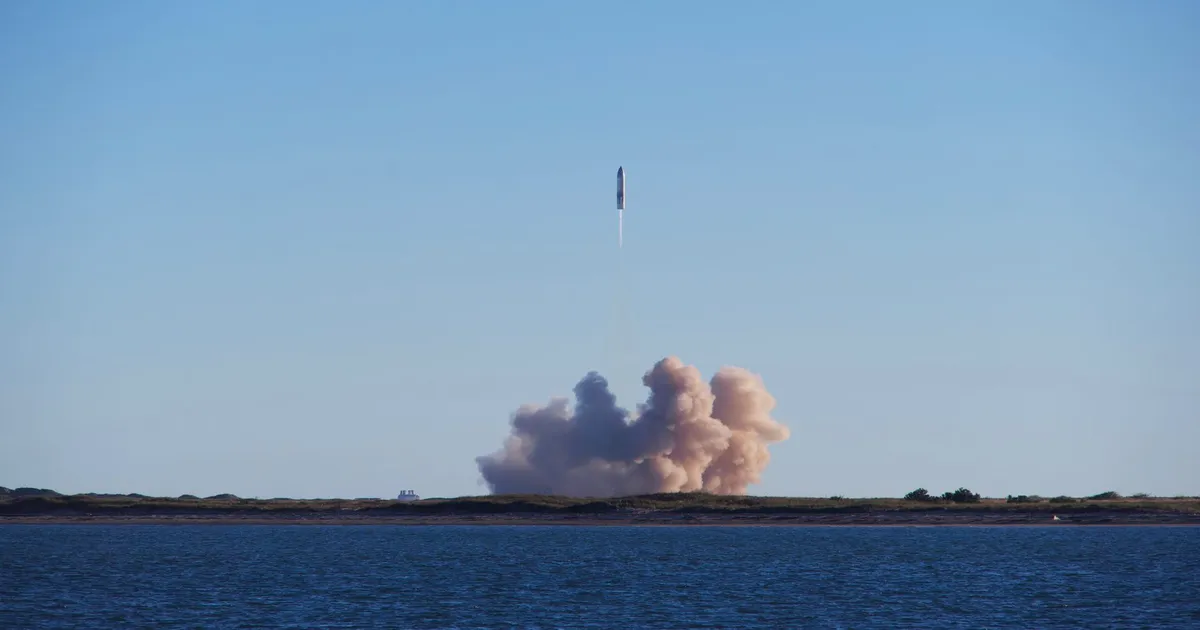
Rocket Lab’s Electron lifted off from Mahia on Saturday evening for the 100th time, carrying the YAMATSUMI-II radar imaging satellite into a 575km orbit for Japanese customer iQPS. That makes Electron the fastest commercially developed rocket to reach 100 launches, beating SpaceX’s Falcon 9 to the mark.
It is easy to file this under feel-good national pride. That would miss the point. In a business where one failure can vaporise a customer’s satellite and years of capital, a long, clean track record is the product. Rocket Lab has now built one, and it is already cashing it in.
The round number is not the real number
Chief executive Sir Peter Beck said as much on the day. “What matters most to us and our customers is that we have achieved a 96% reliability rate across 99 launches,” he said. Four of those 99 missions fell short of success.
That record was not handed out. Electron’s maiden flight in May 2017 failed, and the rocket did not reach orbit until January 2018. The company absorbed the early setbacks, fixed them, and kept flying. Nearly a decade of that is what separates a launch provider from a launch experiment.
The pace has accelerated sharply. Rocket Lab’s annual filing recorded 77 successful missions as of February 2026. Nine months later it has crossed 100.
Repeat customers are the proof
The clearest evidence that reliability converts into revenue is iQPS. Saturday’s mission was its 11th dedicated Electron launch since 2023, all successful, and it has already booked seven more through 2030.
Think about what that means commercially. A customer that locks in launches four years out is not shopping each mission on price. It is buying certainty of schedule and outcome, and it is willing to forgo the option of switching. That is pricing power, earned rather than claimed.
It also validates a strategy academics identified early. A 2023 case study by Borroz and Korber argued Rocket Lab never needed to win on cost per kilogram against bigger rockets. Its edge was “quick and small launches that are customized to the needs of the customer”, freeing satellite operators from being “beholden to the destinations and timing of primary customers” on shared rides.
Trust is being spent on the next bet
The bigger payoff is what the Electron record lets Rocket Lab sell before it has proven anything new. The company has booked 16 Neutron missions ahead of the medium-lift rocket’s first flight. Customers are pre-committing to an unflown vehicle on the strength of a different one’s history.
The same logic runs through the space systems side, where Rocket Lab has more than 55 spacecraft in development and production as part of a multi-billion-dollar order book. In capital-intensive industries with long sales cycles, a demonstrated track record is what lets a company skip the credibility-building phase on its next product. Rocket Lab is doing exactly that.
Built on a private pad in Mahia
For New Zealand business, the home-grown detail deserves attention. Rocket Lab is now headquartered in California but still employs more than 1,000 people here, across Auckland, Warkworth and Mahia.
Mahia is a structural advantage, not just a postcode. The company’s filing describes Launch Complex 1 as fully private, giving it complete control over launch schedule without queuing for government ranges, with capacity for up to 120 missions a year. A US-New Zealand treaty allows American launch technology to be used there, and that framework is the quiet enabler of an entire high-value export industry. It is worth protecting.
This is a manufacturing success that competed globally by delivering, not by lobbying for protection.
Neutron has a much harder brief
None of this guarantees the next chapter. Neutron goes up against Falcon 9, and analysts are clear-eyed about it. Carissa Christensen, chief executive of BryceTech, told Aerospace America in 2026 that Neutron “is competing with arguably the most successful launch vehicle ever.”
Caleb Henry, director of research at Quilty Space, saw an opening in the US medium-lift market but warned that “if you are not at least in the vicinity of that launch price, it’s very hard to compete” with SpaceX. He added a point any competition-minded reader will recognise: “If you want cost savings to be passed along to customers, you need competition,” he told the magazine.
That is the real test ahead. Electron’s 100 launches proved Rocket Lab can execute reliably at small scale. The 16 pre-sold Neutron missions show customers believe it can do it again at a bigger one. When Neutron flies, the market will find out whether that trust was well placed, and whether a company born in Auckland can break SpaceX’s grip on the middle of the launch market.
Sources
- Rocket Lab: The Mountain God Rises (mission page) (2026-11-14)
- SpaceNews: Electron launches for 100th time (2026-11-14)
- Space.com: 100 launches! Rocket Lab sends Earth-observing satellite to orbit on milestone mission (2026-11-14)
- SEC: Rocket Lab 10-K Filing – Fiscal Year 2025 (2026-02-26)
- Rocket Lab: Rocket Lab Hits 100 Electron Launches, Fastest Commercial Rocket to Reach the Milestone (2026-11-14)
- Hawke’s Bay Today: Fastest to 100 launches – Rocket Lab celebrates ‘golden milestone’ (2026-11-14)
- NZ Herald: ‘Fastest to 100 launches’ – Rocket Lab celebrates ‘Golden milestone’ (2026-11-14)
- Aerospace America: Rocket Lab’s next step (2026)
Join the discussion
Add useful context, ask a good question, or challenge an idea — keep it specific and respectful.