

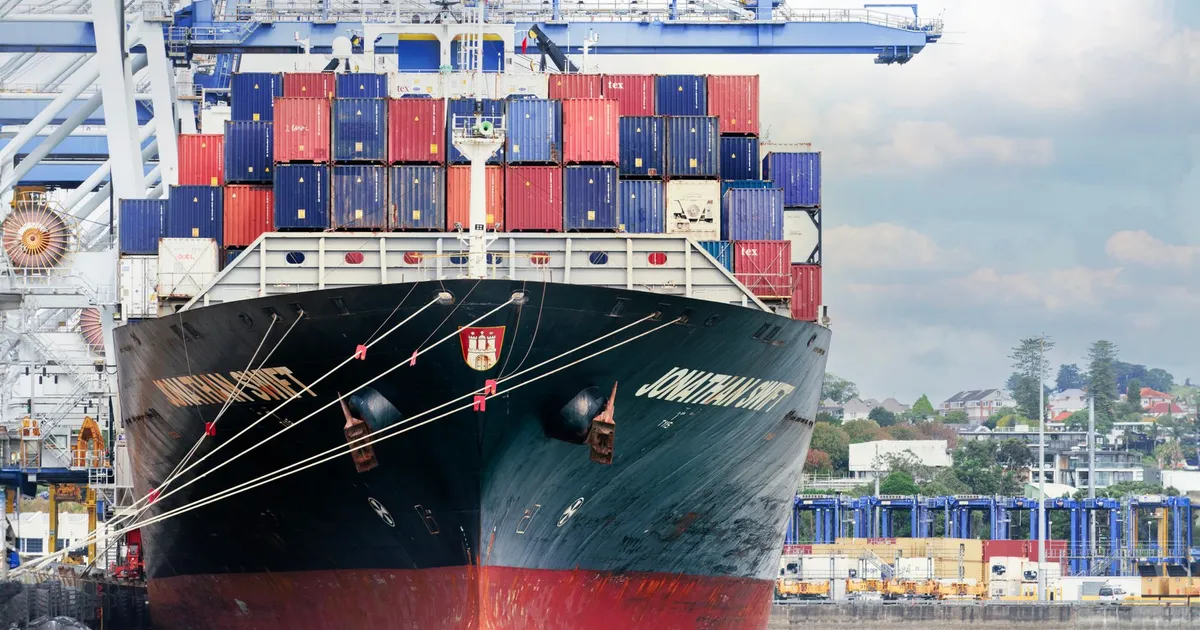
Port of Auckland has delivered a record underlying net profit after tax of $111.2 million, up 30%, on revenue of $403.8 million for the year to 30 June 2026. What makes this result worth a business owner’s attention is not the headline number itself but where it came from. This is not a paper gain from revaluing land or a one-off asset sale. It is real goods moving across the wharves.
Container volumes rose 5.5%, car imports jumped 17.7%, and rail container movements surged 76%. When a monopoly port grows profit off physical throughput rather than accounting adjustments, it is telling you something concrete about the state of trade flowing through the country’s largest city.
The turnaround is the real story
To grasp the scale, you have to remember where this port was. In FY21, at the nadir of its disastrous automation project, the port posted an underlying profit of just $20.7 million and paid Auckland Council a total dividend of only $3.7 million. Years of industrial disruption, hundreds of millions sunk, and operational collapse.
The recovery since has been steep and steady. Underlying profit hit $55.2 million in FY24, then a record $85.4 million in FY25, and now $111.2 million. During FY25 the port finished converting the last of the 27 straddle carriers it bought for the failed automation programme, formally closing that chapter. The council dividend has climbed from $3.7 million in FY21 to $55 million this year, up from $52 million in FY25. That is the sharpest single fact in the whole result.
Volume, not just pricing
The profit lift is built on throughput. Container volumes have grown two years running, hitting 883,516 TEU in FY25, the highest since 2020, with FY26 higher again. Reliability has followed. In FY25, on-time vessel departures at the Fergusson Container Terminal jumped 23 percentage points from 49% to 72%.
By the first half of FY26, container dwell times had improved to 1.9 days and vehicle dwell times to 1.5 days, down from 2.0 and 2.2 days respectively in FY25. For importers, shorter dwell times mean lower demurrage and storage costs and more predictable supply chains. That is money staying in businesses’ pockets.
The rail number nobody is talking about
The 76% growth in rail container movements is the most striking figure in the result and the most under-reported. Moving containers from the port to inland distribution by rail takes trucks off Auckland’s clogged roads and lowers per-unit freight costs for operators geared up for it. The H1 FY26 numbers already showed momentum, with terminal volumes averaging 16,800 TEU per week, so the full-year surge is a trend, not a one-quarter blip.
The vehicle rebound matters to 10,000 jobs
The car story has flipped hard. In FY25 the port handled 172,063 cars, down 17% from 208,370 the year before as consumer demand sagged. The rebound started in H1 FY26 and has held, with CEO Roger Gray noting 25,000 cars arrived in August 2026 alone. With roughly 10,000 Aucklanders connected to the vehicle import and sales sector, that recovery is a genuine employment and demand signal.
The caveat importers should watch
Not all the improvement is volume. In 2025, the port disclosed it had lifted peak container access fees from $95 to $130, with further rises to $230 in July 2026 and $350 in January 2027. The July increase is already biting this financial year. For high-volume importers those fees are a rising cost line that flows through supply chains and, eventually, to consumers. A monopoly port raising prices while posting record profits is exactly the tension importers should keep an eye on.
Gray called the August car volumes and the cruise season opening “very positive”, and on the evidence he is right. A council-owned asset dragging itself from crisis to a record on the back of real trade is good news for ratepayers and a useful barometer of the wider economy. The question for next year is whether the rail momentum holds and whether the fee ratchet starts to bite volume.
Sources
- “Very positive”: Port of Auckland sees record profits as container volumes grow (2026-08-27)
- Port of Auckland delivers $85m profit, driven by volume growth and improved operational performance (2025-08-28)
- Port of Auckland beats forecast with $85.4m record profit (2025-08-28)
- Port of Auckland boosts profit, pays $97m dividend to council (2025-08-27)
- Port of Auckland finally closes chapter on automation debacle (2025-08-28)
- Vehicles down but Port of Auckland posts record $85m profit (2025-08-28)
- Port of Auckland on track to deliver in FY26 (2026-02-26)
Join the discussion
Add useful context, ask a good question, or challenge an idea — keep it specific and respectful.