

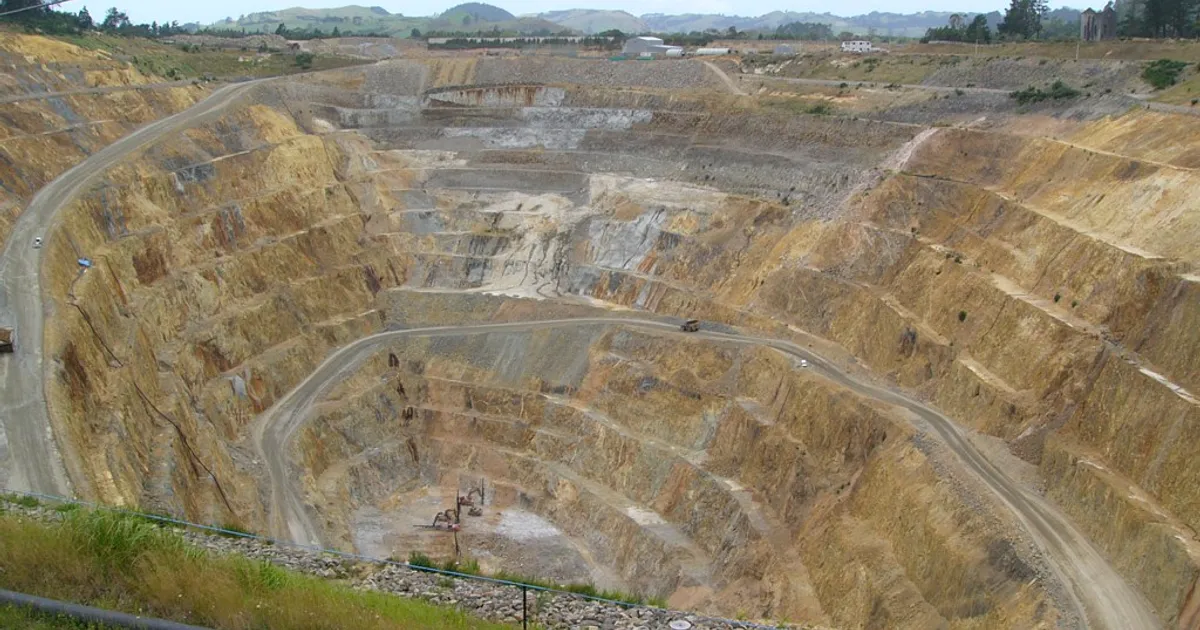
Gold at record prices has turned New Zealand mining into something rare in fiscal policy: a revenue source that asks almost nothing of the government except to get out of the way. OceanaGold’s Waihi operation has historically paid an average of $5.7 million in company tax and $1.3 million in royalties per year. Those are the numbers at old prices. The company just posted record quarterly revenue of $449 million in Q3 2025, with an EBITDA margin of 46%, free cash flow of $283 million year-to-date, and zero debt. In New Zealand dollar terms, gold has exceeded $8,000 per ounce. The gap between what the Crown has historically collected and what is now flowing through mining income statements is enormous.
Three projects, billions in exports
The pipeline is no longer speculative. The Waihi North expansion, approved in early 2026 after 112 working days of expert panel assessment, carries a Crown revenue net present value of $422 million over 18 years in corporate tax, PAYE and royalties. Resources Minister Shane Jones put the export impact at $5.2 billion in additional gold and silver exports, averaging $286 million per year, equivalent to 64% of New Zealand’s wool exports.
Behind Waihi North sits Santana Minerals’ Bendigo-Ophir project in Central Otago, projecting $448 million in royalties and over $1 billion in tax over 14 years. And Endura/Federation Mining has already sunk over $200 million into the Snowy River mine near Reefton, backed by AustralianSuper, Australia’s largest superannuation fund.
For context, MBIE data shows the government collected just over $100 million in gold mining royalties in the 14 years to fiscal 2023/24. Santana alone projects to exceed that from a single mine. Total Crown revenue from all minerals fell 40.1% to $143.4 million in 2024-25 as petroleum production declined. Gold is the growth story now.
Fast-track works until it doesn’t
The Government’s fast-track approvals legislation was supposed to fix this. Shane Jones said Waihi North would have taken longer than five years under the previous system. The panel delivered in 112 working days. That is genuinely impressive.
But Bendigo-Ophir is already testing the limits. The project faces a panel deadline in late October, and Santana has been given one week to respond to 80 requests for information and thousands of pages of public submissions. Faster than the RMA, yes. Frictionless, no.
The West Coast is worse. Councillor Allan Birchfield, a veteran goldminer himself, told the West Coast Regional Council bluntly: “There’s a lot of gold out there, huge potential, and this council is holding the Coast back because you’re not processing the consents.” The council had processed only twelve mining consents in three months, with one consent taking two years.
Wellington takes the gold, regions take the grief
Roger Partridge of the New Zealand Initiative identifies the structural flaw fast-track does not fix. “The council bears the processing costs, the legal exposure, and the community conflict, while the fiscal gains all flow to central government,” he writes. The incentive for councils to find reasons to decline is baked in.
Partridge endorses returning 50% of mining royalties to regions, citing Swiss cantons as precedent: “When communities share directly in the benefits of development, they have a reason to negotiate and to see a mine as partly theirs.” The West Coast relies on mines for roughly 10% of jobs but sees almost none of the royalty revenue.
The price window will not wait for process
Josie Vidal, CEO of the New Zealand Minerals Council, is direct about the time pressure: “The sooner you can get it out of the ground, the better, because it won’t stay like that forever.” She describes the fast-track legislation as “a real game-changer” but warns that New Zealand’s three-year election cycle worries potential investors who fear a change of government could mean a change of policy.
The employment numbers make the case concrete. Mining’s median weekly wage is $2,407, over $125,000 per annum, with worker productivity exceeding $500,000 per worker. Waihi North alone will support around 800 jobs over 18 years, with 80% of project expenditure staying in New Zealand.
Gold prices rose 27% in 2024 and a further 25% in early 2025. The government’s target is to lift mineral exports to $3 billion by 2035. The gold is there. The capital is willing. The prices are historic. What is missing is the one thing government controls: the speed at which it says yes.
Sources
- OceanaGold: Waihi Operation Royalties and Tax
- OceanaGold Reports Third Quarter 2025 Results
- RNZ: Miners awaiting consents chafe as gold price soars
- NZ Herald: Government fast-tracks Waihi North gold mine expansion to 2043
- Kiwiblog: A boost for gold and silver exports
- NZ Herald: The quiet gold rush testing NZ’s appetite for mining wealth
- NZPAM: Mining industry statistics for 2024
- Newsroom: Delay looms for fast-tracked Otago gold mine as public submissions roll in
- Roger Partridge: Wellington takes the gold – Brash and Mitchell
- RNZ: Council braces for new miners as gold price soars
- NZ Herald: Capital Markets – Fast-track ‘real game-changer’ for mining