

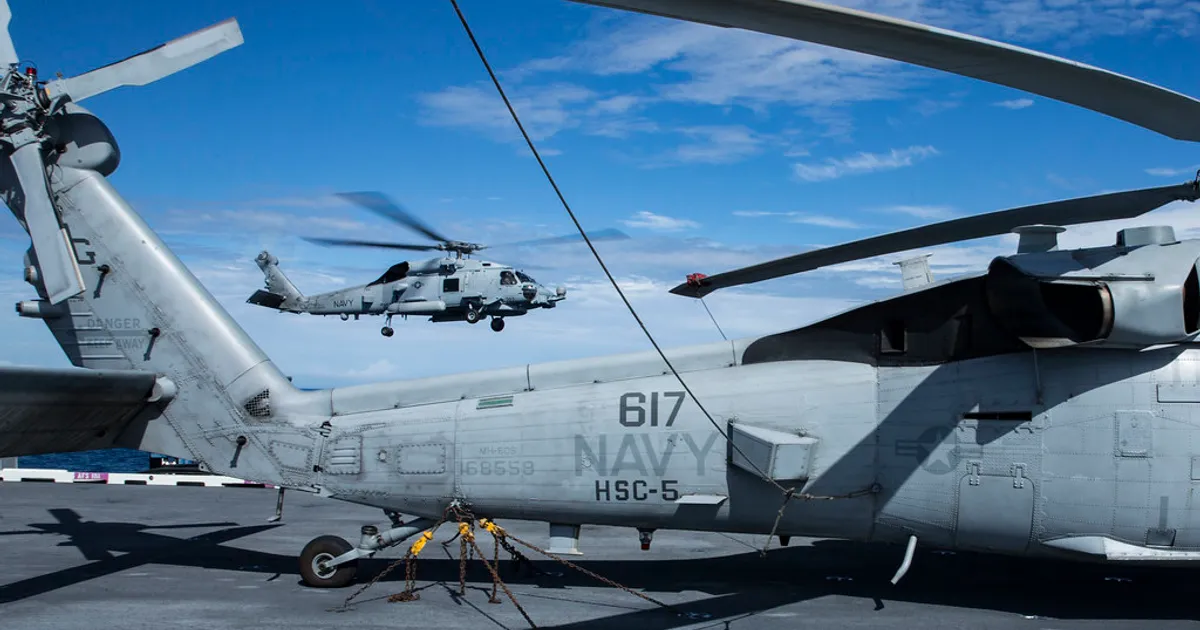
New Zealand has stopped talking about defence and started buying it. The government has signed a $1.6 billion deal with the US government for five MH-60R Seahawk maritime helicopters and the weapons to arm them. It is the first big-ticket item from the government’s defence reset to move from announcement to signed, priced contract, and it marks a real shift in how seriously Wellington is treating regional security.
For business, this matters for two reasons. It shows the government will follow through on capability spending that competes directly with every other call on a stretched Crown balance sheet. And it is a test of whether a defence programme of this scale can be delivered without the cost creep that has dogged so much New Zealand procurement.
What $1.648 billion actually buys
The Ministry of Defence puts the deal at $1,648 million in capital plus $110 million a year in average operating funding over the next decade. Run that operating figure across 10 years and the real commitment is closer to $2.75 billion, before any new infrastructure is counted.
The weapons package is not decorative. According to Jane’s, it includes Hellfire missiles alongside Advanced Precision Kill Weapon System rockets, sonar and anti-submarine systems. BusinessDesk reports the US-approved package covers 225 APKWS missiles and 65 Hellfires, with a separate approval for 20 MK 54 anti-submarine torpedoes.
Deliveries begin from 2030 at RNZAF Base Auckland at Whenuapai.
Replacing aircraft older than most of Cabinet
The case for replacement is hard to argue with. The Seasprite fleet being retired included, as the NZ Herald noted in 2025, four airframes dating to the 1960s and one that had seen service in the Korean War.
In 2025, then-Air Force chief Darryn Webb said the Seahawks would let the NZDF “detect, track, target and, if necessary, prosecute surface and sub-surface targets”. That is a genuine step up from patrol and search-and-rescue to anti-submarine warfare.
The choice of platform is also smart. Australia flies the same Seahawk variant, and interoperability with the Australian Defence Force was an explicit reason for the selection. Buying off the shelf, through a government-to-government sale, from a supply chain our closest ally already uses is exactly the low-risk approach that bespoke projects such as the interisland ferries lacked.
Why exporters should care
In 2025, Judith Collins, then Defence Minister, framed the purchase in trade terms, saying New Zealand is “a small island nation whose economic well-being relies on the freedom to travel and to trade”. For an economy that ships almost everything by sea, protecting sea lanes is not an abstraction.
There is also a domestic industrial thread. The Ministry’s April 2026 briefing to the incoming minister places the Seahawks inside a $12 billion Defence Capability Plan and a commitment to more than double defence spending by 2032/33. The same document points to the Defence Industry Strategy, which pushes prime contractors to develop local industry capability plans and opens doors for New Zealand SMEs. Maintenance, base works and support contracts at Whenuapai are where local firms should be positioning now.
The number that keeps moving
The weak spot is cost clarity. When the purchase was first announced in 2025, Reuters reported a NZ$2.7 billion package that also included two Airbus jets. Figures of $2 billion-plus and around $2.6 billion have since circulated. The signed contract lands at $1.648 billion in capital. Currency moves, scope and the gap between a US approval ceiling and a negotiated contract explain much of the shift, but nobody has publicly reconciled them.
More importantly, the bill is not finished. NZDF’s own assessment found existing ammunition storage is insufficient for the new munitions, so new weapons storage and base upgrades will be needed, and they remain uncosted. The programme is structured in three tranches, with infrastructure and training systems second and uncrewed aerial systems third. Both are future decisions with no price attached.
The real test starts now
This is a good deal on the evidence available: a proven aircraft, allied interoperability and the retirement of a fleet that should have gone years ago. Signing it shows the defence reset has teeth.
But the government now owns the discipline question. Ministers should publish a full lifetime cost, including Whenuapai storage, base works and the drone tranche, before those contracts are let. Taxpayers and the businesses that fund them can accept a serious defence bill. What they should not accept is one that grows quietly between press releases.
Sources
- RNZ: New Zealand signs $1.6 billion deal to buy five navy helicopters and weapons (2026-10-20)
- Ministry of Defence: Purchase of maritime helicopters confirmed (2026-10-16)
- Jane’s: New Zealand orders MH-60R Seahawks (2026-10-16)
- BusinessDesk: Seahawk helicopters will need new NZDF weapons storage (2026-10-18)
- NZ Herald: Government buying helicopters with Hellfire missiles, ‘precision kill system’ as global tensions ramp up (2025-08-21)
- NZ Herald: How NZ’s new defence helicopters will detect and target undersea threats (2025-08-21)
- Ministry of Defence: Briefing to the Incoming Minister of Defence (2026-04)
- Ministry of Defence: Maritime Helicopter Replacement (2025-08-21)
Join the discussion
Add useful context, ask a good question, or challenge an idea — keep it specific and respectful.