

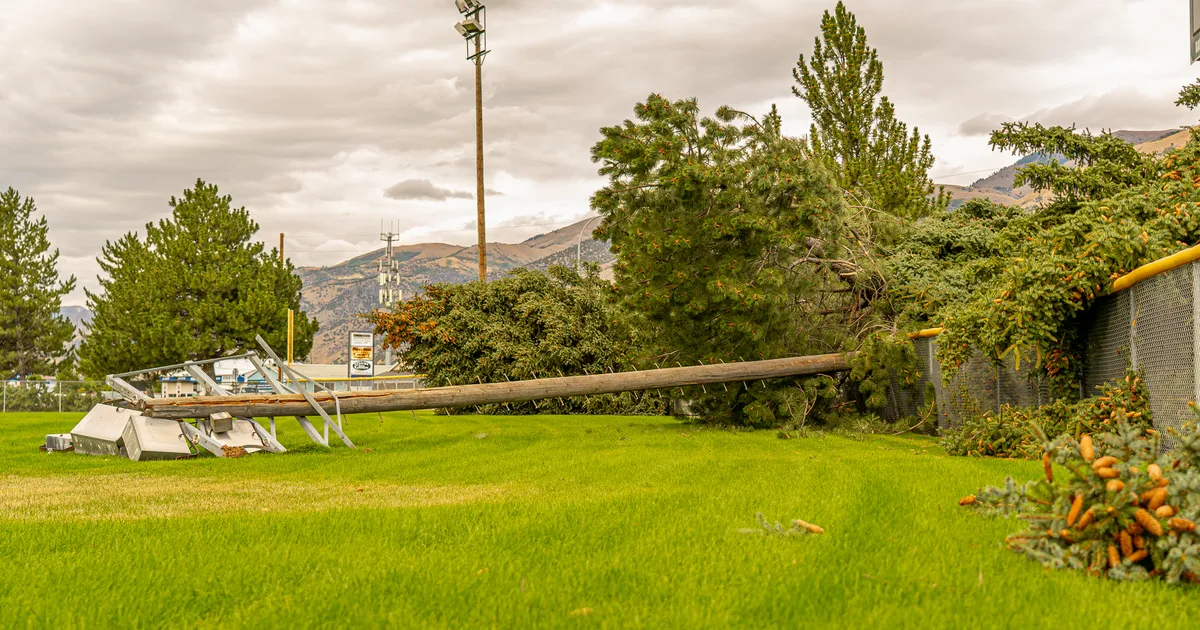
One storm, the same story again
A low-pressure system tore through the central and lower North Island on Friday 27 June 2026, and the result was depressingly familiar. At peak, Powerco reported 5549 customers without power, including 3806 in Taranaki, 1192 in Manawatu and 477 in Wairarapa. Wellington Electricity counted about 2000 customers in the dark by 9pm Friday. By Saturday morning more than 2000 were still off, and single-property faults were warned they could wait until the following week.
Powerco’s own assessment was blunt: “Damage to the electricity network is significant and therefore we are unable to provide restoration times”. Wellington Electricity explained the triage that follows: “Restoration is being prioritised to restore supply to the largest affected areas first”. Translation for any business sitting on a single feeder line – you go to the back of the queue, regardless of what the outage is costing you.
This keeps happening
This is not a freak event. In February 2026, a severe storm knocked out power to nearly 8000 properties in Whanganui and Rangitikei, with 107 still off more than a week later. Powerco head of network operations Mark Dunn said that event produced “the highest fault volumes and damage to the network since Cyclone Gabrielle”, with more than 250 field staff drafted in from as far away as Tauranga and Dannevirke.
The benchmark is still Cyclone Gabrielle in February 2023, which cut supply to nearly 240,000 customers, 11% of all NZ connections. The industry review that year put the value of lost load at $474 million over two weeks for distribution businesses, plus another $137 million for transmission. That figure is the order of magnitude every business owner should keep in mind when they consider what going dark actually costs.
The numbers under the weather
The weather is real, but it is exposing a structural problem. Powerco’s 2025 performance disclosure shows a network whose assets average 44 years old, with 18.2% already past their design age. The company is spending – $305.3m of capex in 2025, 35.5% of it on asset replacement, and a regulatory asset base that has grown to $3 billion – but it is playing catch-up.
The sector-wide trend is going backwards. Commerce Commission data shows that between 2013 and 2023, total outage duration per customer grew 6.2% a year. The Auditor-General’s 2025 audit found only 5 of 19 distribution businesses met their outage duration targets in 2022/23, down from 13 just two years earlier.
The industry knows why. Electricity Networks Aotearoa chief executive Tracey Kai said in March 2026 that “deferring replacement helped keep costs lower for earlier consumers, but it has also meant that more investment is now needed over a shorter period”. In the same reporting, Vector’s chief executive pinpointed the weak spots: “The biggest problems are at the fringes” – the long rural lines that snake out from the main network. Warea, Martinborough, Waverley, Patea, Okato. Exactly the places that turn up on Powerco’s outage list, storm after storm.
What it costs a business
For retailers, hospitality, food producers, manufacturers and logistics operators, an outage is not an inconvenience, it is a hit to the books. No EFTPOS, no refrigeration, no production line. Spoiled stock, disrupted delivery schedules, staff paid to stand around. And unlike a national generation shortage, there is no compensation mechanism and no clear point of accountability – confusion over whether the lines company, the retailer or the distributor owns the fault is a recurring theme.
The lesson businesses in the lower North Island are now learning the expensive way is that resilience has to be bought, not assumed. The Cyclone Gabrielle review noted that distribution businesses cannot guarantee continuous supply, even to critical facilities, and that physical access to remote sites is often the single biggest constraint on restoration. That is a polite way of saying you may be on your own for days.
With each multi-day outage, the investment case for on-site generation, solar and battery back-up gets stronger. For any operator whose revenue stops when the lights do, the cost of a generator now looks less like overhead and more like insurance against a network that is quietly ageing faster than it is being rebuilt.
Sources
- Stuff: Thousands wake up without power after wild weather batters central and lower North Island (2026-06-27)
- NZ Herald: Powerco crews work to restore power after severe storm in Whanganui and Rangitikei (2026-02-26)
- Newsroom: Businesses warn lines companies to put power supply before profits (2026-03-31)
- Commerce Commission: Powerco Limited 2025 Performance Summary (2025)
- Commerce Commission: Trends in local lines company performance
- ENA: Electricity Distribution Sector Cyclone Gabrielle Review (2023-07-13)
- Auditor-General: Electricity distribution businesses observations from the 2023/24 audits (2025)
- ENA Submission on Strengthening New Zealand’s Emergency Management Legislation