

The decision that should have been routine
On 15 June 2026 the Environment Court granted resource consents allowing Meridian Energy’s Waitaki Power Scheme to keep operating for another 35 years, through to the early 2060s. The new consents (CRC240441-CRC240549) replace 18 existing water permits and 23 existing discharge permits, folding a tangle of old approvals into a single long-duration consent.
That consolidation matters more than it sounds. For an asset this central to the national grid, a contested or short-dated consent hanging over it is a live commercial risk. The Court has now removed that overhang on Meridian’s most important generation asset, and done it for the better part of four decades.
Why Waitaki is not just another power station
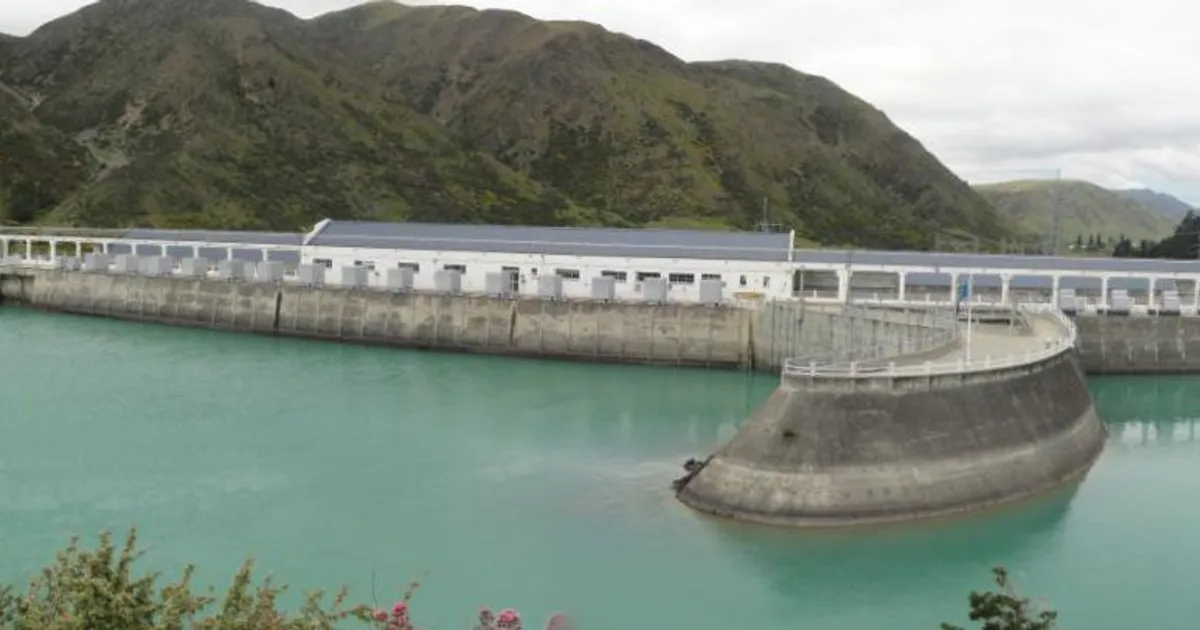
Waitaki is New Zealand’s largest and most flexible hydro scheme, six stations running from Lake Pukaki down to the Waitaki River mouth, with installed capacity of 1,553 MW, almost 30% of the country’s total hydro capacity. The six Meridian stations alone generate enough power for around 832,000 average homes a year.
Add Genesis Energy’s Tekapo A and B stations in the same catchment and the two schemes together produce about 18% of New Zealand’s annual electricity and hold more than 75% of average national hydro storage. That storage figure is the one to remember. It is the buffer that lets the country run a high-renewables grid without the lights going out when the wind drops. Waitaki is the single biggest store of it.
The timing could hardly be sharper
MBIE’s Energy Quarterly for the March 2026 period shows renewables supplied 94.5% of total generation, the second straight quarter above 90%, with hydro up 19.6% on strong inflows. Gas-fired generation fell 67.4% and coal 65.6% over the same window.
Meanwhile demand is climbing. Consumption rose 2.2%, with industrial demand up 4.8%. Thermal is being squeezed out, renewables are carrying the load, and the load is growing. In that environment, locking in the operating certainty of the country’s biggest firming asset is not a nice-to-have. It is the difference between a stable grid and an anxious one.
The expansion signal hiding in the press release
Meridian chief executive Mike Roan called hydro “the cheapest and cleanest firming solution for New Zealand’s electricity system” and said knowing the scheme can run for another 35 years “provides certainty to our business, the electricity system and the economy”.
The more telling line is what comes next. Roan said the certainty means Meridian can “step up the work we’re doing to explore opportunities to add more storage and generation to this scheme”. Feasibility work on extra capacity at Waitaki was never going to stack up with a short or contested consent attached to the asset. With a four-decade horizon in hand, the numbers change. That is precisely how long-duration consent is meant to unlock investment.
The consent comes with a bill
This is not a free pass. The approval requires a significant lift in indigenous biodiversity management across the catchment, delivered through the Department of Conservation. Meridian will contribute a minimum $2.3 million a year, CPI adjusted, to a DOC-administered fund covering weed and predator control, wetland and river habitat restoration, and nesting-island creation, alongside greater mana whenua involvement through a 10-year strategic action plan.
That is the trade. A genuine, costed environmental obligation in exchange for genuine, long-term operating certainty. It is a far better template than the open-ended uncertainty that has dogged large infrastructure consenting elsewhere in the country.
What happens next
The question now is whether Meridian moves from exploring to committing on additional storage and generation. If industrial demand keeps rising at close to 5% a year, the commercial case for expanding the country’s biggest hydro asset only strengthens. The IBEP’s mana whenua governance model may also become a reference point for the next round of large-scale hydro consents. For once, an energy decision has given investors the one thing they constantly say is missing here. The test is whether anyone builds on it.