

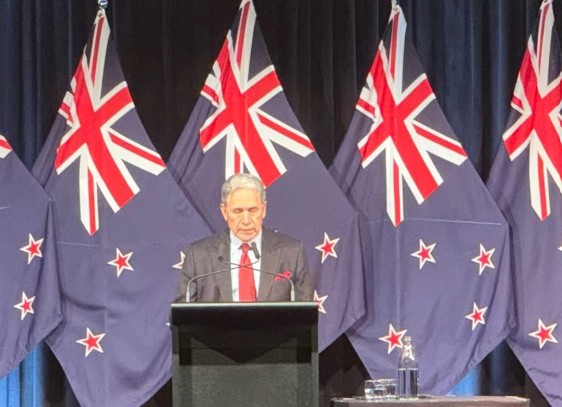
New Zealand First leader Winston Peters says his party’s proposal to buy back the Bank of New Zealand would restore greater national control over the country’s banking sector and strengthen long-term financial sovereignty, arguing the move is in the public interest despite mounting questions over its cost, practicality, and potential burden on taxpayers.
Peters has unveiled a package of economic interventions, including a proposal to buy back the Bank of New Zealand and merge it with Kiwibank to form a larger state-backed banking institution.
He also announced plans to automatically enrol all newborn citizens into KiwiSaver with an initial $1,000 government contribution.
Peters said the proposed new entity, to be called the National Bank of New Zealand, would operate on a fully commercial basis while competing directly with the major Australian-owned banks.
Asked how the proposal would be funded, Peters said New Zealand needed to “recalibrate” its approach to government debt.
“We pay far too much costly debt everywhere… This is a world awash with money,” he said.
“New Zealand is one of those countries more likely to get investment because of the stability of our democracy.”
Peters also pushed back against estimates suggesting the proposal could cost between $10 billion and $20 billion, describing those figures as overstated and arguing they do not accurately reflect the intended structure or long-term financial approach of the plan.
He suggested the bank could potentially be acquired for “something above $7.5 billion,” arguing that critics have misunderstood both New Zealand First’s financing strategy and broader economic conditions in Australia that he says influence the valuation and feasibility of the deal.
Peters described the proposal as an “investment” rather than a cost, arguing it should be viewed as a long-term asset for the country rather than a short-term expenditure.
He also argued that foreign ownership of major banks has led to profits being repatriated overseas, reducing the amount of value retained within the local economy and strengthening the case, in his view, for greater domestic control of the banking sector.
“Why are we paying all this money to an Australian bank to run parts of our economy… when we should and used to do it ourselves?”