

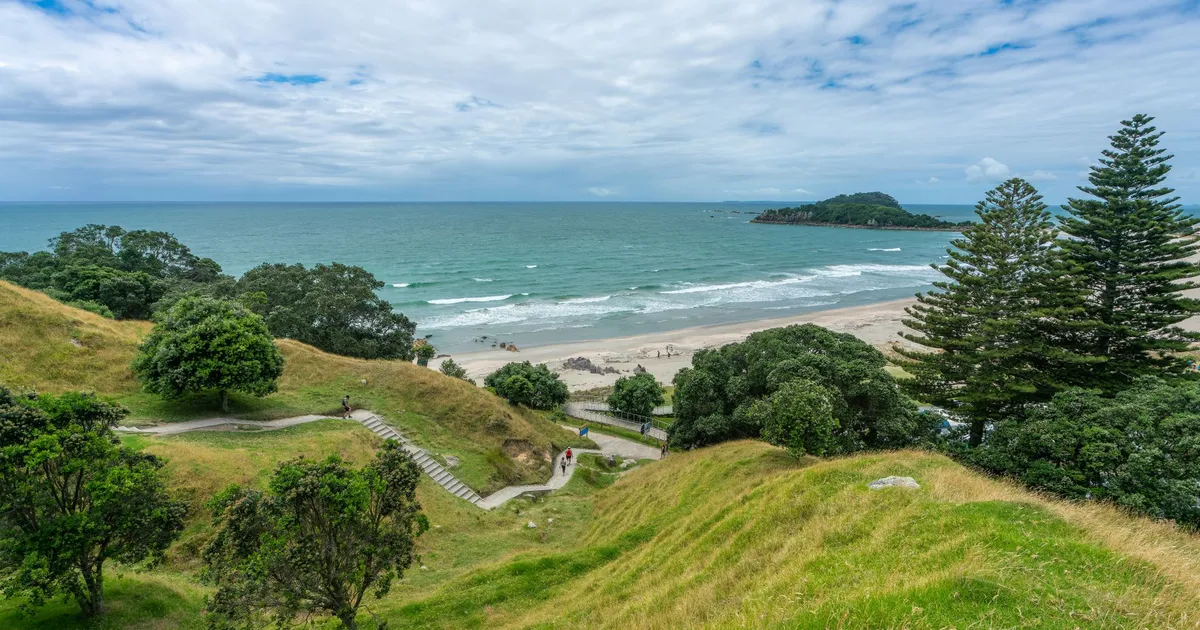
When a section of Mauao collapsed into the Beachside Holiday Park on 22 January 2025, killing six people, it did not just reshape the mountain. It reshaped the economics of every business within walking distance. The disaster struck at the precise moment those businesses earn the money that keeps them alive through winter, and the support system designed to help them was built for a different kind of crisis entirely.
Seventeen months later, the question is not whether the initial response was adequate. It plainly was not. The question is whether anything has changed to prevent the same outcome next time a natural asset closes and the businesses around it start bleeding cash.
Summer revenue vanished while fixed costs stayed
The surrounding area was cordoned off for six days during the initial emergency operation. Even after the cordon lifted, the Mauao track remained closed, the hot pools stayed shut, and cruise ships diverted elsewhere because passengers could not walk the Mount.
In early 2025, Rustica Italian Food owner Michele Delaini reported revenue had halved, describing conditions as “like winter trading at the height of summer.” Neighbouring businesses were cutting hours. The seasonal maths was brutal: summer is when Mount hospitality operators collect the surplus that carries them through the quiet months, and that surplus was not being collected.
In February 2025, RNZ reported foot traffic declines of 10 to 30 percent across the wider business district. Mount Made reported at least a 10 percent decline; Gigi’s reported 30 percent fewer customers. The damage radiated well beyond the cordon.
Mount Mainstreet manager Jay Banner warned in early 2026 that the loss of summer trading had “significant financial implications not just immediately but for their plans to get through winter.” Banner appealed directly to the community to return to the Mount.
$4,000 against a $7,000-a-day hole
The support that materialised was almost comically mismatched to the scale of the problem. Each directly affected ground-floor business was offered approximately $4,000 from the Mayoral Relief Fund. In early 2025, Mount Break Cafe owner Jana Puri told the NZ Herald that figure did not even cover food waste, let alone the cafe’s $7,000 daily peak-summer turnover.
Central government allocated $100,000 from a $1.2 million storm recovery fund shared across six councils. The Western Bay Emergency Response Fund had attracted just $395 in public donations by mid-February 2025. A group of 16 hospitality businesses formally requested rates remission from Tauranga City Council. No wage subsidies were extended, unlike after Cyclone Gabrielle.
Insurance offered almost nothing. Only around 10 percent of consequential losses would be covered for businesses closed as a consequence of the disaster rather than physically damaged by it. For most operators on Marine Parade, that was precisely their situation.
The framework is built for the wrong disaster
Then-Tauranga Business Chamber chief executive Matt Cowley identified the structural problem in a February 2025 analysis: “If premises were not physically damaged by the event, support was often limited or unavailable.” Businesses near Mauao “pay some of the highest retail lease costs in the country, so taking away 1 million people from Mauao completely changes their business model.”
This is the core policy failure. New Zealand’s disaster recovery architecture assumes that economic harm follows physical damage. But the country’s tourism economy is built substantially on access to natural assets: tracks, beaches, geothermal features, marine reserves. When those assets become inaccessible, the businesses clustered around them face severe, prolonged, and largely uninsurable economic disruption. The Mayoral Relief Fund, the emergency response funds, and central government mechanisms are all calibrated for short-term disruption and property damage, not for the working capital hole that opens when a tourism-dependent business loses its peak season.
MBIE’s Monthly Regional Tourism Estimates and Hospitality Sales datasets give government the tools to quantify these impacts at a territorial authority level. The analytical capability exists. The policy response does not.
Every coastal tourism town should be watching
Mount Maunganui is not unique. It is a template. Queenstown depends on access to trails and ski fields. Kaikoura’s economy collapsed when the 2016 earthquake severed road and rail access, not because the restaurants were damaged. Rotorua’s hospitality sector lives and dies on geothermal tourism. Any town where the cash register depends on a natural drawcard faces the same structural vulnerability.
Cowley warned in 2025 that “if another major emergency hits, and people want to raise funds to support urban small business recovery, the Western Bay Emergency Response Fund isn’t set up for that.” Seventeen months on, there is no evidence the framework has been redesigned. The businesses that survived the first post-landslide winter did so on their own reserves and their owners’ willingness to work unpaid. That is not a disaster recovery strategy. It is luck, and it runs out.
Sources
- RNZ: ‘Significant financial implications’ for Mount businesses after deadly landslide (2026-02-01)
- RNZ: Mt Maunganui business owner says revenue down by half after landslide
- NZ Herald: Mauao landslide – Marine Parade businesses beg council for rates break
- NZ Herald: Mount Maunganui small businesses need better disaster support – Matt Cowley (2025-02-01)
- RNZ: Mount Maunganui landslide – Businesses plead for customers to support them (2025-02-01)
- NZ Herald: Mount Maunganui landslide – Businesses hit hard call for urgent help